At 52,000 feet over the Persian Gulf, a U.S. Navy MQ-4C Triton surveillance drone squawked 7700 — the universal distress signal. Then it began falling. Within fifteen minutes, the $200 million aircraft dropped to 9,500 feet and vanished from every tracking system on Earth.
The incident on April 9, 2026, has ignited a firestorm of speculation. Was it a catastrophic mechanical failure? Iranian electronic warfare? Or did Tehran just shoot down another American drone over the Strait of Hormuz — and nobody is willing to say so?
The U.S. Navy has not released an official statement. And that silence is deafening.
Descent: From 52,000 ft to 9,500 ft in ~15 minutes before signal loss
Base: Naval Air Station Sigonella, Italy
A Three-Hour Mission That Ended in Mystery
The Triton — registration 169804, callsign VVPE804 — had departed Naval Air Station Sigonella in Italy for a routine intelligence, surveillance, and reconnaissance mission over the Strait of Hormuz. For roughly three hours, it circled the strategically critical waterway at its standard operating altitude above 50,000 feet, visible on public flight-tracking platforms like Flightradar24 the entire time.
Then, on its return leg, something went wrong. The aircraft’s transponder switched to code 7400, indicating a loss of the communication link between the drone and its remote pilot. Moments later, it broadcast 7700 — the international general emergency signal. And then the Triton began a steep, continuous descent.
At 9,500 feet, the signal vanished. No further transmissions were recorded.
The Ghost of 2019
The parallels to June 2019 are impossible to ignore. That summer, Iran’s Islamic Revolutionary Guard Corps shot down a U.S. Navy RQ-4A Global Hawk — the Triton’s close cousin — with a surface-to-air missile over the Strait of Hormuz. Tehran claimed the drone had entered Iranian airspace. Washington insisted it had not. The incident nearly triggered a military strike that President Trump called off with planes already in the air.
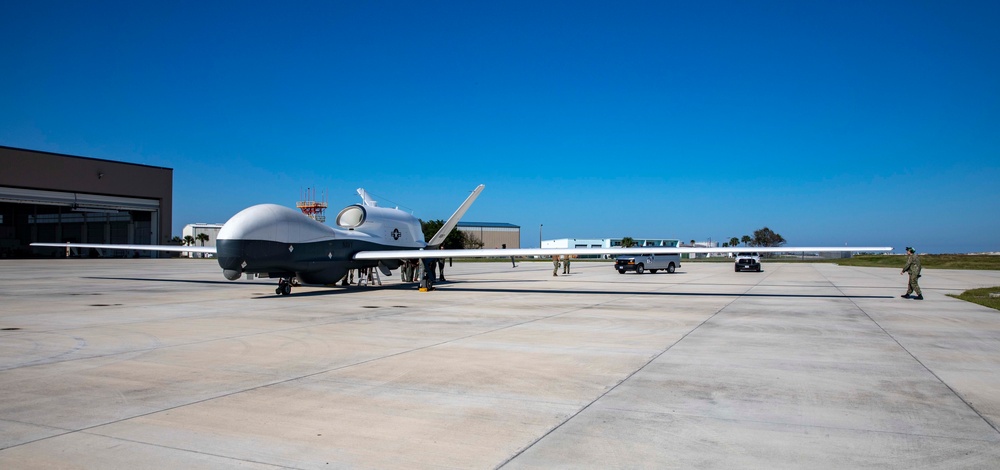
The RQ-4A and MQ-4C share the same basic airframe, the same manufacturer (Northrop Grumman), and the same unmistakable silhouette: a bulbous nose, 130-foot wingspan, and a cruising altitude that puts it above commercial air traffic. If Iran brought down one, bringing down the other is not a stretch.
But this time the circumstances are murkier. The 2019 shootdown was clean — a missile hit, wreckage in the water, both sides immediately claiming or denying it. In this case, there is no wreckage, no claim, and no clarity.
An MQ-4C Triton lands during operations. The high-altitude surveillance drone operates above 50,000 feet. U.S. Navy photo / DVIDS
Three Theories, Zero Answers
Analysts have outlined several plausible explanations. The first is a catastrophic mechanical or systems failure — possible but unusual for an aircraft designed for 24-hour endurance missions at extreme altitude. The Triton’s airframe is derived from the proven RQ-4 Global Hawk, which has accumulated tens of thousands of flight hours.
The second theory is electronic warfare. Iran has invested heavily in GPS spoofing and communications jamming technology. In 2011, Iran claimed to have brought down a CIA RQ-170 Sentinel stealth drone by spoofing its GPS, causing it to land intact on Iranian soil. If the Triton’s satellite communication link was disrupted — preventing standard lost-link recovery procedures — the aircraft may have entered an unrecoverable descent.
The third possibility is the most provocative: a deliberate shootdown. Iran possesses surface-to-air missile systems capable of reaching 52,000 feet, and Tehran would have strong motivation to demonstrate that capability during a period of active hostility. But a shootdown without a claim is unusual for Iran, which has historically been quick to publicize such actions.
Why It Matters Beyond the Drone
The timing could not be worse. The MQ-4C disappearance comes during the fragile U.S.-Iran ceasefire announced on April 7. If the Triton was brought down by Iranian action — whether kinetic or electronic — it could shatter the already tenuous truce before negotiations even begin.
The Triton fleet is also small and expensive. The Navy operates only a handful of the aircraft, each worth roughly $200 million, making every loss strategically significant. Unlike the thousands of small drones expended in modern warfare, losing a Triton is like losing a satellite with wings.
For now, the only certainty is that a $200 million surveillance platform fell out of the sky over one of the most contested waterways on Earth — and nobody is saying why.
Sources: The War Zone, The Aviationist, Defence Security Asia, itamilradar, IntelSky
On October 3, 1967, test pilot William J. “Pete” Knight climbed into a black, dart-shaped aircraft bolted to the wing of a B-52 bomber. At 45,000 feet over the Mojave Desert, the B-52 released him. Knight lit the rocket engine. In the next 84 seconds, he accelerated...
On September 6, 1976, a Soviet MiG-25 Foxbat interceptor appeared on Japanese radar screens without warning. It was flying fast, low, and heading straight for Hakodate Airport on the northern island of Hokkaido. The pilot had not filed a flight plan. He had not...
The next generation of Portuguese military pilots will learn to fly in an aircraft that weighs less than a family car. On April 9, 2026, Tecnam and Spanish aviation services provider World Aviation announced that the Portuguese Air Force has selected the Tecnam...




 English
0 Comments