
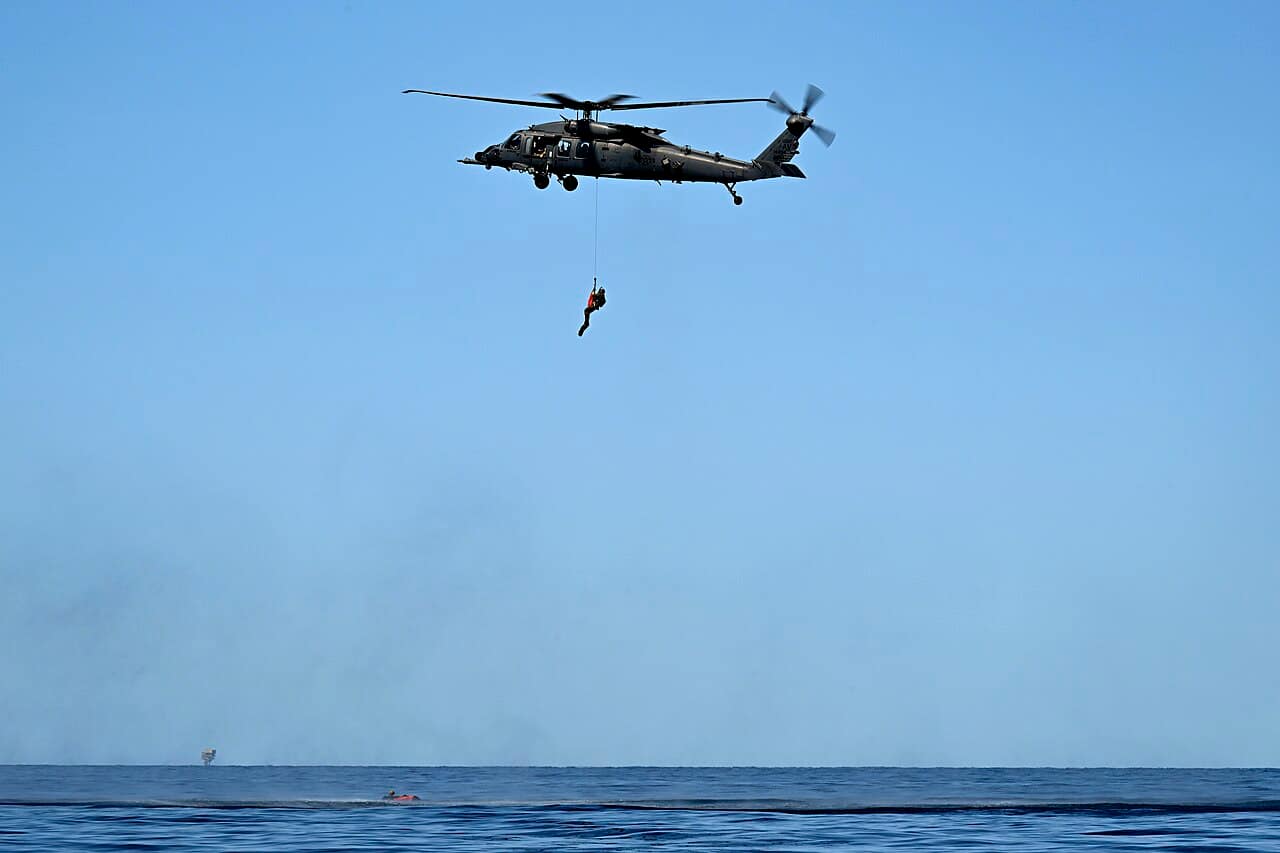
They had been in the raft for five hours when the helicopter found them. Eleven Bahamians, mostly families, drifting in the Atlantic somewhere off the coast of central Florida. The twin-engine Beechcraft King Air they had boarded that morning at Marsh Harbor in the Bahamas had lost an engine, then lost altitude, then lost the runway it was trying to reach at Freeport. By the time the pilot ditched the aircraft in open water, the only thing standing between his passengers and the sea was a single inflatable life raft and an emergency locator transmitter that, against the odds, actually worked.
What happened next is the kind of rescue story the U.S. Air Force trains for and almost never gets to execute on its own coastline. On 12 May 2026, an HC-130J Combat King II and an HH-60W Jolly Green II from the Air Force Reserve’s 920th Rescue Wing — both originally airborne on a routine training flight out of Patrick Space Force Base — were diverted by a Coast Guard radio call. By the time the helicopter set down at Melbourne Orlando International, all eleven survivors had been hoisted out of the water, fed, given water, and were listed in stable condition. The rescue helicopter was down to its last minutes of fuel reserve.
Find. Stabilise. Retrieve.
The 920th’s doctrine for an open-ocean rescue is a textbook three-step. First, find the survivors. Second, drop survival supplies — food, water, additional flotation, an emergency radio — to extend their survival window. Third, retrieve them. The HC-130J does steps one and two; the HH-60W does step three. The pairing works because the C-130 has the range and endurance to loiter and search, while the helicopter has the hover and hoist capability the recovery requires.

By the time the HH-60W arrived overhead, a thunderstorm was building to the south. The Jolly Green crew had a hard window — perhaps an hour before the weather forced a withdrawal. Eleven hoists, give or take, on a hover that consumes fuel at twice the rate of forward flight, with the aircraft commander watching the fuel gauge tick down past every commitment line on the planning chart.
The pararescue jumpers — the PJs, the U.S. military’s specialist combat-and-medical rescue troops — went into the water. One PJ in the raft. Survivors clipped into the hoist one at a time, lifted up to the hovering helicopter. About nine separate hoists, one after another. When the last survivor came up, the fuel gauge was down to its final minutes of reserve.
All Eleven Stable
The HH-60W flew the survivors to Melbourne Orlando International Airport, the nearest medical facility with a trauma capability. Ambulances were waiting. All eleven were transferred to local hospitals. As of the 14 May reporting, all were listed in stable condition. The pilot of the King Air was among the eleven pulled from the water.
For the survivors, the story is the kind of thing they will tell their grandchildren. For the 920th Rescue Wing, it is exactly the mission the unit was built for — combat search and rescue, expressed in its purest form. The Wing’s motto reads “These Things We Do, That Others May Live.” Eleven Bahamian families now know exactly what that means.

The Reserve Wing Question
There is a quiet political subtext to this story. The 920th Rescue Wing is one of the few Air Force Reserve units the Pentagon has repeatedly tried to consolidate or retire over the last decade. Each time, congressional delegations from Florida have pushed back, citing exactly the kind of mission flown on 12 May. The numbers — Reserve aircrew, Reserve aircraft, an organic CSAR capability based on a strategically located coastline — make a strong case the active-duty Air Force does not always want to make.
Eleven Bahamian survivors and a routine training flight that turned real are this argument’s strongest form. The 920th does the same training every week. Most of the time, nobody outside the Wing notices. On 12 May, eleven people who would not otherwise have made it home are alive because the Wing happened to be in the air.
Sources: Air & Space Forces Magazine (16 May 2026); NBC News; FOX 13 Tampa Bay; Maritime Executive; Deseret News; USAF 920th Rescue Wing public affairs release; U.S. Coast Guard RCC Miami.
 English
0 Comments