
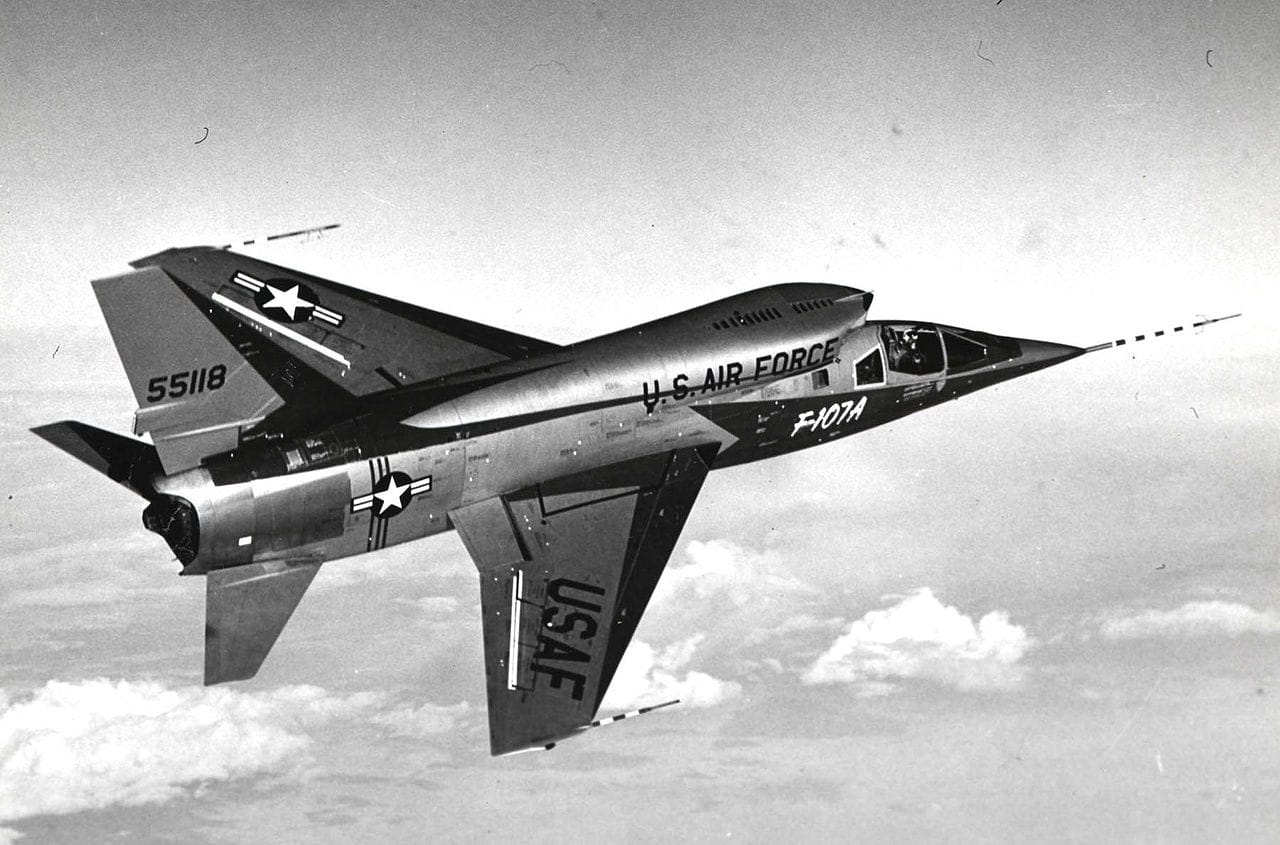
On 10 September 1956, in the high desert above Edwards Air Force Base, North American Aviation's chief test pilot Bob Baker pushed the throttle of an aircraft nobody outside the U.S. Air Force fighter procurement office had ever heard of into afterburner. The airframe in front of him looked, from twenty feet away, like an F-100 Super Sabre. Closer inspection revealed something stranger. The air intake was not under the nose. It was on top of the fuselage, behind the cockpit, in a configuration so visually awkward that pilots immediately nicknamed the aircraft the "Ultra Sabre" or, less kindly, the "Man Eater" — because if the pilot ever needed to eject, the intake duct was right above his head.
Baker took the first YF-107A to Mach 1.03 in level flight that afternoon. It was the start of a six-month flight-test programme that produced one of the most overlooked Century Series fighters ever built — an aircraft that lost the U.S. Air Force's tactical-fighter-bomber competition to the F-105 Thunderchief in 1957, was retired immediately, and survives today in the form of two airframes in American museums. Almost nobody remembers it.
In March 1957 the Air Force cancelled the F-107 programme. The three prototypes — 55-5118, 55-5119, and 55-5120 — were grounded as production aircraft. Two of them (55-5118 and 55-5120) were transferred to the National Advisory Committee for Aeronautics (NACA, soon to become NASA) for high-speed research. The third, 55-5119, was retired and flown to the Air Force Museum at Wright-Patterson in November 1957.
What If
The F-105 went to Vietnam. By the end of the war, the Air Force had lost 382 F-105s in Southeast Asia, the large majority of them in combat. The aircraft, designed for nuclear delivery at high speed and low altitude, was repurposed into a conventional fighter-bomber for which it was not optimised, and paid a brutal price. F-105 pilots flew the Wild Weasel SAM-suppression mission with weapons and tactics that were being invented week-by-week as the war unfolded.
The counterfactual question — what if the Air Force had chosen the YF-107A — never had a definitive answer. Some analysts argue the F-107 would have suffered the same losses, because the underlying problem in Vietnam was tactical (low-level penetration of dense air defence) not airframe. Others note that the YF-107A's recessed weapons mounting was more flexible for conventional ordnance than the F-105's bomb bay, and that the F-107 might have transitioned more naturally into the multi-role fighter the F-105 was forced to become. The honest answer is: nobody knows.

The Two Survivors
YF-107A 55-5118 lives today at the Pima Air & Space Museum in Tucson, Arizona, sitting outdoors in the high desert sun. YF-107A 55-5119 is at the National Museum of the United States Air Force at Wright-Patterson AFB in Dayton, Ohio, restored to flight-test livery. The third prototype, 55-5120, never flew again after an aborted-takeoff accident in 1959 — Scott Crossfield was at the controls — and was eventually expended in firefighting training.
Visitors to either museum sometimes stop in front of the F-107 and ask why the air intake is on top. The answer requires a small lecture on 1956 nuclear-delivery requirements, the geometry of the Mark 7 bomb, and the politics of Tactical Air Command procurement decisions. Most visitors lose interest after thirty seconds. The Ultra Sabre, nearly seventy years after Bob Baker took it to Mach 1 over Rogers Dry Lake, remains the Century Series fighter that almost nobody remembers. It deserved better.
Sources: Wikipedia — North American F-107; The Aviation Geek Club; Defense Media Network; SilverHawkAuthor; Skytamer; Jets 'n' Props; John Weeks F-107 Survivors website; Pima Air & Space Museum; National Museum of the USAF.
Related Questions
What was the YF-107 Ultra Sabre?
The North American YF-107 "Ultra Sabre" was an American Century Series fighter prototype of the mid-1950s, derived from the F-100 Super Sabre. Its most unusual feature was a large air intake mounted above and behind the cockpit. Only three were built before the programme was cancelled.
Why was the YF-107 cancelled?
It lost the U.S. Air Force's tactical fighter-bomber competition to the Republic F-105 Thunderchief in 1957. Although the YF-107 performed well, only the F-105 was ordered into production, and the three YF-107 prototypes were grounded almost immediately.
What made the YF-107 unusual?
Its air intake sat on top of the fuselage, directly above and behind the cockpit — an unusual and risky placement, since it was close to the pilot's ejection path. The aircraft otherwise resembled the F-100 Super Sabre from which it was developed.
How fast was the YF-107?
It was a supersonic fighter; on its first flight on 10 September 1956, test pilot Bob Baker took it past Mach 1 in level flight. Built by North American Aviation — later the maker of the Mach 3 XB-70 Valkyrie — it was a capable design that simply lost its competition.
How many YF-107s were built?
Three prototypes were built (serials 55-5118, 55-5119 and 55-5120). After cancellation in 1957, two were handed to NACA (soon NASA) for high-speed research and one went to the Air Force Museum. Two airframes survive in American museums today.
0 Comments