
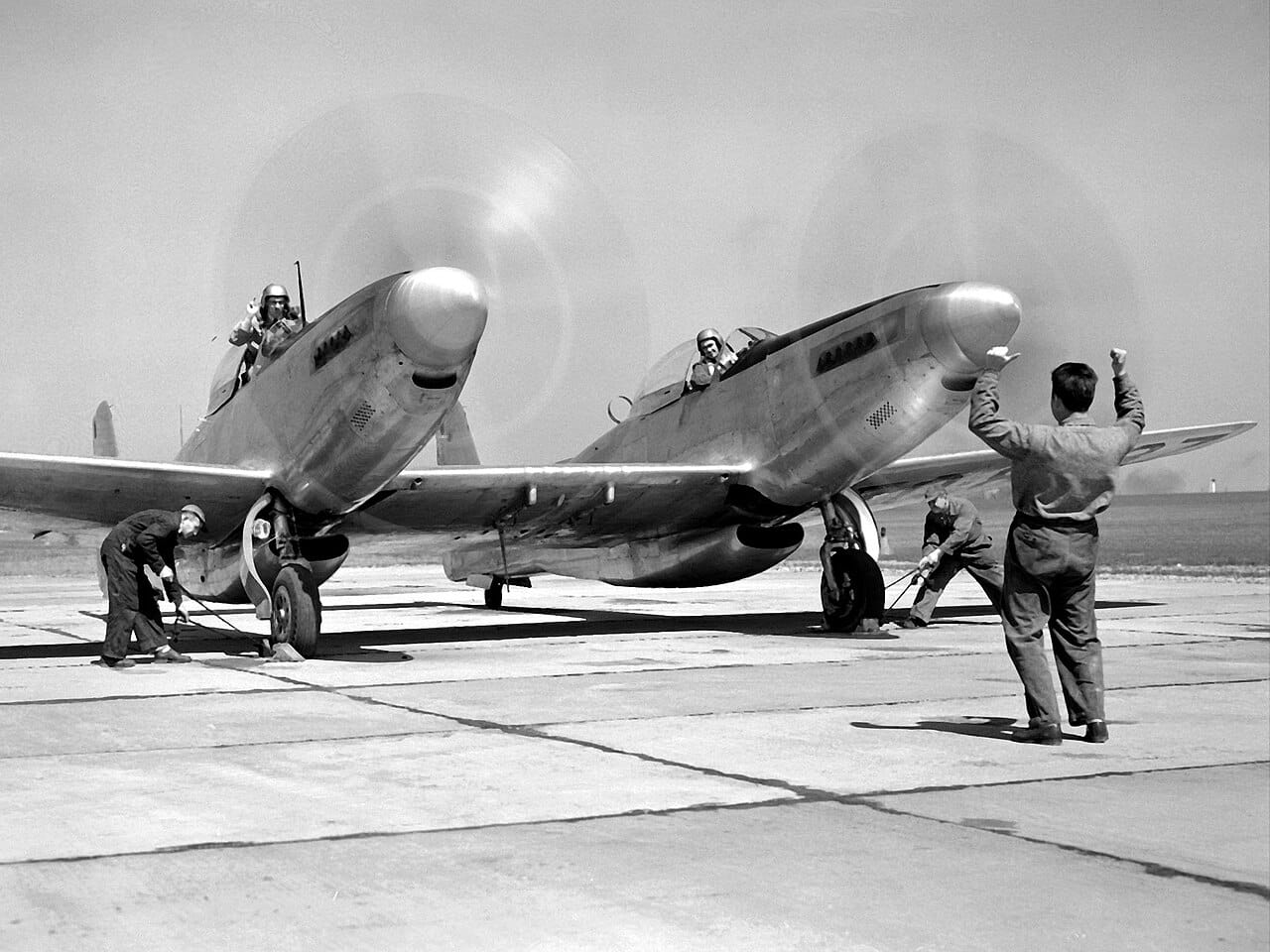
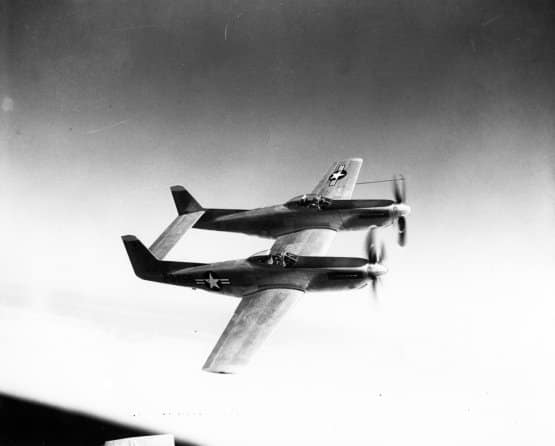
Glue two P-51 Mustangs together along the wing. Share a tailplane between them. Put the radio operator's seat in the right fuselage. Tell the pilot in the left fuselage to fly the aircraft. The result is the F-82 Twin Mustang — the longest-range piston fighter ever built, the last propeller-driven fighter the United States Air Force ever ordered new, and the aircraft that scored the first American air-to-air kill of the Korean War.
It looks like a hoax. It absolutely was not. North American built 272 of them, and the design was dead serious.
Quick Facts
Aircraft: North American F-82 (originally P-82) Twin Mustang
First flight: 26 June 1945
Crew: Two — pilot left fuselage, co-pilot/radar operator right fuselage
Engines: 2× Packard V-1650 Merlin (later Allison V-1710)
Range: 3,605 km (2,240 mi) — longest of any piston fighter ever
Top speed: 742 km/h (461 mph)
First Korea kill: 27 June 1950 — Lt. William Hudson shoots down Yak-11
Why Build a Two-Headed Fighter?
The B-29 Superfortress could fly to Tokyo from Saipan. No fighter could. The P-51 Mustang's 1,500-mile range was extraordinary for a single-engine fighter, but it still meant a Pacific bomber escort was a one-way mission. North American Aviation's solution was simple: take two P-51s and weld them into one aircraft. Two pilots could share the workload on a 12-hour mission. Two engines meant survivability.
The aircraft that emerged was not actually two P-51s — every part except some superficial details was redesigned — but the Twin Mustang inherited its parent's elegance and added the brute endurance the Pacific war demanded. Then Japan surrendered. The Twin Mustang arrived too late for what it was designed for.
Korea Saved It
The USAF kept buying anyway. By 1950, when North Korea invaded the South, the F-82 was the only American fighter at Itazuke air base in Japan that could fly all the way to the Korean front, fight, and return. On 27 June 1950 — the third day of the war — three F-82s of the 68th Fighter All-Weather Squadron tangled with a flight of North Korean Yak-9s and La-7s over Seoul. Lieutenant William G. Hudson shot down a Yak-11 trainer being used as a fighter. It was the first American kill of the war.
The Twin Mustangs flew night-fighter missions, ground attack, and convoy escort through the first year of the war. They were finally retired in 1953 as the F-86 Sabre took over. The last operational F-82 was withdrawn from Alaska's air defence mission in 1953 — the very last front-line piston fighter in the US Air Force inventory.
The Twin That Defined a Boundary
The F-82 marked an exact line in aviation history. It was the last new-build piston fighter in American service, and it was beaten into retirement by the same conflict that gave it its only kills. It is also one of the very few aircraft built specifically to use a peculiar layout — twin fuselages — that other engineers tried and abandoned. The German Luftwaffe had Heinkel He 111Z (two He 111s glued together to tow a glider). The British had nothing comparable. Only the Americans actually got the layout to work as a fighter.
Five Twin Mustangs survive today — and one of them flies. After a decade-long restoration, the XP-82 prototype returned to the air on 31 December 2018 and has appeared at airshows since. The others sit in their hangars looking like nothing else in aviation history — twin-headed, oddly graceful, the last of their kind.
Sources: National Museum of the US Air Force, Korean War Project, North American Aviation type history.
Related Questions
What was the F-82 Twin Mustang?
The North American F-82 Twin Mustang was a long-range fighter built around two P-51 Mustang-style fuselages joined to a shared centre wing and tailplane. The pilot flew from the left fuselage while a co-pilot/radar operator sat in the right. It was the longest-range piston fighter ever built.
Was the F-82 really two P-51s joined together?
Not exactly. Although it looks like two P-51 Mustangs welded together, nearly every part of the F-82 was redesigned around a single airframe sharing one centre wing. North American built 272 of them as a serious design, not a novelty - it was the last propeller-driven fighter the US Air Force ordered new.
Why was the F-82 Twin Mustang built?
The F-82 was built to escort B-29 bombers across the vast distances of the Pacific, which no single-engine fighter could cover. Joining two Mustang-type fuselages gave two pilots to share a gruelling 12-hour mission and two engines for survivability, producing a fighter with a range of about 3,605 km.
What was the first American air-to-air kill of the Korean War?
The first US air-to-air kill of the Korean War was scored by an F-82 Twin Mustang on 27 June 1950, when Lt. William Hudson shot down a North Korean Yak-11. The piston-engined Twin Mustang opened the air war that would soon be dominated by jets over MiG Alley.
How far could the F-82 Twin Mustang fly?
The F-82 had a range of about 3,605 km (2,240 miles) - the longest of any piston fighter ever built - and a top speed near 742 km/h. That endurance suited the long-range escort and patrol missions of the early Korean War, a conflict later defined by jet duels like one Panther pilot’s clash with seven MiGs.
When did the F-82 Twin Mustang first fly?
The F-82 Twin Mustang first flew on 26 June 1945, just as World War II was ending. It arrived too late for the Pacific bomber-escort role it was designed for, but found new purpose in the Korean War, scoring the conflict’s first aerial victory on 27 June 1950.
0 Comments