
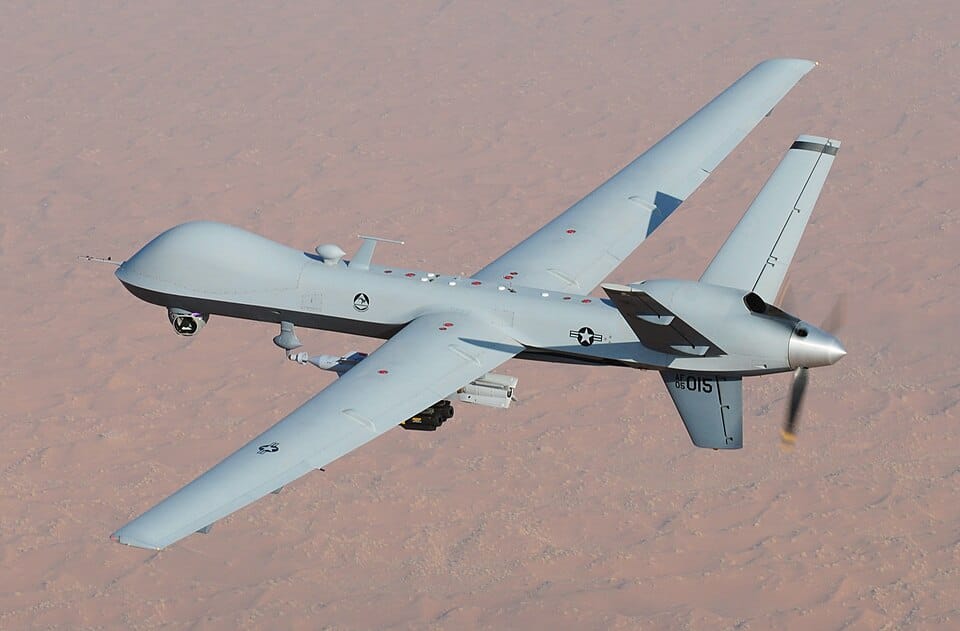
There is a number that keeps the people who manage America's drone fleet awake at night, and that number is 189. That is the minimum number of MQ-9 Reapers the Air Force says it needs to sustain its worldwide intelligence, surveillance, reconnaissance, and strike operations — the invisible constellation of remotely piloted aircraft orbiting above conflict zones from West Africa to the Western Pacific, twenty-four hours a day, seven days a week, year after year. For the better part of a decade, the fleet hovered comfortably above that line. It does not hover there anymore.
As of this week, the operational MQ-9 Reaper inventory has fallen to approximately 135 aircraft. The reason is brutally simple: in six weeks of operations over Iran during Operation Epic Fury, the United States lost 24 Reapers. Twenty-four. To put that in perspective, the Air Force lost more Reapers in a month and a half than it had lost in the previous twenty years of continuous combat operations combined. The bill, conservatively estimated, exceeds $720 million — and the cost in capability is even steeper.
🚩 Current fleet: ~135 MQ-9 Reapers (below 189-aircraft operational minimum)
💥 Losses: 24 Reapers lost over Iran in six weeks during Operation Epic Fury
💰 Estimated cost: $720 million+ in destroyed aircraft
🌎 Active operations: 56 combat lines maintained worldwide
📄 Next-gen replacement: Requirements document signed May 11, 2026
📈 Original fleet peak: ~280+ aircraft
Built for Permissive Skies
To understand how the Air Force found itself in this position, you have to understand what the MQ-9 Reaper was designed to do — and, crucially, what it was never designed to survive. The Reaper is a child of the post-9/11 era, conceived in a world where American air superiority was so total, so unquestioned, that the primary design challenge was not surviving enemy air defences but rather staying aloft long enough to find a Toyota Hilux full of insurgents in the Helmand River Valley. It is a magnificent machine for that mission: a 66-foot-wingspan turboprop aircraft that can loiter for more than 27 hours, carrying a suite of sensors that can read a licence plate from 25,000 feet and a payload of Hellfire missiles and GBU-38 bombs that can turn that licence plate into a crater.
It will also, almost certainly, need to be cheaper to lose. That sounds coldly actuarial, and it is. The military logic of remotely piloted aircraft has always been partly about expendability — trading silicon and aluminium for the irreplaceable value of a human pilot. But at $30 million per copy, the MQ-9 had quietly crossed into territory where losing one was no longer a rounding error. The next-gen platform will need to be either survivable enough to come home or cheap enough that it does not matter if it does not.
In the meantime, the Air Force is doing what militaries always do when equipment inventories fall below requirements: it is making do. Maintenance crews are working overtime to keep every available Reaper flyable. Sortie schedules are being optimised to extract maximum coverage from minimum airframes. And somewhere in a windowless operations centre, mission planners are making the uncomfortable daily decision about which intelligence gaps to accept and which threats to leave unwatched. It is the kind of quiet, unglamorous crisis that rarely makes headlines — until, suddenly, something that should have been watched was not.
Sources: U.S. Air Force Air Combat Command; Office of the Secretary of the Air Force for Acquisition; General Atomics Aeronautical Systems; Department of Defence budget documents FY2026; Congressional Research Service, "Unmanned Aircraft Systems: Current and Future Force Structure" (2026).
Related Questions
What is the MQ-9 Reaper?
The MQ-9 Reaper is a large remotely piloted aircraft used by the US Air Force for intelligence, surveillance, reconnaissance, and strike missions. Conceived in the post-9/11 era, it was built for long endurance over conflict zones where the US held total air superiority, not for surviving modern enemy air defences, a limitation now being painfully exposed.
How many MQ-9 Reapers does the US Air Force have?
The operational MQ-9 Reaper inventory has fallen to roughly 135 aircraft, below the 189 the Air Force says it needs to sustain worldwide operations and down from a peak of more than 280. Even so, the fleet still maintains around 56 combat air patrols, or lines, across the globe around the clock.
How many drones did the US lose over Iran?
The US lost 24 MQ-9 Reapers in roughly six weeks of operations over Iran during Operation Epic Fury, an estimated $720 million-plus in destroyed aircraft. The losses, against a capable air-defence environment, drove the Reaper fleet below its operational minimum. Earlier, a Predator drone was also shot down over Iran.
Why is the MQ-9 Reaper vulnerable in modern combat?
The MQ-9 Reaper is vulnerable because it was built for permissive skies: slow, non-stealthy, and optimised for endurance rather than survivability. Against capable surface-to-air missiles and fighters it is relatively easy to detect and shoot down, as Iran demonstrated, pushing the Air Force toward a more survivable next-generation replacement.
What is replacing the MQ-9 Reaper?
The US Air Force signed a requirements document on 11 May 2026 for a next-generation drone to replace the MQ-9 Reaper, emphasising survivability in contested airspace. The shift is visible across the fleet, as older types in the MQ-1 Predator lineage fade and stealthier, more defensible uncrewed designs are explored.


0 Comments