
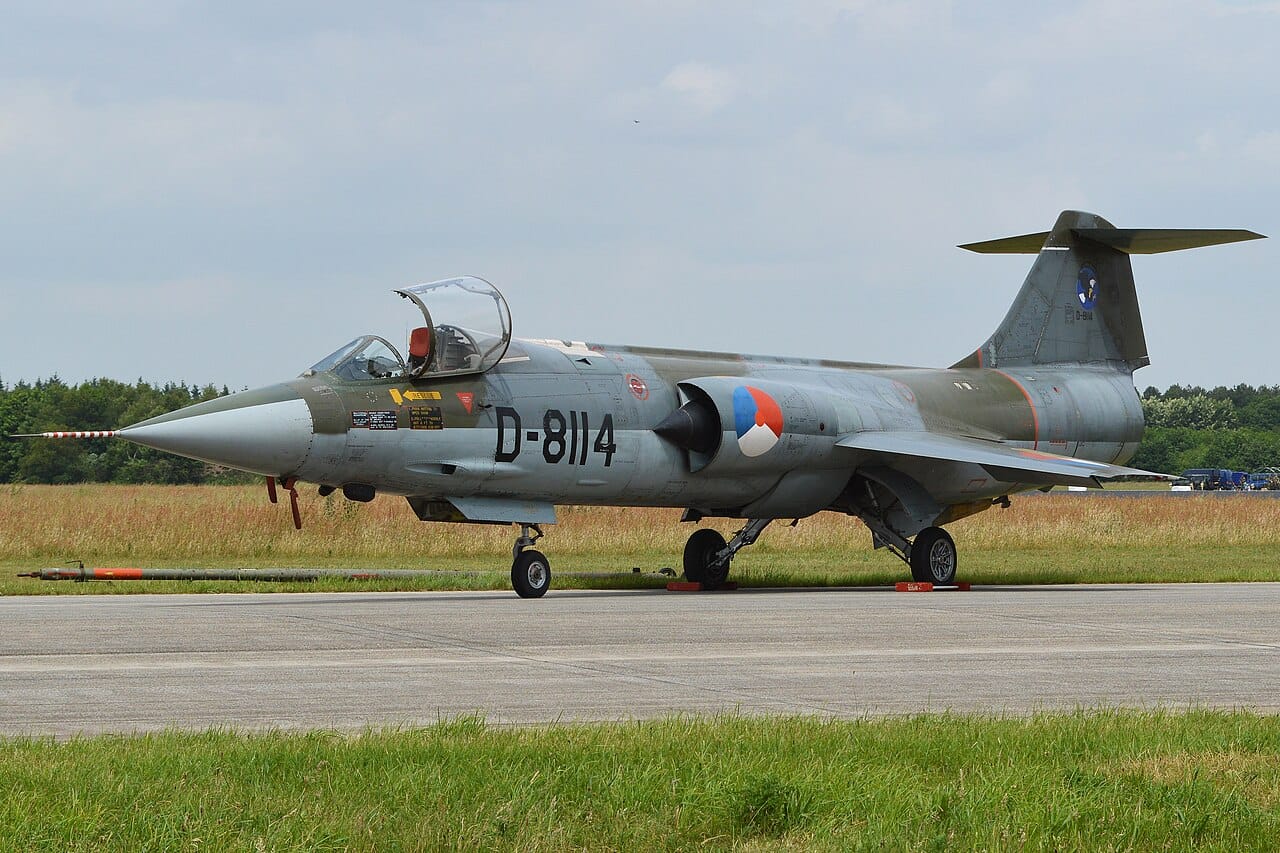
On 22 May 1991, F-104G serial 26+40 lifted off from Ingolstadt-Manching in Bavaria for the final operational flight of any West German F-104 Starfighter. The pilot flew a brief profile over the Alps. He returned to Manching. The aircraft was shut down. The chocks went under the wheels. And with that, thirty-one of the most controversial years in any European air force’s history came to an end.
The F-104 Starfighter is the aircraft Germany still argues about. To some, it was the airframe that taught the post-war Luftwaffe how to fly first-line fast jets. To others — particularly to the 116 German pilot families it killed — it was a monstrous mistake forced on a country still rebuilding its military credibility. Thirty-five years on, the truth sits in between, and the F-104 retains its place as the most paradoxical aircraft in modern Luftwaffe history.
Quick Facts
Last operational flight: 22 May 1991 — F-104G serial 26+40 at Ingolstadt-Manching
Final retirement (test duty): 22 May 1991 (last research flight; operational fleet ended October 1987)
Years in Luftwaffe service: 1960-1991 (31 years)
Total German F-104s: 916 aircraft (the largest Starfighter fleet outside the United States)
Variants flown: F-104F, F-104G, RF-104G, TF-104G, F-104CCV
Aircraft lost in accidents: 292 of 916
German pilots killed: 116 (plus dozens of crew on other duties)
Leading cause of accidents: 41% engine failure, 16% bird strike, remainder mostly low-altitude controlled flight into terrain
A Mach 2 dart bought for the wrong job
The F-104 Starfighter was conceived by Lockheed’s Kelly Johnson — the same engineer behind the U-2 and SR-71 — as the absolute purest expression of a high-altitude interceptor. A long, needle-thin fuselage. Tiny stub wings sized for raw transonic speed, not for low-altitude lift. A J79 turbojet pushing it past Mach 2. American Air Defence Command had been after exactly such an aircraft to chase Soviet bombers cruising over the Arctic at 50,000 feet. The F-104 was conceived for that mission, optimised for that mission, and capable of nothing else particularly well.
What it absolutely was not designed for was European low-altitude nuclear strike — the role for which West Germany, Italy, Belgium, the Netherlands, Canada, Norway, and Denmark all bought it in the late 1950s and early 1960s. NATO had decided that the next war with the Warsaw Pact would be won by low-flying nuclear strike fighters ducking under Soviet radar coverage to deliver tactical nuclear weapons at chokepoints in East Germany and Czechoslovakia. The F-104 was selected for that job because it was fast, because it was American, and because Lockheed’s sales effort was — to put it diplomatically — extraordinarily aggressive.

The “Widow Maker”
The accident rate was staggering from the start. Of 916 German Starfighters delivered, 292 were lost in non-combat accidents. 116 German pilots were killed. The German press coined a nickname — Witwenmacher, the Widow Maker — that stuck for the rest of the type’s career. The Belgian, Canadian, Dutch, and Italian Starfighter fleets fared similarly. The Canadian CF-104 force lost 110 aircraft out of 238 delivered. The Belgian losses were proportionally worse.
The root causes were a complex combination. The J79 engine was reliable in clean American skies but vulnerable to bird strikes in Europe’s densely populated lowlands. The aircraft’s tiny wings and high wing-loading made it unforgiving at low altitude — exactly where NATO doctrine demanded it operate. Pilot training, particularly in the early years, was rushed. Maintenance was learning a new generation of complexity. The German political establishment refused to acknowledge the magnitude of the problem for years.

The aircraft that taught Germany jet aviation
And yet — and this is the paradox at the heart of the German Starfighter story — the F-104 also did something genuinely important. It dragged the postwar Luftwaffe from the propeller era into the supersonic age in a single jump. It taught Germany how to operate, maintain, and fly Mach-2-capable swept-wing jets. It introduced air-to-ground precision attack doctrine that the Tornado fleet inherited. It gave the postwar Bundeswehr a generation of pilots, mechanics, and engineers who understood modern jet operations from the inside out.
Without the Starfighter, there would have been no Tornado in 1981. There would have been no Eurofighter Typhoon programme in the 1980s and 90s. The painful, costly, sometimes deadly transition the Luftwaffe lived through with the F-104 was the price of becoming a modern air force. The veterans who flew it remember both halves of that story.

The Lockheed scandal
One cannot talk about the F-104 in Europe without mentioning the Lockheed bribery scandal. In the early 1970s, U.S. Senate investigations uncovered that Lockheed had paid bribes worth tens of millions of dollars to senior government officials in Germany, Italy, the Netherlands, and Japan to secure F-104 orders in the 1950s and 1960s. The scandal helped bring down the Dutch government, contributed to political crises in Japan and Italy, and forced the resignation of West Germany’s Defence Minister Franz Josef Strauß years after the original procurement decision.
The bribes did not, on their own, make the F-104 a bad aircraft. They did, however, make the German political establishment particularly defensive about admitting any problem with the type. The accident rate became politically uncomfortable to discuss openly. By the time the Luftwaffe finally acknowledged the issues and began the long, difficult transition to the Tornado in the late 1970s, hundreds of pilots had already died.
The last flight, 22 May 1991
By 22 May 1991, the operational German F-104 fleet had already been gone for almost four years — final operational sorties had ended in October 1987. The aircraft that flew that final flight from Manching, F-104G 26+40, had been retained for research and test duty by Wehrtechnische Dienststelle 61, the German military’s flight-test centre. After 22 May 1991, it too was retired.
26+40 now sits at the WTD 61 museum at Manching. Several other German F-104s survive in museums across Europe — at the Deutsches Museum in Munich, the Luftwaffenmuseum at Berlin-Gatow, the Hermeskeil aviation museum, and elsewhere. The aircraft is now a piece of history. The arguments about it have outlived the airframe.
Sources: Luftwaffe historical records; Wehrtechnische Dienststelle 61 archives; This Day in Aviation; Lockheed Starfighter operator histories.
 English
0 Comments