
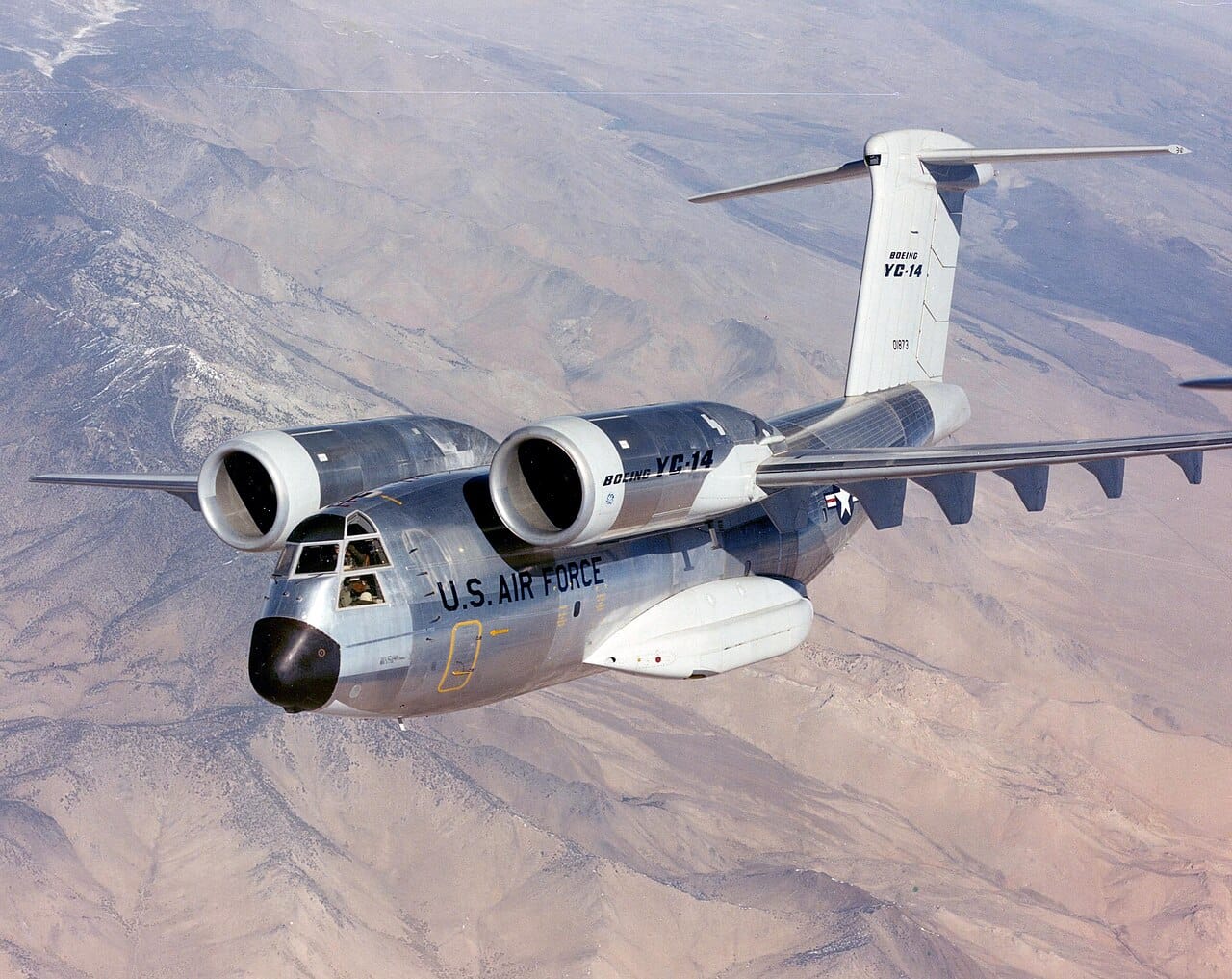
In 1976, Boeing rolled a strange-looking jet out of its Renton plant. Two turbofans mounted high above the wings — not under them, where every cargo aircraft in history had put its engines. Stubby, square fuselage. T-tail. A wing that looked too small for the airframe. The aircraft was the YC-14, and it could do something no cargo plane before or since has managed: take off in less than 600 metres, with a full payload, on a hot day, from an unprepared dirt strip — and then cruise like a jetliner. The U.S. Air Force tested it for three years against a McDonnell Douglas competitor. It crushed every requirement. And then — somehow — the Pentagon cancelled the entire programme.
Fifty years later, every major military cargo aircraft requirement Boeing and Lockheed are still chasing — STOL performance, short field, hot-and-high payload, fuel efficiency on the cruise — was solved on the YC-14 in 1976. The aircraft sits in a museum. The technology was decades ahead of its time. The decision to kill it remains one of the most baffling procurement choices in Pentagon history.
Quick Facts
Aircraft: Boeing YC-14 (Advanced Medium STOL Transport)
First flight: 9 August 1976, Edwards Air Force Base
Built: 2 prototypes (YC-14-1 and YC-14-2)
Engines: Two General Electric CF6-50D turbofans (51,000 lbf each)
Key innovation: Upper-Surface Blowing — engines exhaust over the wing, using the Coanda effect to generate massive low-speed lift
Payload: 27 tonnes (60,000 lb)
Take-off run with full payload: Approximately 580 metres (1,900 ft) on dirt
Competitor: McDonnell Douglas YC-15 (which eventually became the basis of the C-17 Globemaster III)
Programme cancelled: 1979
Where the prototypes are now: Pima Air & Space Museum (Tucson) and AMARG storage (formerly)
A C-130 replacement that flew like a jet
The Advanced Medium STOL Transport (AMST) programme was the Air Force’s 1970s attempt to replace the Lockheed C-130 Hercules. The Hercules was a fine aircraft — still is — but it was a 1950s design built around turboprops, with a cruise speed barely above 300 knots and a low-altitude profile that was increasingly vulnerable in any contested airspace. The Air Force wanted something faster, longer-ranged, with comparable short-field performance. The contract went to two companies: Boeing for the YC-14 and McDonnell Douglas for the YC-15.
Both were jets. Both used over-the-wing or under-the-wing blown flap concepts. Both achieved performance specs the C-130 could not. But the YC-14 was the more radical of the two — and on most performance measures, it was also the better aircraft.
Upper-Surface Blowing — the magic trick
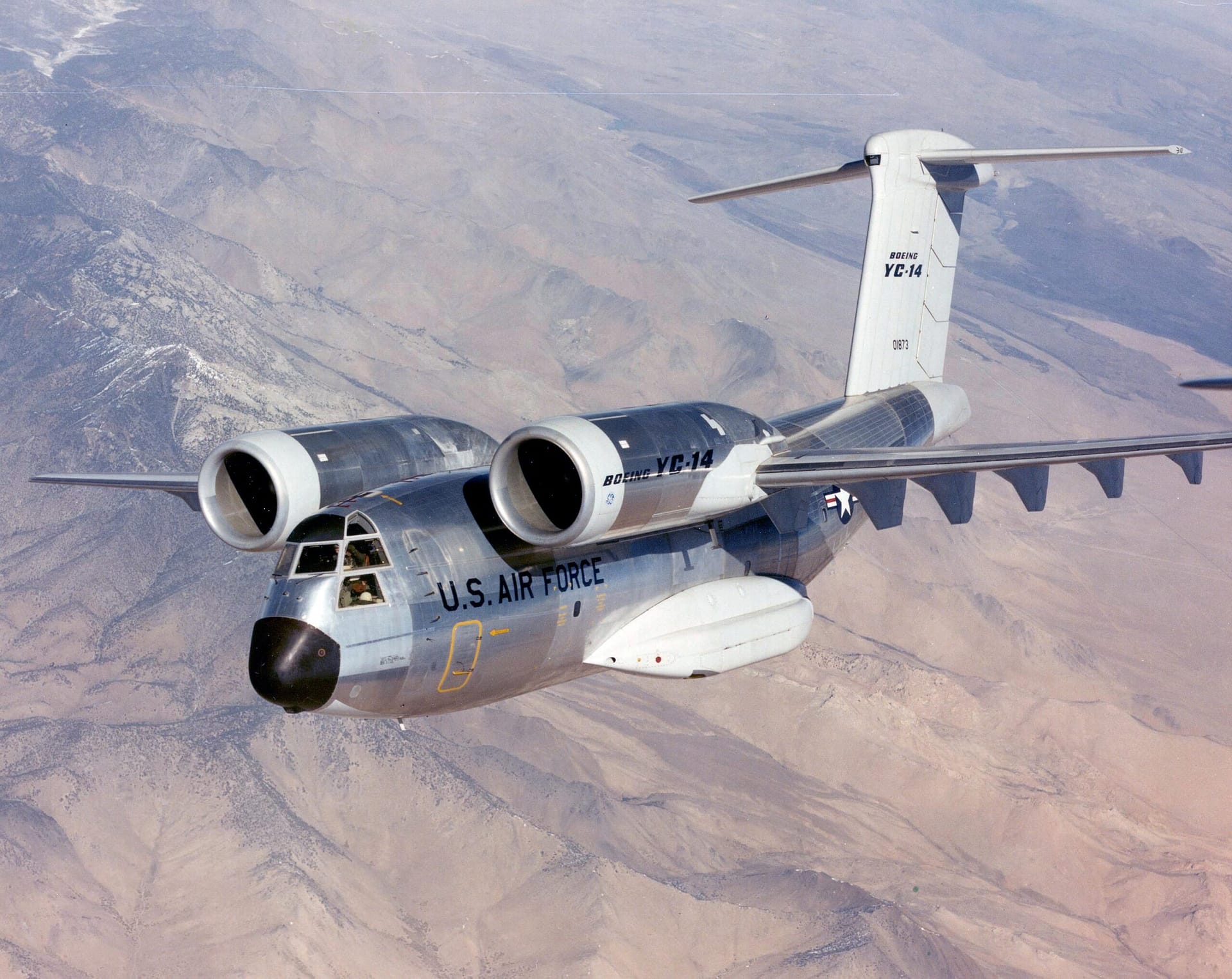
The YC-14’s trick was the engine placement. Conventional jets put engines under the wing, where the exhaust does nothing useful for low-speed flight. Boeing put the YC-14’s engines on top, directly above the wing leading edge. At low speeds, the deflected exhaust flowed across the wing’s upper surface — and thanks to the Coanda effect (the same phenomenon that pulls liquid around the curve of a spoon), that exhaust stream stayed attached to the wing all the way to the trailing edge, dramatically boosting lift.
The numbers were staggering. With the engines at full thrust and the flaps fully deployed, the YC-14 could generate lift coefficients above 5.0 — three times what a conventional jet wing achieves. That meant take-off and landing speeds in the 80-knot range instead of the 150-160 knots a comparable conventional jet would need. The aircraft could be airborne in 580 metres carrying 27 tonnes of cargo. The C-130 needed almost twice that runway for the same load.
Why the Air Force killed it
This is the part that still puzzles aerospace historians. The YC-14 met or exceeded every AMST performance specification. So did the YC-15. The Air Force was supposed to pick one of them in 1977 and put it into production. Instead, in 1979, Defence Secretary Harold Brown cancelled the entire programme.
The reasons given at the time were budgetary. The Air Force could not afford a clean-sheet medium transport while it was also paying for the F-15, the F-16, the A-10, the B-1, and the upcoming F-117. The C-130 would do for the medium-lift mission. The C-141 and C-5 Galaxy would do for strategic lift. The AMST programme was the most expendable line item on the books.
What the Air Force actually meant — and what nobody said publicly — was that the operational concept the AMST programme had been built around was no longer the priority. In 1972, the Air Force had wanted aircraft that could deliver heavy loads into short, austere strips close to the front line, in a European war scenario. By 1979, the strategic emphasis had shifted to power projection across oceans — and that required a much larger aircraft, not a tactical STOL transport. The McDonnell Douglas YC-15 design eventually evolved into the C-17 Globemaster III, which Boeing later inherited when it bought McDonnell Douglas. The YC-14 was simply orphaned.
The legacy
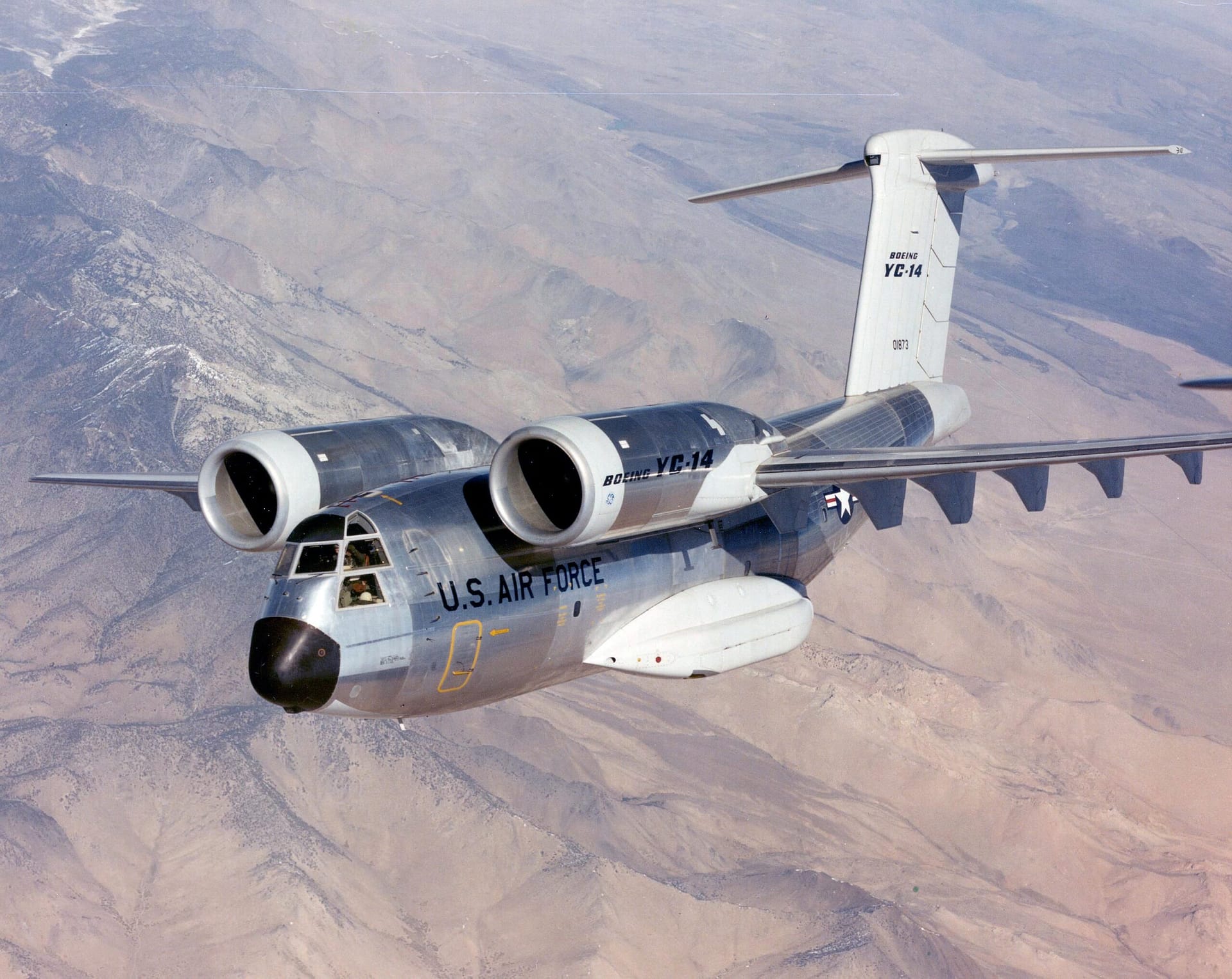
The technology the YC-14 demonstrated did not disappear. Upper-Surface Blowing has appeared in design studies for the Boeing 7J7, the McDonnell Douglas MD-91X, the Japanese Kawasaki C-2, and most recently in the NASA-Boeing X-66A Sustainable Flight Demonstrator. The YC-15’s under-wing externally blown flap arrangement made it into the C-17, which has been the U.S. Air Force’s primary strategic-tactical lift aircraft since 1995. The AMST programme’s engineering paid forward into both successor designs.
What the Air Force lost when it killed the YC-14 was the most efficient short-field tactical jet transport the United States ever flew. Fifty years on, the U.S. military still does not have an aircraft that combines the YC-14’s 27-tonne payload, sub-600-metre take-off run, and 400-knot cruise. The closest modern equivalent — the Brazilian KC-390 — comes within striking distance on payload and field performance but cannot match the YC-14’s cruise efficiency. The C-130 keeps soldiering on, in its J variant, into the 2050s.
The YC-14 sits in the desert in Tucson, quiet, complete, restored to its original livery. People who walk past it usually do not realise what they are looking at. It is the most under-appreciated cargo aircraft in U.S. aviation history — and a reminder that the right design, at the wrong moment, can be lost forever.
Sources: NASA Technical Reports; Boeing AMST programme documentation; Pima Air and Space Museum archives; aviation historian Norm DeWitt.

 English
0 Comments