
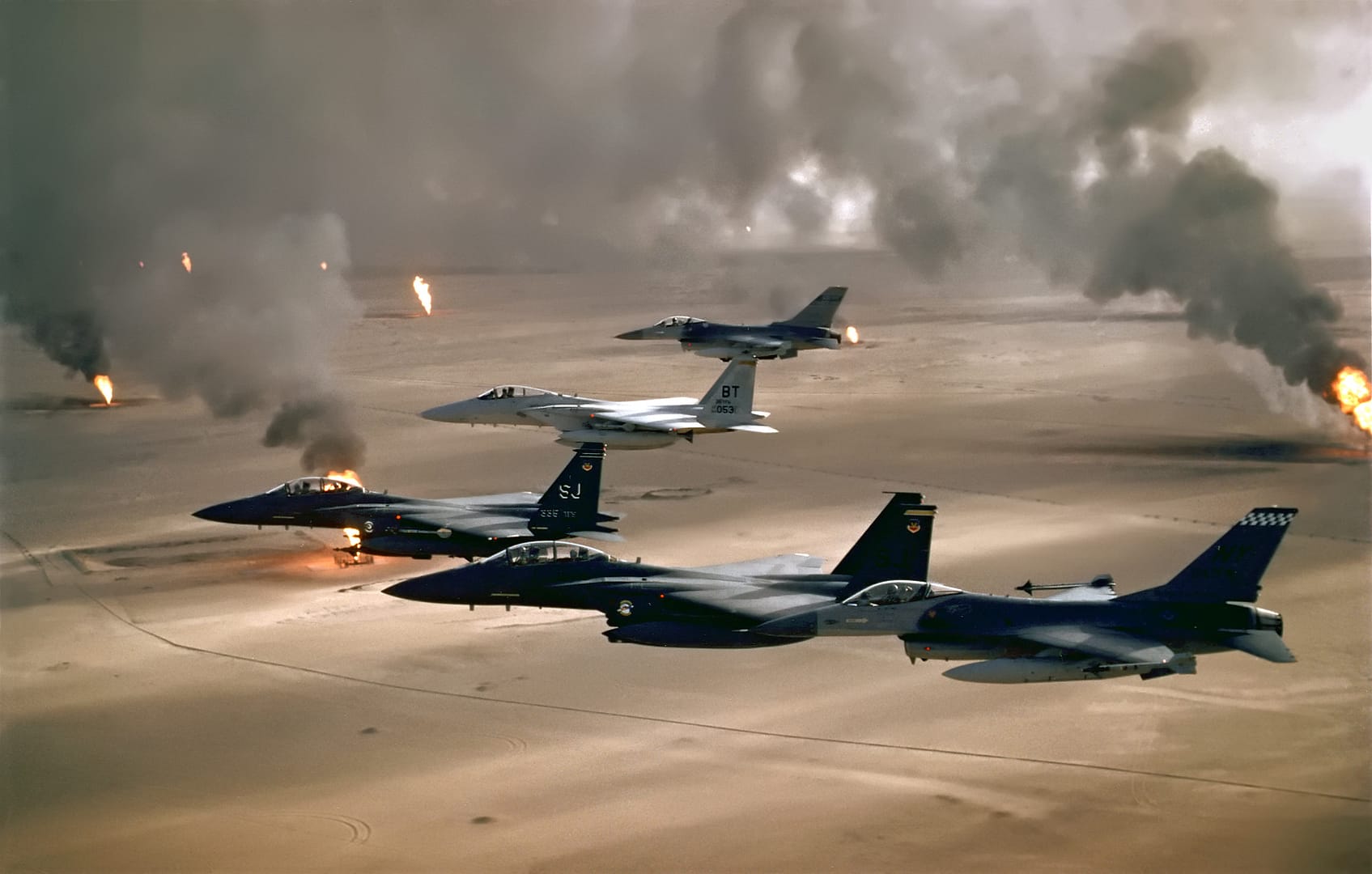
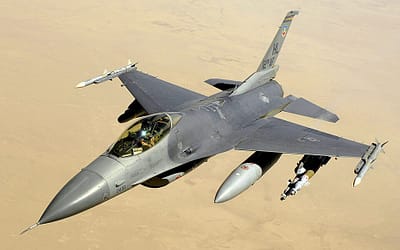
On 19 January 1991, three days into Operation Desert Storm, the U.S. Air Force launched the largest F-16 strike in history. Seventy-two Vipers, supported by F-15 escorts, F-4G Wild Weasels, EF-111 Ravens, and KC-135 tankers, headed for downtown Baghdad. The mission was code-named Package Q. It went badly. Iraqi air defences put up a wall of SAMs and AAA so thick that the planners had not seen its equal since Vietnam. Most of the F-16s never got to release their bombs and turned for home.
Major Emmett “E.T.” Tullia did not turn for home. He pressed in, found his target, dropped two 2,000-pound bombs onto the Daura oil refinery, and turned to egress. That is when the Iraqi air defences locked onto him with six surface-to-air missiles in succession. That is also when he discovered that his chaff and flare dispensers had failed to deploy a single round during the entire mission. The HUD video of what followed is one of the most-watched real-combat clips in U.S. Air Force teaching archives.
Quick Facts
Date: 19 January 1991
Pilot: Major Emmett “E.T.” Tullia, callsign Stroke 3
Aircraft: F-16C Fighting Falcon
Squadron: 614th Tactical Fighter Squadron, 401st Tactical Fighter Wing
Mission: Package Q Strike — largest F-16 raid of the Gulf War (72 F-16s plus supporting aircraft)
Target: Daura oil refinery, southern Baghdad
Defences faced: SA-2, SA-3, SA-6 surface-to-air missiles plus heavy AAA
Critical failure: Chaff and flare dispensers failed to release any countermeasures the entire mission
Threats survived: At least six surface-to-air missile launches, including a tracking SA-6 lock
Closest miss: SA-6 motor sound audible inside the cockpit as the missile passed
Award: Distinguished Flying Cross
Why Package Q happened
By 19 January 1991, the Coalition had been hammering Iraqi targets for three nights. F-117 stealth fighters had been doing the deep-Baghdad work — including the famous precision strike on Baghdad’s “AT&T Building” telecommunications centre on the first night of the war. But the F-117 fleet was small, and U.S. Central Command wanted to demonstrate to Saddam Hussein’s air defence commanders that conventional, non-stealthy strike aircraft could also reach Baghdad in daylight without prohibitive losses.
Package Q was that demonstration. Seventy-two F-16s — almost an entire wing’s worth of aircraft — would push into central Baghdad in broad daylight, drop GBU-10 and Mk-84 2,000-pound bombs on a list of refineries, command bunkers, and the Republican Guard barracks, and egress. The supporting cast was equally large: F-15 Eagles for top cover, F-4G Wild Weasels firing AGM-88 HARMs at any SAM site that emitted, EF-111 Ravens jamming the rest, and a fleet of KC-135 tankers stretching the F-16s’ short legs to make the round trip from bases in Saudi Arabia.
What the planners did not appreciate was just how dense, redundant, and well-rehearsed the Iraqi integrated air defence system around Baghdad had become. The Iraqis had been preparing for this fight for a decade. When Package Q arrived in their engagement zone, every SA-2, SA-3, SA-6, and SA-8 battery in the city opened up simultaneously. The Wild Weasels could not suppress them all. The jammers could not jam them all. Most of the F-16 force found itself manoeuvring violently to defeat missile launches before getting anywhere near their targets — and many simply jettisoned bombs and ran.
Tullia’s problem
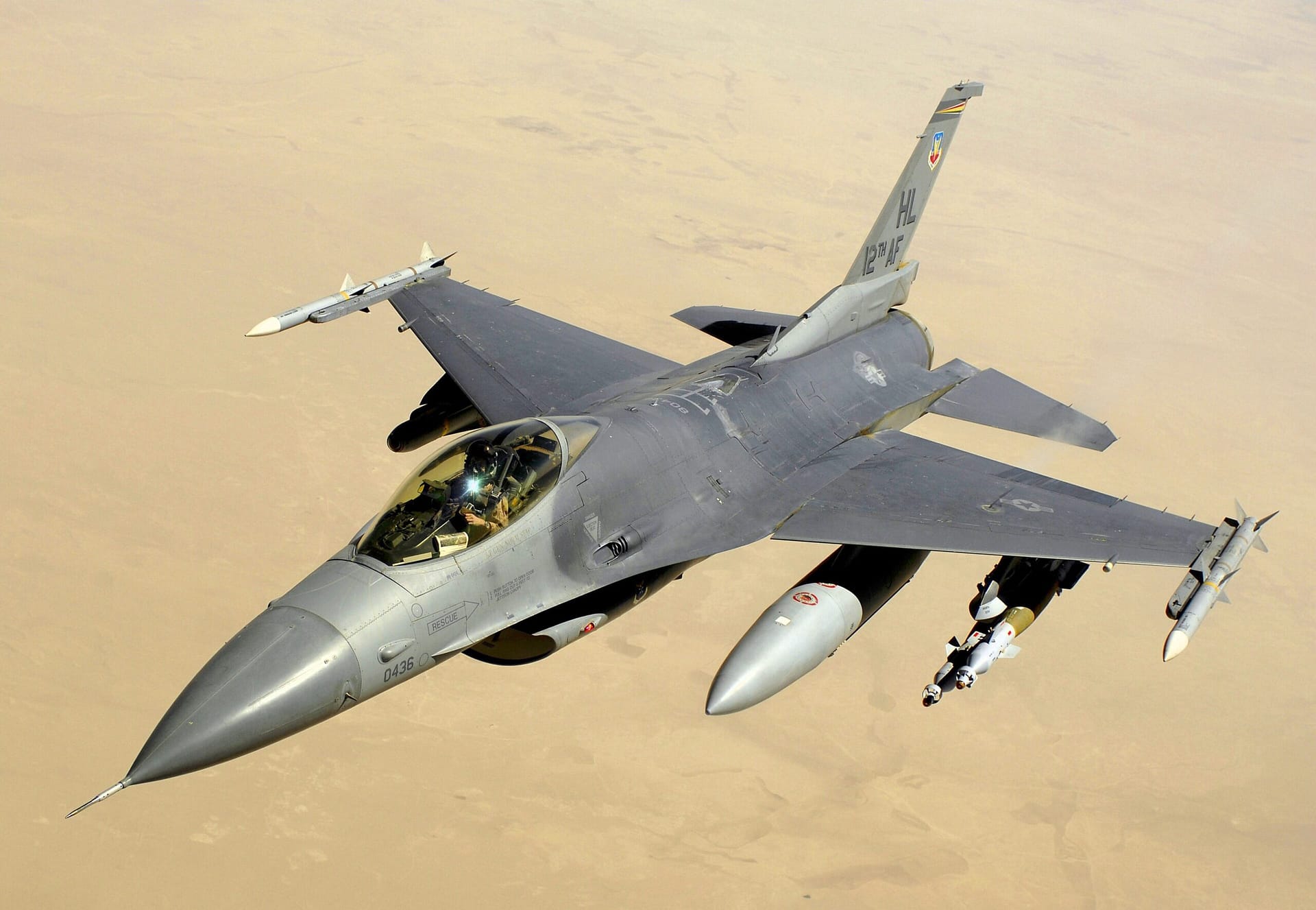
Tullia did not jettison and run. He pressed in, found the Daura oil refinery in the haze and smoke, lined up, and dropped both his bombs on target. Then he turned south and lit the afterburner to leave. That is when the first SA-3 launched.
The F-16’s defensive systems should have responded automatically. The radar warning receiver should have detected the SAM uplink. The pilot should have hit the chaff/flare switch, which would have launched bundles of metallic chaff (to confuse the missile’s radar) and pyrotechnic flares (to confuse infrared seekers). Tullia’s dispensers put out nothing at all — a malfunction he would only fully confirm after landing.
What Tullia had left was his stick, his throttle, his eyes, and the laws of physics. The HUD video — preserved by the USAF and shown to generations of student pilots since — captures the next few minutes in real time. The audio is a man working very hard and breathing very heavily. The video shows the F-16 entering a series of high-g defensive turns, deliberate altitude changes, and energy-management manoeuvres designed to break each successive missile’s tracking solution. SA-3, defeated. Second SA-3, defeated. SA-2 ascending, defeated. SA-6 lock-on, the most dangerous of all, with the rocket motor sound audible inside the canopy — defeated. Two more SAMs. All defeated.
Tullia later recalled that the SA-6 was the missile he would never forget — it passed close enough that he could hear its rocket motor from inside the canopy as he rolled away from it.
What the HUD video taught the Air Force
The video became required viewing at the F-16 Replacement Training Unit at Luke AFB and at the U.S. Air Force Weapons School at Nellis. It is still shown today, 35 years later. The reasons go beyond the obvious “it is incredible footage.” The video demonstrates, in real time, several principles that doctrinally American fighter pilots are supposed to internalise:
Energy management beats reflexes. Tullia did not flail. Each defensive manoeuvre was deliberate, geometrically optimised, and traded altitude for airspeed (or vice versa) in a calculated way. The F-16’s combat radius and energy state at the end of the engagement were such that he still had fuel and altitude to reach the tanker.
Visual SAM defeat is a real skill. Many pilots have been taught the theory of defeating a SAM by visual sighting — wait for the smoke trail, break perpendicular to the missile track, force a high-aspect rate the missile cannot follow. Few have ever had to do it for real. Tullia did it six times in a single egress.
Countermeasures are not magic. Even with chaff and flares working, the same engagement would have required exactly the same airmanship. The countermeasures buy time and degrade probabilities. The pilot still has to manoeuvre.
After-action
Tullia made it back to the tanker, made it back to base, debriefed his squadron commander, and was on the morning brief for the next mission. The Distinguished Flying Cross citation describes what he did in characteristically deflationary language — “extraordinary achievement while participating in aerial flight” — noting that, undaunted by defences that shot down two other aircraft near him, he continued his attack and delivered his bombs precisely on target. Nothing about the audible rocket motor. Nothing about the breathing on the audio track. Nothing about the calm voice of the wingman calling out missile tracks.
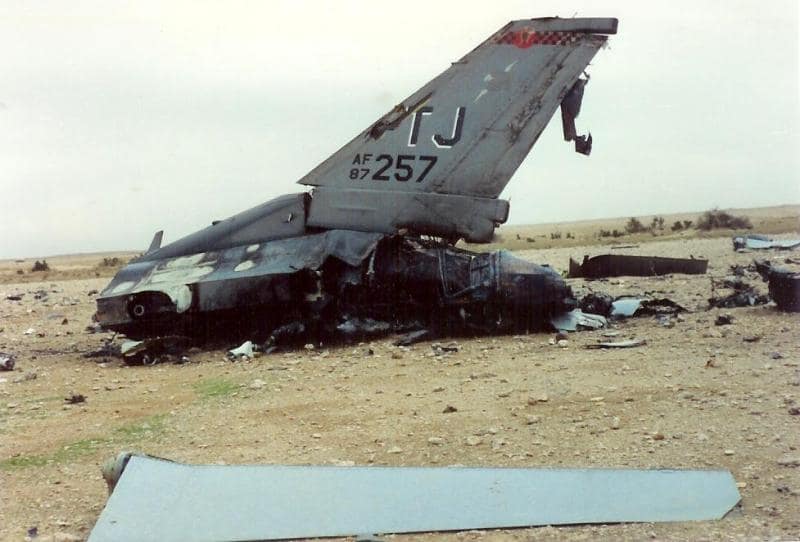
Package Q overall was treated by Central Command as a mixed result. Most of the F-16s did not bomb their assigned targets. Several aircraft took damage, and two F-16s — flown by Major Jeffrey Tice and Captain Mike Roberts of the 614th — were shot down by SAMs, both pilots surviving as prisoners of war. The lesson was that pushing 72 non-stealthy aircraft into central Baghdad in daylight was a marginal proposition even with that much support. Subsequent deep-Baghdad missions in Desert Storm went to F-117s.
Tullia went on to complete a full Air Force career. He gives occasional talks at USAF schools and at civilian aviation events. The HUD video plays on a loop on YouTube, viewed by tens of millions of people. The story it tells is straightforward: a pilot, an airplane, and the airmanship to keep both alive in the worst minutes of his career.
Watch: HUD footage from Major Tullia’s F-16 dodging six Iraqi SAMs over Baghdad on 19 January 1991, with breakdown of each defensive manoeuvre.
Sources: USAF Operation Desert Storm after-action reports; Major Tullia public interviews; Sandboxx; Task & Purpose; The Aviation Geek Club.
 English
0 Comments