
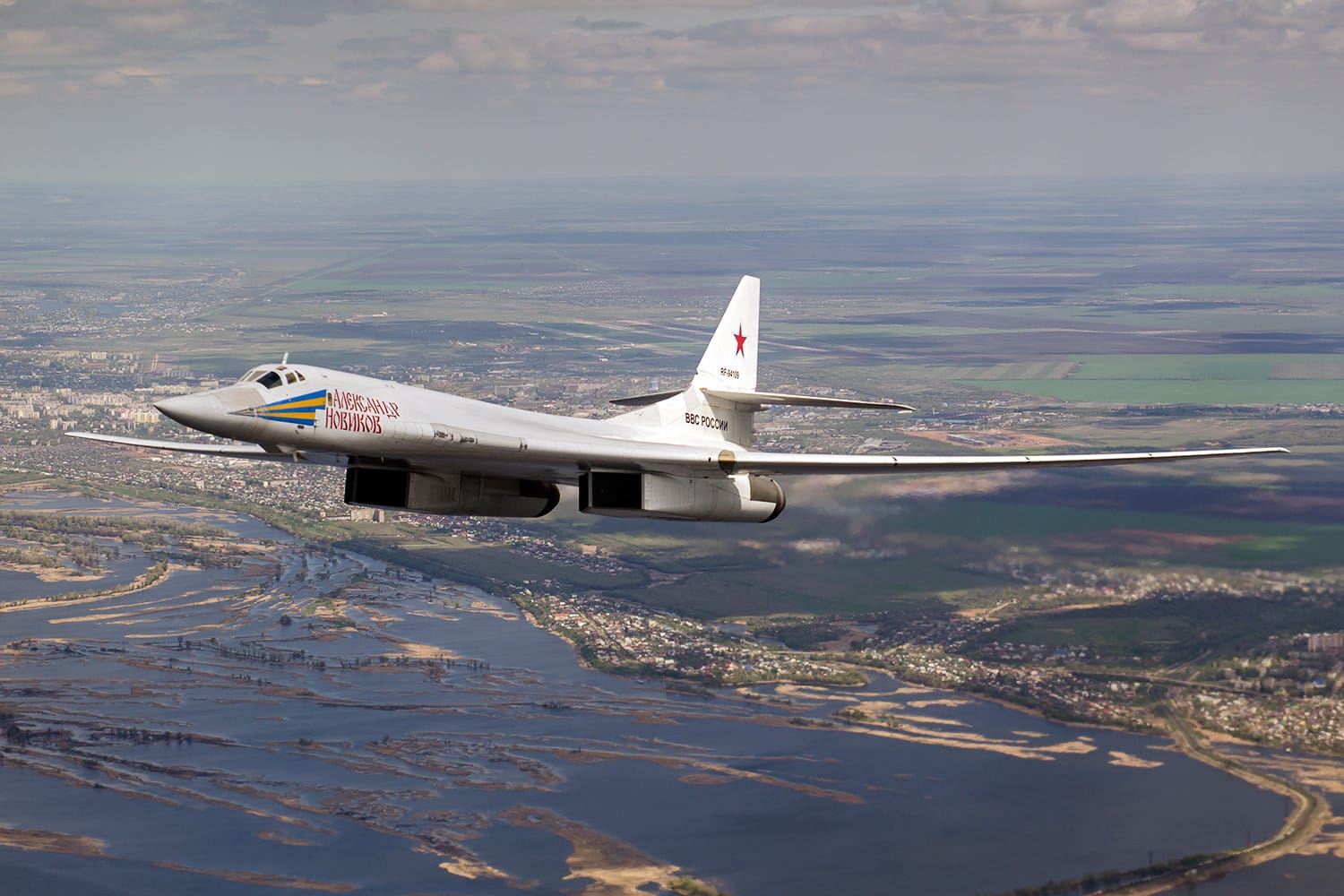
The pilots call it the White Swan. NATO calls it Blackjack. Either way, the Tupolev Tu-160 is the largest, heaviest, fastest combat aircraft ever built — a 110-metre wingspan of variable-sweep wing, a 275-ton maximum takeoff weight, four 25,000-kilogram-force afterburning turbofans, and a top speed inside Mach 2 that not a single American or Chinese bomber has ever come close to matching.
It is also, against all odds, still in production. The B-52 will outlive most of us, but the Tu-160 is the only Cold War strategic bomber that has actually been re-built since the Cold War ended. The Kazan production line — shuttered in 1995 — was restarted in 2020. The newest Tu-160M2 to roll off it flew in 2025. And the type that first turned a runway in 1981 is still, in 2026, the closest thing the world has to a flying tactical-nuclear delivery truck shaped like a manta ray.
Quick Facts
Designer: Tupolev OKB
First flight: 18 December 1981
Length: 54.1 m (177 ft)
Wingspan: 55.7 m swept forward, 35.6 m fully back
Max takeoff weight: 275,000 kg (606,000 lb)
Top speed: Mach 2.05 (2,220 km/h / 1,380 mph)
Built so far: 35 Tu-160, plus first-batch Tu-160M2 in production
Why a Soviet manta ray
The Tu-160 was conceived in the late 1960s as the Soviet answer to the American B-1A — a long-range, supersonic, low-level penetration bomber that could fly under American air defences, lob a nuclear cruise missile from over the Arctic, and turn for home before the radar operator finished his sandwich. Vladimir Bliznyuk’s design team at Tupolev took two basic decisions that defined the airframe: variable-sweep wings, like the Tu-22M Backfire, and a clean blended-wing fuselage that produces lift across most of its length rather than just from the wings.
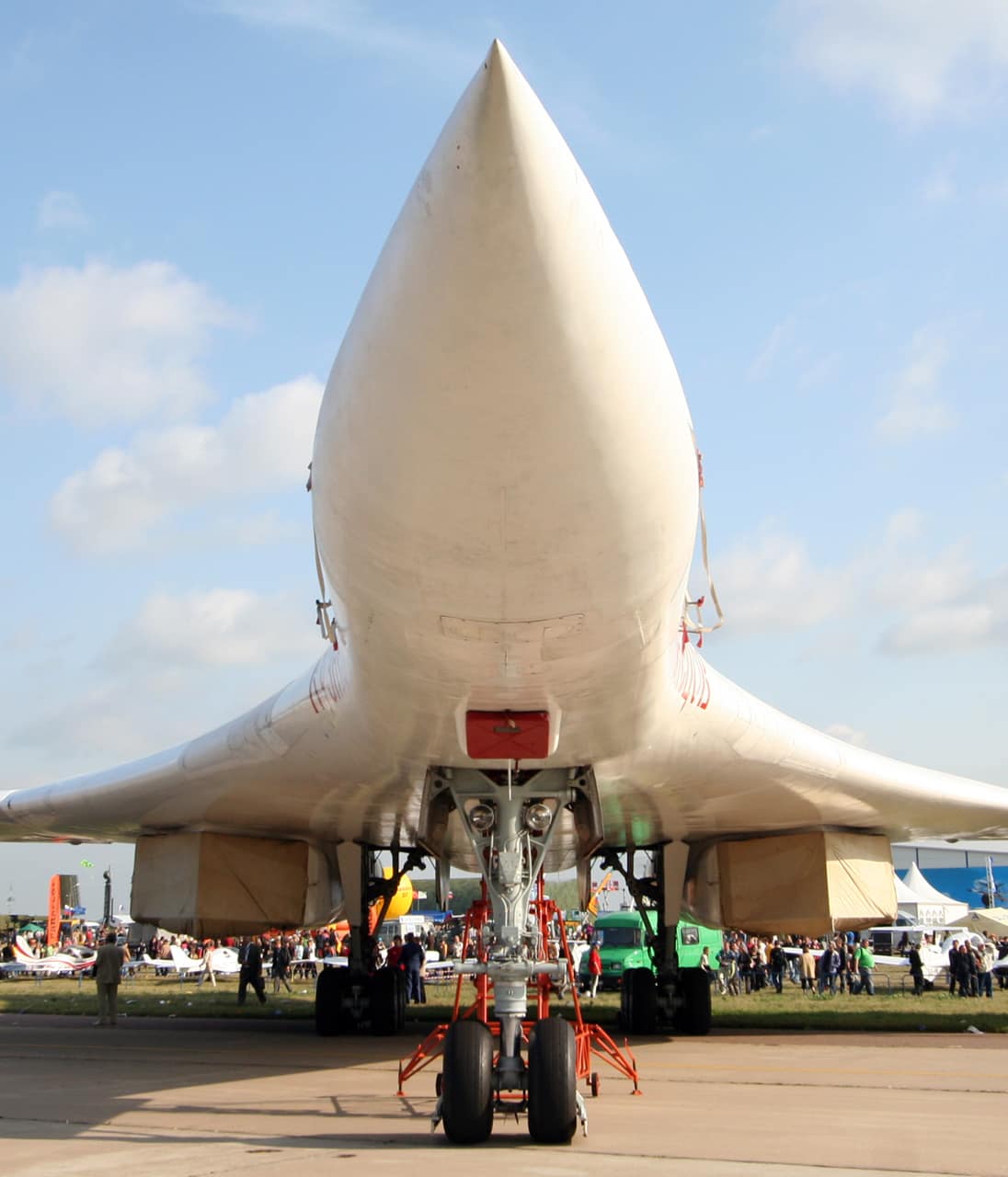
The result is an aircraft that, when its wings are swept fully back, has the silhouette of a delta-wing fighter at three times the size, and that can supercruise — almost — at Mach 1.5 without afterburners. With its wings forward, it can take off heavy from short Russian alternates and land carrying weapons rather than empty.
35 airframes against the Cold War
Production at Kazan ran from 1984 to 1995. Of the 35 Tu-160s built, 19 went to the 184th Heavy Bomber Air Regiment at Pryluky in what was then Soviet Ukraine. When the Soviet Union dissolved, those 19 bombers became Ukrainian property — and one of the most awkward strategic-arms problems of the 1990s.
Eight were eventually transferred to Russia in 1999 as part-payment of a $285 million gas debt. Ten were scrapped under the START treaty, with American funding. One survives in the Poltava Museum. The remainder of the fleet — about 16 airframes — stayed in service with Russia’s 121st Heavy Bomber Aviation Regiment at Engels-2 Air Base, where they remain the only aircraft in Russian service capable of carrying the Kh-101 and Kh-102 long-range cruise missiles.
The 2020 restart
Russia’s decision to restart Tu-160 production at Kazan in 2020 was, on paper, one of the most expensive aerospace decisions in the country’s post-Soviet history. The PAK DA stealth bomber — Russia’s answer to the B-21 Raider — had slipped badly. The existing Tu-160 fleet was aging. And Russia faced a strategic-nuclear problem: the Bear and Backfire were both subsonic, and only the Tu-160 could penetrate modern air defences fast enough to deliver a nuclear cruise missile from outside the engagement envelope.
The new variant — the Tu-160M2 — keeps the airframe but updates the avionics, radar, and engine controls. It is in essence a clean-sheet rebuild of a 45-year-old design. The first new-build Tu-160M2 flew at Kazan in January 2022, and the second in 2024. Russia plans to build 50 of the new variant by 2035, which would make it the largest single Russian strategic-bomber order since the dissolution of the Soviet Union.
It will not be a B-21. It will not be stealth. But it will be the only aircraft on either side of the new Cold War that can take off in Saratov, fly Mach 2 with its wings back, and put a Kh-101 over a target 5,500 kilometres away without ever crossing into hostile airspace. For a strategic bomber, that is still a job description nobody else writes.
Sources: Tupolev OKB, Russian Ministry of Defence, RUSI, FlightGlobal.

 English
0 Comments