
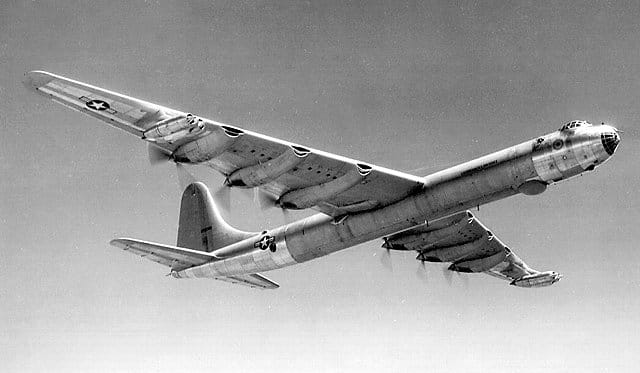
"Six turning, four burning" is one of the great aviation phrases. The six are 28-cylinder Pratt & Whitney R-4360 Wasp Majors, mounted backwards along the trailing edge of the wing, swinging massive pusher propellers through air thinner than any propeller ever met before. The four are General Electric J47 turbojets, slung under the wings in pairs. They are all running at once. And they are pushing 186 tonnes of aluminium and uranium and fuel and bombs to the edge of the stratosphere.
The Convair B-36 Peacemaker is, by almost every measurable standard, the most absurd combat aircraft America ever built. Its wingspan was 70.1 metres — wider than a 747. It carried up to 39,000 kilograms of bombs. Its fuselage was so long that crews moved between the front and rear compartments on a wheeled trolley through a pressurised tunnel. And it is the only aircraft in history to have been built specifically to nuke Moscow from Texas without refuelling on the way.
Quick Facts
Designer: Convair (Consolidated Vultee)
First flight: 8 August 1946
In service: 1948–1959
Wingspan: 70.1 m (230 ft) — wider than a Boeing 747
Powerplant: 6× Pratt & Whitney R-4360 piston engines + 4× GE J47 turbojets
Range: 16,000 km (10,000 miles) unrefuelled
Built: 384 aircraft
The bomber the Cold War demanded
The B-36 was conceived in 1941, when the prospect of Britain falling to the Nazis made the US Army Air Forces seriously plan for a bomber that could fly from North America, attack Germany, and return. The specification asked for a 16,000-kilometre range and a 6,400-kilometre combat radius with a 4,500-kilogram bomb load — figures no aircraft on earth could touch.
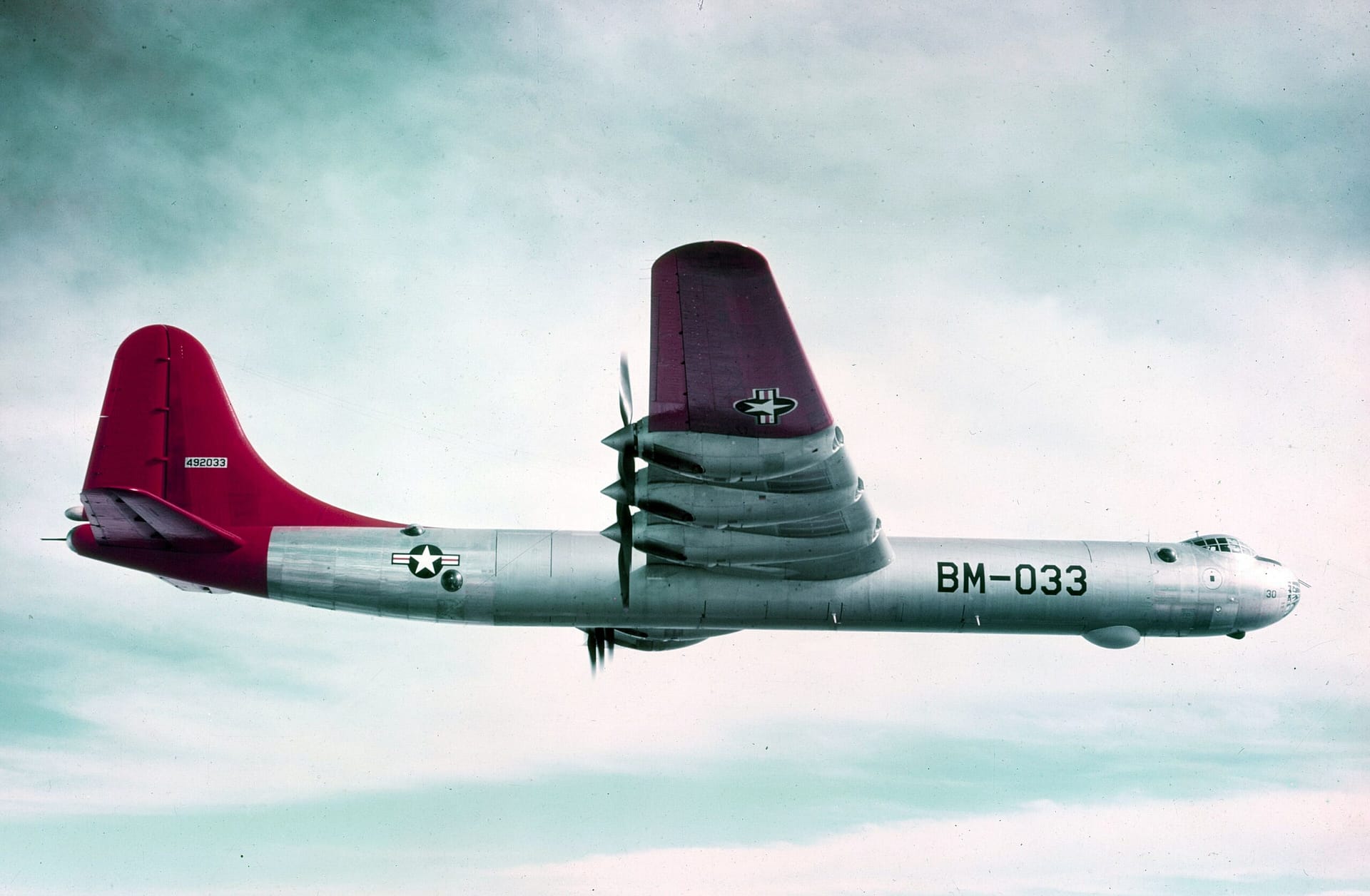
The war ended before the aircraft flew. The mission did not. By 1946 the requirement had become the early Cold War's strategic-bomber problem: deliver an atomic weapon over the Soviet Union without staging through European airfields that did not yet exist. The B-36 was the only aircraft on the planet that could do it. The B-50 (the upgraded B-29) needed forward bases in Britain. The Tu-95 Bear, on the Soviet side, was still on the drawing board. The Peacemaker had the runway to itself.
Designed before the jet age, then dragged into it
The piston engines were the original design choice and a deeply Cold War problem. The R-4360 Wasp Major is the largest aero-piston engine ever mass-produced — 28 cylinders, 71.5 litres of displacement, 3,800 horsepower at full military. The B-36 carried six of them. Each cylinder had two spark plugs. That is 336 spark plugs per aircraft. A single change of plugs across the SAC B-36 fleet consumed roughly 35,000 plugs at a time.
And the R-4360 had a serious problem: it cooled poorly. With the engines mounted backwards behind the wing, the airflow into the cylinders was disturbed by the wing itself. In-flight engine fires were a recurring problem — common enough that crews joked the slogan was really "two turning, two burning, two smoking, two choking, and two more unaccounted for."
The jets on the wings, then the swan song
The four J47 turbojets bolted under the outer wings were a Korean War-era addition. They were not for cruise; they were for take-off, climb, and target dash. With all ten engines running, the B-36 could exceed 700 km/h at altitude — fast enough, for a brief window in the early 1950s, that the Soviet PVO did not have a fighter that could reliably catch it.
That window closed when the MiG-15 entered service. By 1955 the B-36 was operating only at altitudes above 13,000 metres, where its size and slow speed made it a target that the Soviet S-75 SAM eventually killed off the strategic-bomber problem entirely. By 1959, with the B-52 in full service, the last B-36 was retired to Davis-Monthan boneyard.
The aircraft never dropped a bomb in anger. It also never crashed in combat. Its real legacy was the doctrine — that the Soviet Union could be reached from the continental US by a single nuclear-armed aircraft — that defined every American strategic-bomber programme that followed it. The B-52 inherited the mission. The B-1 inherited the speed. The B-2 inherited the stealth. The B-21 will inherit all three. But the B-36 was the one that built the architecture.
Four complete Peacemakers survive in American museums. Each one is somehow physically bigger than you expect when you walk up to it. They still look, in 2026, like an aircraft from another, slightly mad, era. They are.
Sources: National Museum of the US Air Force, Strategic Air Command Memorial Museum, Air Force Historical Research Agency.
Related Questions
What was the B-36 Peacemaker?
The Convair B-36 Peacemaker was a giant American intercontinental bomber of the early Cold War. With a 230-foot wingspan — wider than a Boeing 747 — and ten engines, it could fly 10,000 miles unrefuelled to strike targets across the globe.
Why is the B-36 called 'six turning and four burning'?
Because of its unusual ten-engine layout: six piston engines with propellers ("six turning") plus four jet engines ("four burning"). The phrase described the mix of propeller and jet power the huge bomber used to get airborne and cruise.
How big was the B-36 Peacemaker?
Its wingspan was 70.1 metres (230 feet) — even wider than a Boeing 747. The B-36 was one of the largest combat aircraft ever built, designed to carry heavy bomb loads across intercontinental distances.
What engines did the B-36 have?
It had ten engines: six Pratt & Whitney R-4360 piston engines driving propellers, plus four General Electric J47 turbojets for extra speed and high-altitude performance — the combination behind the famous six turning, four burning.
Why was the B-36 built?
The concept arose in 1941, when planners feared Britain might fall to Nazi Germany and the U.S. would need a bomber able to strike Europe directly from North America. The result was an intercontinental bomber with a 10,000-mile unrefuelled range.
0 Comments