
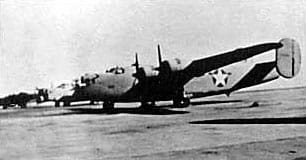
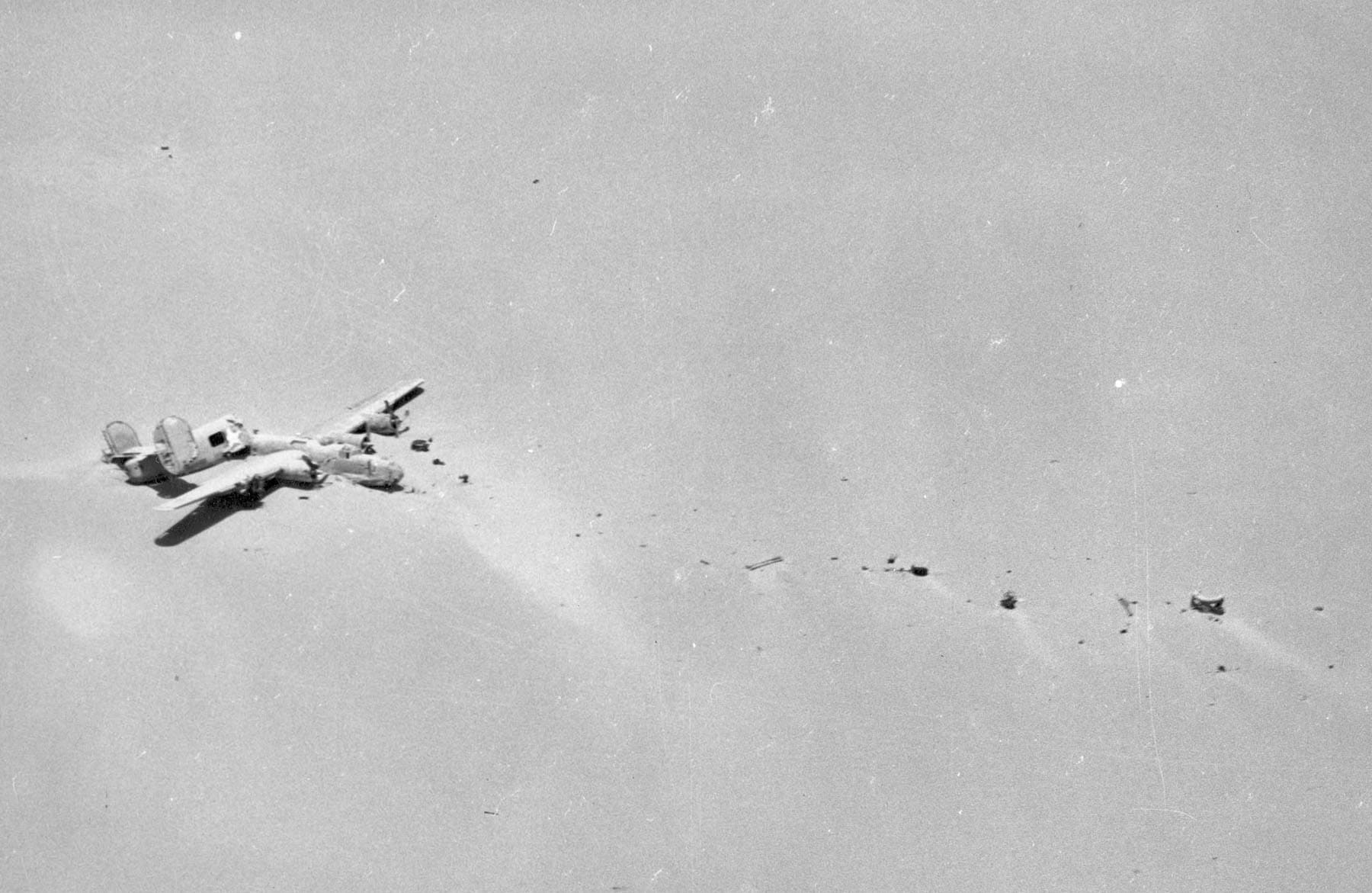
On the morning of 9 November 1958, a British oil-exploration crew flying a Silver City Airways Dakota across the eastern Libyan Sahara saw something on the sand below that should not have been there. It was an aircraft. A whole one, almost. Broken in two, but still recognisable, still upright, still painted in 1943 olive drab, sitting alone in the deepest emptiest stretch of the Calanscio Sand Sea — 710 kilometres south of the nearest road.
They marked it on the map and flew on. Nobody had reported a missing plane in this area, ever. There was no airfield within five hundred miles. There was no record at Wheelus Air Base of any aircraft that could have ended up there. For three more months, the wreck stayed alone in the sand.
What the British crew had spotted, although nobody yet knew it, was the most famous lost-aircraft mystery in the history of the United States Army Air Forces. Its name was painted on the right side of the forward fuselage in the round cursive script of a Gershwin song. Lady Be Good.
Quick Facts
Aircraft: Consolidated B-24D Liberator, s/n 41-24301, identifier “64”
Unit: 514th Bomb Squadron, 376th Bomb Group, 9th Air Force
Crew: 9 men, all on their first combat mission
Mission: High-altitude bombing of Naples harbour, 4 April 1943
Take-off: Soluch Field, Libya, 14:50 local
Crash site: Calanscio Sand Sea, Libya — 710 km south-east of Soluch
Wreck spotted: 9 Nov 1958 from the air; ground-confirmed 27 Feb 1959
Crew remains found: Feb–Aug 1960 (eight of nine; SSgt Vernon L. Moore never officially located)
The mission that vanished
The crew of Lady Be Good were new. All nine men had arrived in Libya on 18 March 1943 and trained on B-24Ds for just over two weeks before the mission. The pilot, 1st Lt William J. Hatton, was 26. His co-pilot, 2nd Lt Robert F. Toner, kept a small pocket diary in his flight suit. The navigator, 2nd Lt Dp “Deep” Hays — christened with his father’s initials — was on his first combat sortie. So was every other man aboard.
The plan, on the afternoon of 4 April 1943, was a high-altitude bombing run on Naples by twenty-five B-24Ds of the 376th Bomb Group. Twelve aircraft formed the first wave; thirteen, including Lady Be Good, the second. The flight launched into a sandstorm that swelled as the formation climbed away from the Libyan coast. Eight B-24s turned back almost immediately. By the time the formation reached Naples at 19:50 it was four aircraft strong, and dusk was setting over the harbour.
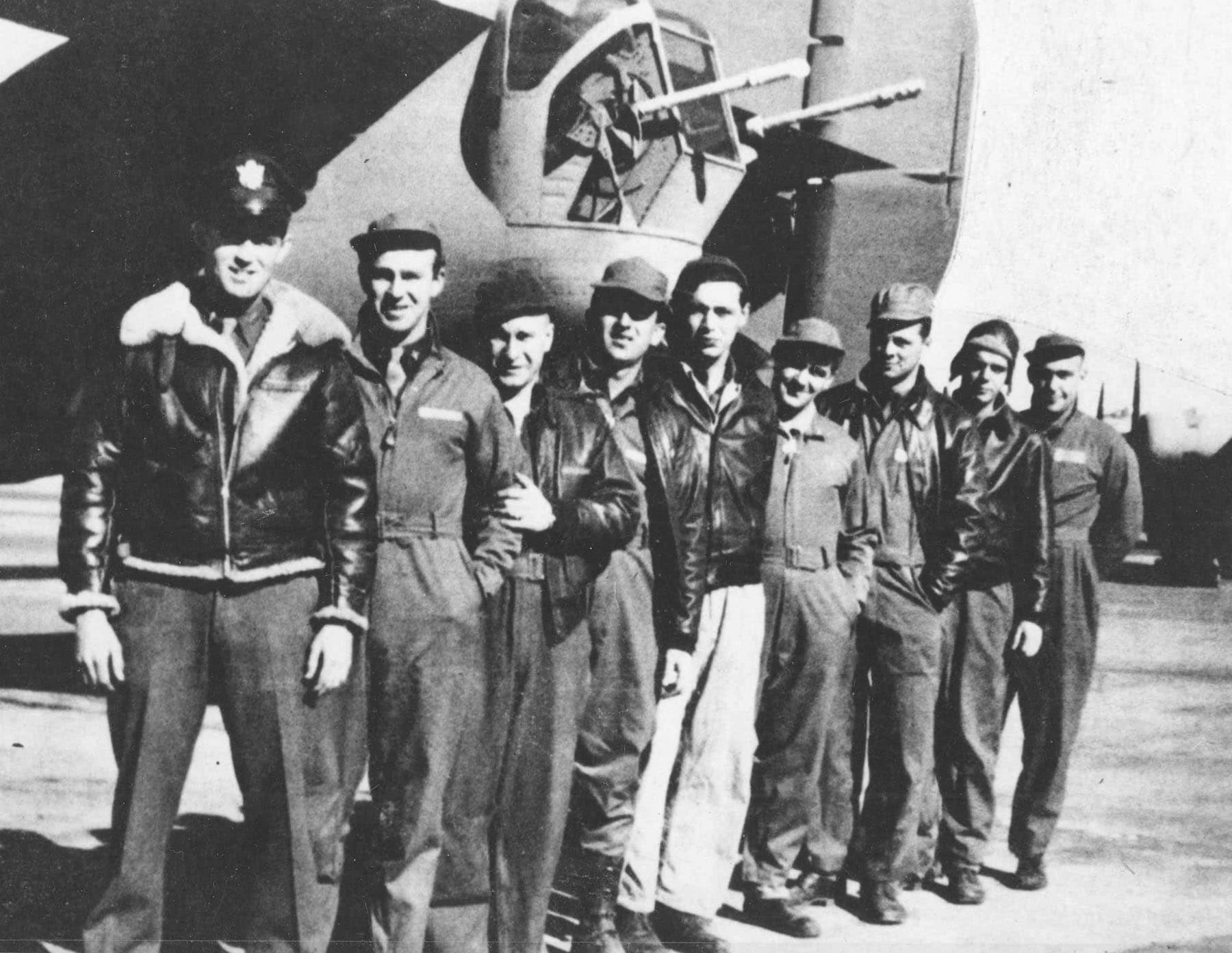
Cloud obscured the primary target. Two of the four B-24s went after their secondary; the other two — Lady Be Good among them — dumped their bombs into the Mediterranean to lighten the airframe for the return leg, turned south, and set course alone for Soluch.
At 00:12 on 5 April, Hatton came up on the radio with one transmission: his automatic direction finder was not working. He needed a fix back to base. The single-loop ADF at Benina airfield, just up the coast from Soluch, took a bearing of 330 degrees off the call and radioed back. What nobody on the ground or in the aircraft realised — and what would kill all nine men — is that the single-loop antenna at Benina could not tell the difference between a signal coming in from the Mediterranean and a signal coming in from the desert behind it. The bearing was a reciprocal. Lady Be Good had already overflown its base.
For the next two hours she flew south on the wrong half of the compass needle, deeper and deeper into empty Sahara, while the crew strained for the coastal flares they thought were just over the horizon. At about 02:00 the inboard engines coughed and quit. The crew bailed out in moonless dark over what they believed was the Mediterranean.
It was not the Mediterranean. They were four hundred miles inland.
The aircraft that landed itself
Empty of crew, the abandoned B-24 flew on. With the wings still loaded with fuel for a Mediterranean crossing that did not exist, and with the autopilot trimmed for cruise, she drifted in a long, shallow glide. Sixteen miles further south she made a controlled belly-landing onto the flat floor of the Calanscio Sand Sea, slid roughly a thousand feet across the surface, broke in half at the rear bomb bay, and stopped. Both engines on one wing were still windmilling when she came to rest.
The search-and-rescue effort that followed assumed she had ditched in the Mediterranean. Patrol craft worked the sea between Naples and Benghazi for days. They found nothing. Lady Be Good was logged “Missing in Action — presumed lost at sea.” The war moved on. Hatton’s parents received the telegram in Whitestone, New York. Toner’s diary, in his flight suit, lay where it had fallen on the desert.
February 1959 — a thermos of drinkable tea
The British oil-prospecting industry was only just beginning to push into Libya’s interior in the late 1950s. A British Petroleum geological survey marked the wreck on its 1958 charts. On 27 February 1959, BP oil surveyor Gordon Bowerman and geologists Donald Sheridan and John Martin reached the site overland from the BP camp at Maradah. They walked around the broken airframe in disbelief.
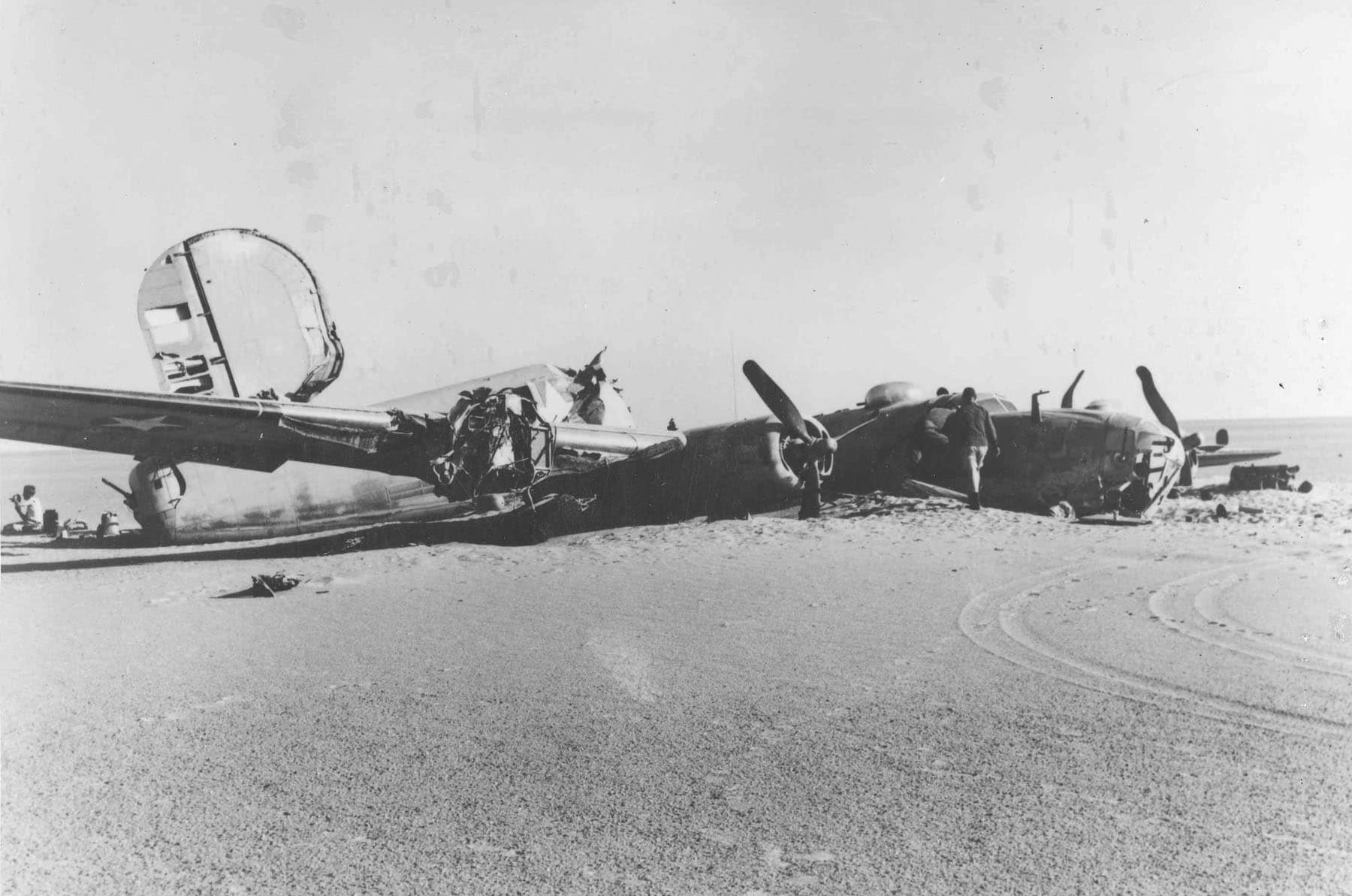
The aircraft was, considering its age and circumstances, immaculate. Both .50 calibre machine guns in the tail turret still cycled when tested. The aircraft radio still drew power. Inside the cockpit, sitting upright between the seats, was a steel thermos flask. When Sheridan opened it the tea inside, sixteen years old, was still drinkable. Tin rations in the cabin galley were intact. Aircrew gloves and goggles were laid neatly on the seats.
What was not there were people. No remains. No parachutes. Nothing on the surrounding sand for as far as the survey team could see. Lady Be Good had crashed herself, alone.
The eight days
When the US Air Force ground party from Wheelus Air Base arrived in May 1959, they began the search for the missing crew that would take the next fifteen months. In February 1960 the first five bodies were found 130 kilometres north of the crash site: 1Lt Hatton, 2Lt Toner, 2Lt Hays, TSgt LaMotte and SSgt Adams. Toner’s diary was still on him.
The diary, written in pencil in a small notebook, recorded eight days. The men had landed in the desert thinking they were over coastal Libya. They had located each other in the dark by firing their revolvers and signal flares into the air. They had a single half-canteen of water shared between eight men. They walked north because they thought the Mediterranean was close. For the first day they were chatty. By day three they were rationing the half-canteen in single drops.
On day five the three strongest men — SSgt Guy Shelley, TSgt Harold Ripslinger and SSgt Vernon Moore — left the rest of the group to walk faster for help. They walked north into the open dunes. By the time the US Air Force found them in May 1960, Shelley had covered 32 kilometres further. Ripslinger had walked 43 kilometres beyond Shelley. Moore was never officially found. (In 2001 a former British Army patrol member came forward to say he had buried unidentified human remains in the same area in 1953, photographed but uninvestigated. Forensic review of the photographs suggested the skull might have matched Moore’s. The remains have never been recovered.)
The bombardier, 2Lt John Woravka, was found in August 1960, near the original bail-out point. His parachute had not fully opened. He had died on the night of 4 April 1943, the same evening the others were still walking north.
The cursed parts
When the US Air Force eventually salvaged components from Lady Be Good for technical evaluation, they were quietly returned to the inventory and reused. The aircraft they went into did not have happy careers.
A C-54 transport fitted with several autosyn engine-instrument transmitters from Lady Be Good developed propeller trouble and only landed safely by throwing cargo overboard. A C-47 fitted with one of her radio receivers ditched in the Mediterranean. A US Army de Havilland Canada DHC-3 Otter fitted with an armrest from her cockpit crashed in the Gulf of Sidra with ten men aboard; nothing was recovered from the wreck except a small amount of debris washed ashore — including, according to the US Army Quartermaster Foundation, the armrest.
The Air Force does not officially endorse the curse. Among the airmen who flew with her parts, almost none of them ever felt entirely comfortable about it.
Where she is today
The recovered wreckage of Lady Be Good sat for decades at the edge of the original crash site. In August 1994 a team led by Dr Fadel Ali Mohamed transported the major components by road to the Libyan Air Force base at Tobruk for protection from desert souvenir hunters. The remains are now held at Gamal Abdul El Nasser Air Force Base.
The most important surviving artefacts — one of the four propellers, one Pratt & Whitney engine, the nosewheel, the crew’s personal effects, and the stained-glass memorial window originally installed in the chapel at Wheelus Air Base — are on permanent display at the National Museum of the United States Air Force in Dayton, Ohio. A second propeller stands outside the village hall in Lake Linden, Michigan, the hometown of radio operator TSgt Robert E. LaMotte.
The aircraft itself, for fifteen years before she was found, was the most successful unmanned long-distance flight in the history of the B-24 Liberator. She stayed airborne after her crew bailed out. She glided to a controlled landing. She kept her cargo of food, water, weapons and equipment intact across a stretch of Sahara that takes a modern Land Cruiser three days to cross. And she did all of it for the nine men who, in the dark at 02:00 over what they believed was the Mediterranean, jumped out of her into the wrong half of the wind.
Sources: National Museum of the United States Air Force; Ralph Barker, “The Lady Be Good,” in Great Mysteries of the Air (1966/1988); Dennis McClendon, Lady Be Good: Mystery Bomber of World War II (1962/1982); US Army Quartermaster Foundation; US National Archives.

 English
0 Comments