
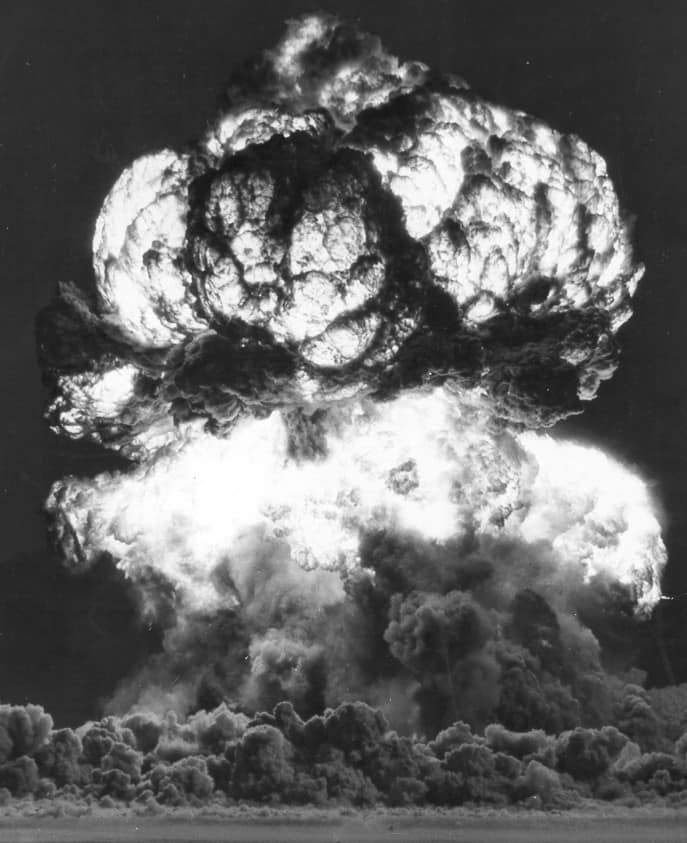
At Frenchman Flat in the Nevada desert, on the morning of 27 August 1957, the United States Atomic Energy Commission detonated a small nuclear device at the bottom of a 152-metre vertical shaft. They sealed the shaft with a four-inch-thick welded steel cap, weighing about 900 kg, partly to contain fallout, partly to find out what would happen if you welded a four-inch plate over a nuclear explosion.
What happened was a single high-speed-camera frame, six and a half kilometres per second, and a steel disc that has never been seen again. According to the physicist who designed the test, that disc is the fastest object ever launched from Earth — faster than any rocket, any space probe, any meteor escaping Earth’s gravity. It is also, almost certainly, no longer with us. But the question of where it went, and how fast it really went, has been argued about for the better part of seventy years.
Quick Facts
Test: Pascal-B, Operation Plumbbob
Location: Frenchman Flat, Nevada Test Site
Date: 27 August 1957, 11:35 PDT
Device yield: 300 tons TNT equivalent
Shaft depth: 152 m (500 ft)
Cap: ~900 kg steel plate, 4 in / 10 cm thick
Estimated launch velocity: ~66 km/s (~240,000 km/h) — ~6× Earth escape velocity
Pascal B and the man who designed it
Operation Plumbbob was the United States’ fifth full-scale series of atmospheric and underground nuclear tests at the Nevada Test Site. Between May and October 1957, scientists detonated twenty-nine nuclear devices in airbursts, balloon shots, tower shots and — for the first time — underground in vertical shafts. The first underground test of the series was Pascal-A, on 26 July 1957. The shaft was left open at the top. The fireball, the radiation and the shock wave all came shooting straight out of the borehole and produced one of the most spectacular plumes of the entire series. Robert Brownlee, the Los Alamos physicist responsible for the test, watched it from the control bunker and concluded that an open shaft was clearly not the way to do this.

For the next shot — Pascal-B, a 300-ton-yield device set 152 metres down a parallel vertical shaft — Brownlee designed an iron concrete plug and a four-inch-thick welded steel cap to be bolted across the borehole. The intent was to contain the fireball. The expectation, in Brownlee’s own words later, was that the cap would not survive.
It did not. When Pascal-B detonated, the explosion sent a shock wave straight up the shaft. The compressed air ahead of the shock front accelerated the steel cap upward at, by Brownlee’s calculations, several hundred thousand g’s over a fraction of a millisecond. A high-speed motion-picture camera positioned to film the borehole had been running at 160 frames per second. The cap was visible in exactly one frame. Then it was gone.
66 kilometres per second — and a frame of film
From that single frame, Brownlee calculated the cap’s velocity at roughly 66 kilometres per second — about 240,000 km/h. Earth’s escape velocity is 11.2 km/s. The cap was launched at almost six times the speed needed to leave Earth’s gravity. If it had survived its trip through the atmosphere, it would have departed the planet.
Did it actually leave Earth?
Almost certainly not. The cap accelerated through several hundred metres of atmosphere at six times escape velocity. The atmospheric heating at that speed and density — vastly greater than what any meteor experiences during a “regular” entry — would have vaporised the entire mass within a fraction of a second. The cap probably became plasma somewhere between Frenchman Flat and 30 kilometres altitude.
It is also worth noting that even if the cap had survived intact, it would not have been an “object in space” in the meaningful sense. A vertical trajectory launches an object that comes straight back down — minus its sideways orbital velocity, it cannot orbit anything. It could, theoretically, have escaped Earth’s gravity well on a hyperbolic trajectory if its speed sufficed (it did). But the atmospheric drag would have killed it long before it got there.
And yet — fastest manmade object?
Probably. Even modern hypersonic vehicles like Parker Solar Probe, currently NASA’s record-holder for highest spacecraft velocity, only reach about 192 km/s during its closest perihelion passes — and those are measured well after launch, after gravity assists. At the moment of launch, no human-built object has ever moved faster than the Pascal-B cap. By Brownlee’s calculation it was launched at roughly a third of Parker Solar Probe’s peak operational velocity, in a single millisecond, with no rocket motor.
The Pascal-B cap is, in 2026, a fixture of physics undergraduate problem sets, science-YouTube videos, and the kind of dinner-party trivia that turns into an argument about how fast escape velocity actually is. It is also, in a small but real sense, a piece of nuclear-test history that was never officially declassified by name until 1995. Brownlee’s account is now in the public record. The cap itself is not. Probably nobody ever will find it. It has, with reasonable scientific confidence, been gone for sixty-eight years.
Sources: Robert Brownlee, “Learning to contain underground nuclear explosions” (Los Alamos National Laboratory, 1995); Operation Plumbbob official report (US DOE); Carey Sublette, “The Nuclear Weapon Archive — Operation Plumbbob”; Institute of Physics, “The speedy steel plate.”
 English
0 Comments