
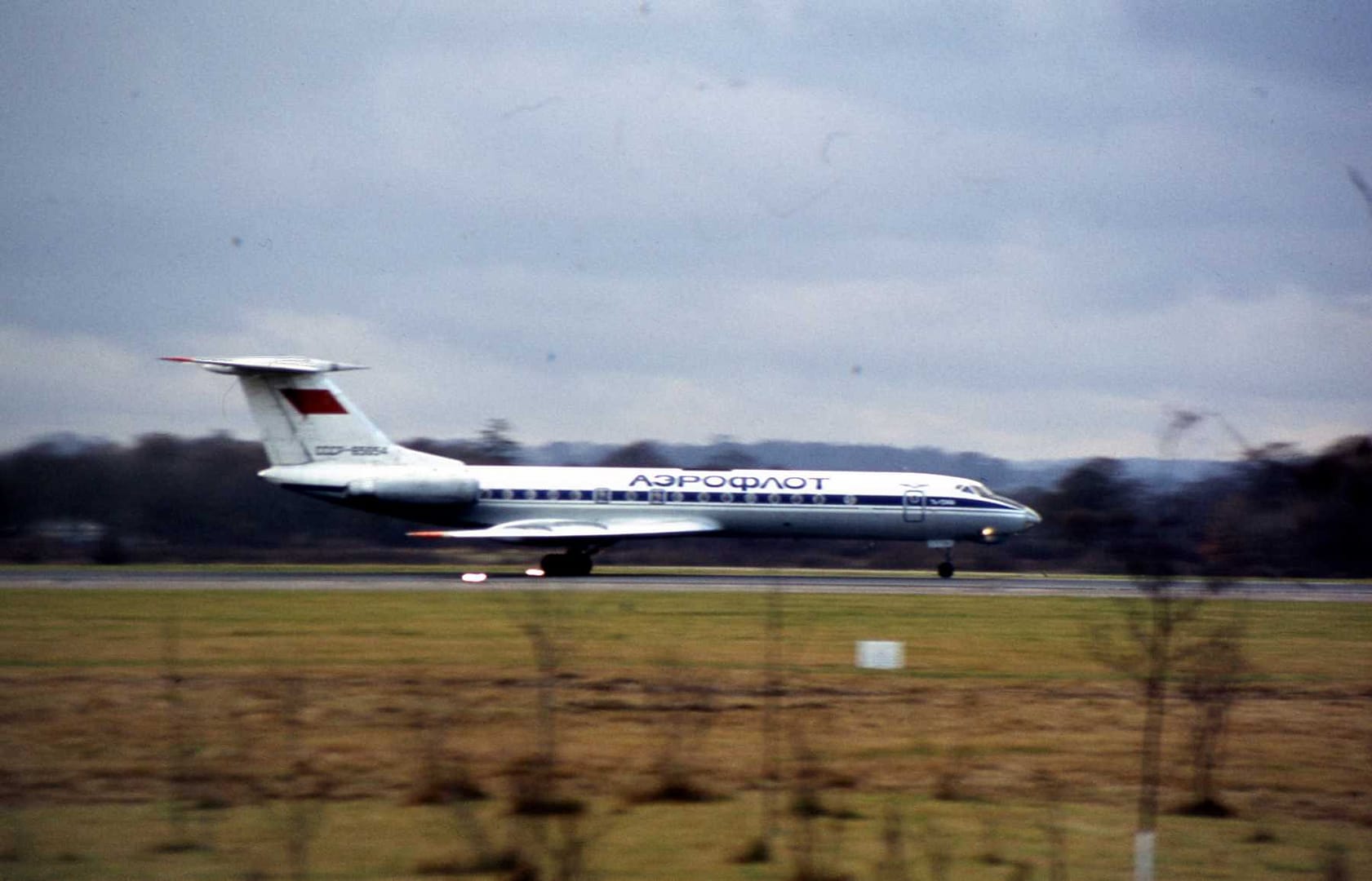
Outside Moscow on a clear day in late 1973, a Soviet-Italian film crew built a road. Not a real road for cars. A road-coloured runway, marked up with traffic paint, complete with painted Lada-grey lane lines and roadside signs in Cyrillic, all of it laid down across an unused stretch of asphalt at Sheremetyevo airport. Then they got the chief of Aeroflot training to land a Tupolev Tu-134 jetliner on it — at full landing speed, in a straight line, with the chairman of the production company strapped into the cockpit jumpseat for verification.
The scene appears in the 1974 film “Невероятные приключения итальянцев в России” — “Unbelievable Adventures of Italians in Russia” — directed by Eldar Ryazanov and Franco Prosperi. It plays as a chase gag, with the jetliner improbably descending onto a crowded motorway. Nothing in the scene is CGI. Nothing is rear-projected. The jet is a real Tu-134. The road is a real, full-length, jet-rated runway disguised by the Soviet Ministry of Civil Aviation’s set-design department to look like the M-1 highway. And every “civilian” car on it is being driven by an Aeroflot test pilot who has spent the morning being briefed on exactly how not to get hit by a 50-tonne airliner.
Quick Facts
Film: “Unbelievable Adventures of Italians in Russia” (1974)
Directors: Eldar Ryazanov (USSR) / Franco Prosperi (Italy)
Aircraft: Aeroflot Tupolev Tu-134, twin-jet airliner
Location: Sheremetyevo International Airport, Moscow
“Road”: Unused taxiway disguised with paint and props as a public motorway
“Drivers”: Active Aeroflot pilots
Soviet box office (1974): 49.2 million tickets sold
A Soviet-Italian comedy in the deep Cold War
By 1973 the Soviet Union and Italy had concluded a decade of cinematic co-productions that, by Politburo standards, qualified as warm. The Italian film industry — strong, leftward-leaning, hungry for the Russian market — kept making joint films with Mosfilm. Eldar Ryazanov, then 44 and already one of the most successful comedy directors in Soviet cinema, was paired with Franco Prosperi to make a slapstick chase comedy in which a group of Italian fortune-hunters search for hidden Tsarist gold across Leningrad and Moscow.

The script called for a jet landing on a highway. The Italian side wanted to use a model. The Soviet side, in the person of Mosfilm’s chief production designer, suggested that they simply ask Aeroflot. Permission for a real jet to perform the stunt came back from the Soviet Ministry of Civil Aviation within two weeks. The Ministry’s reasoning, recorded in production correspondence later released in the 1990s, was that the alternative — a model shot — would look fake, and the international audience for the film would notice. A real Tu-134 was found.
How they actually built the shot
The location was an unused parallel taxiway at Sheremetyevo, roughly 2,500 metres long and capable of handling Tu-134-class loads. Mosfilm’s set department painted the taxiway centreline and edges in the colours of the M-1 highway, added painted lane markings, dressed the verges with prop bushes and Soviet roadside billboards, and built a guard-rail-style central reservation. From the air at low altitude the result looked like a normal stretch of two-lane Soviet highway.
The “civilian” traffic was provided by the Aeroflot flight test centre. Twelve cars — a mix of Volgas, Moskvitches and Zhigulis — were driven by serving Aeroflot pilots and flight engineers who were briefed on the exact lateral spacing the Tu-134 needed to clear them on touchdown. Several of those drivers were Tu-134 type-rated themselves and understood the wingspan, landing-gear track and ground-effect characteristics of the aircraft from the cockpit. They could see, in their rearview mirrors, exactly where the jet would be and what they had to do to stay out of its path.
The shot the Italians could not believe
The shot is cut into the film as a single approach, touchdown and rollout. From the air the road looks completely ordinary. The aircraft passes over a Soviet woman pushing a perambulator. The aircraft passes between two Ladas. The aircraft touches down between the painted lane markings and rolls past the camera with its thrust reversers fully deployed, kicking up dust and propsetting.
The Italian crew, who had not been told in advance that the road was actually a runway, are visibly stunned in the dailies. Footage from a behind-the-scenes documentary released in 2014 shows Franco Prosperi shouting “ma è vera?” — “but it’s real?” — repeatedly as the Tu-134 rolled past him. The Italians had assumed the Soviets would build a model. The Soviets had assumed the Italians knew they were going to use the real aircraft. Neither side had been quite right.
The film, the aircraft, the legacy
The film opened in the Soviet Union in March 1974 and sold 49.2 million tickets in its first year — making it the third-highest-grossing film of 1974 in Soviet box office. It was released in Italy as “Una matta, matta corsa in Russia” with very modest box office, though it remains a cult favourite in both countries. The Tu-134 highway-landing sequence is, in 2026, one of the most-watched pieces of Soviet film footage on YouTube.
The aircraft itself stayed in Aeroflot service through the 1980s and was eventually scrapped at Tashkent in the early 1990s. The taxiway it landed on still exists at Sheremetyevo and is still in use, though the road dressing has long since been removed. Aleksey Borisov, the pilot, retired from Aeroflot in 1987.
What Ryazanov and Prosperi produced is, in essence, one of the most spectacular practical stunts in aviation cinema history. No green screen. No miniatures. No process plates. A real 50-tonne twin-jet airliner landed on a real Soviet runway disguised as a Soviet highway, with real Aeroflot pilots driving Soviet cars across its path. In 1974 it cost the Soviet Ministry of Civil Aviation absolutely nothing — they were going to be doing landing-current proficiency training that week anyway. Borisov simply did it in front of a Mosfilm camera with his wife and a Mosfilm grip in the back seat.
Sources: Eldar Ryazanov memoir “Невероятная жизнь Эльдара Рязанова” (Moscow, 1995); Mosfilm production archive; Russian Civil Aviation historical records; SovietMoviesOnline.


 English
0 Comments