
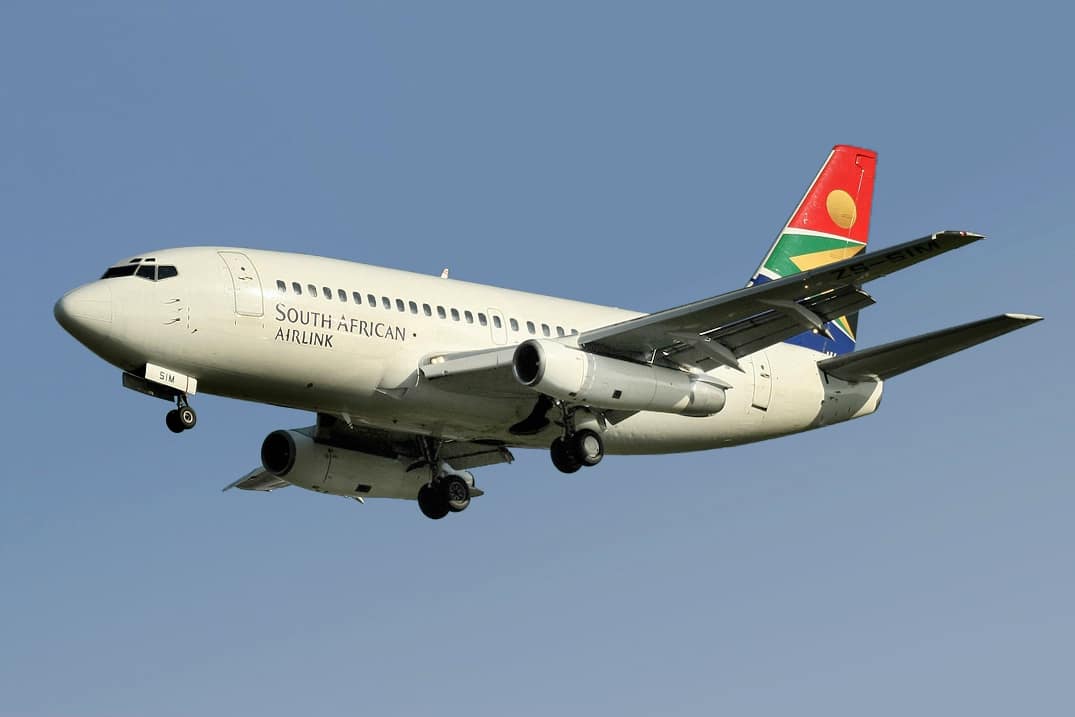
On the back of an early Boeing 737-200's Pratt & Whitney JT8D engine, just behind the exhaust plug, are two big curved aluminium-honeycomb panels. In normal flight they wrap around the rear of the engine and look like the back end of the nacelle itself. On landing, the pilot's left hand pulls the thrust-reverser levers, the panels rotate upward and downward at the same time — and the entire exhaust jet of a 14,000-pound-thrust turbofan is suddenly redirected forward, blowing a thirty-metre rooster-tail of vapour off either side of the aircraft.
This is the clamshell, or "bucket," thrust reverser. Boeing inherited the original clamshell design from the 727 in 1967 — and after it proved largely ineffective, Boeing and Rohr redesigned it by 1969 into the hydraulically powered target reverser, mounted on a 48-inch tailpipe extension, that the type carries today. This kind of reverser has not been used on any new Boeing aircraft since the last 737-200 was built in 1988. And yet, on every 737-200 still flying somewhere in Africa, Latin America, or northern Canada in 2026, the system is still essentially identical to that 1969 redesign.
Quick Facts
Aircraft: Boeing 737-100, 737-200, 737-200 Advanced
Engine: Pratt & Whitney JT8D-9, -15, -17 turbofan
Reverser type: Target (bucket) — hydraulically actuated; original pneumatic clamshell system replaced in 1969
Origin: Boeing 727 clamshell, 1963; redesigned by Boeing/Rohr, 1969
Replaced by: Cascade-style fan reversers on 737-300/-400/-500 (CFM56-3) and later
Last 737-200 produced: 1988 (Xiamen Airlines)
Still in service 2026: ~40 airframes (Nolinor, Air Inuit, Buffalo Airways and others)
How a clamshell reverser works
The principle is mechanically elegant and visually unmistakable. Each JT8D engine has two curved deflector doors — an upper and a lower clamshell — installed at the very rear of the engine nacelle. In their stowed position they form the aerodynamic tail-cone of the engine itself, so smoothly faired that most passengers never notice they are there.
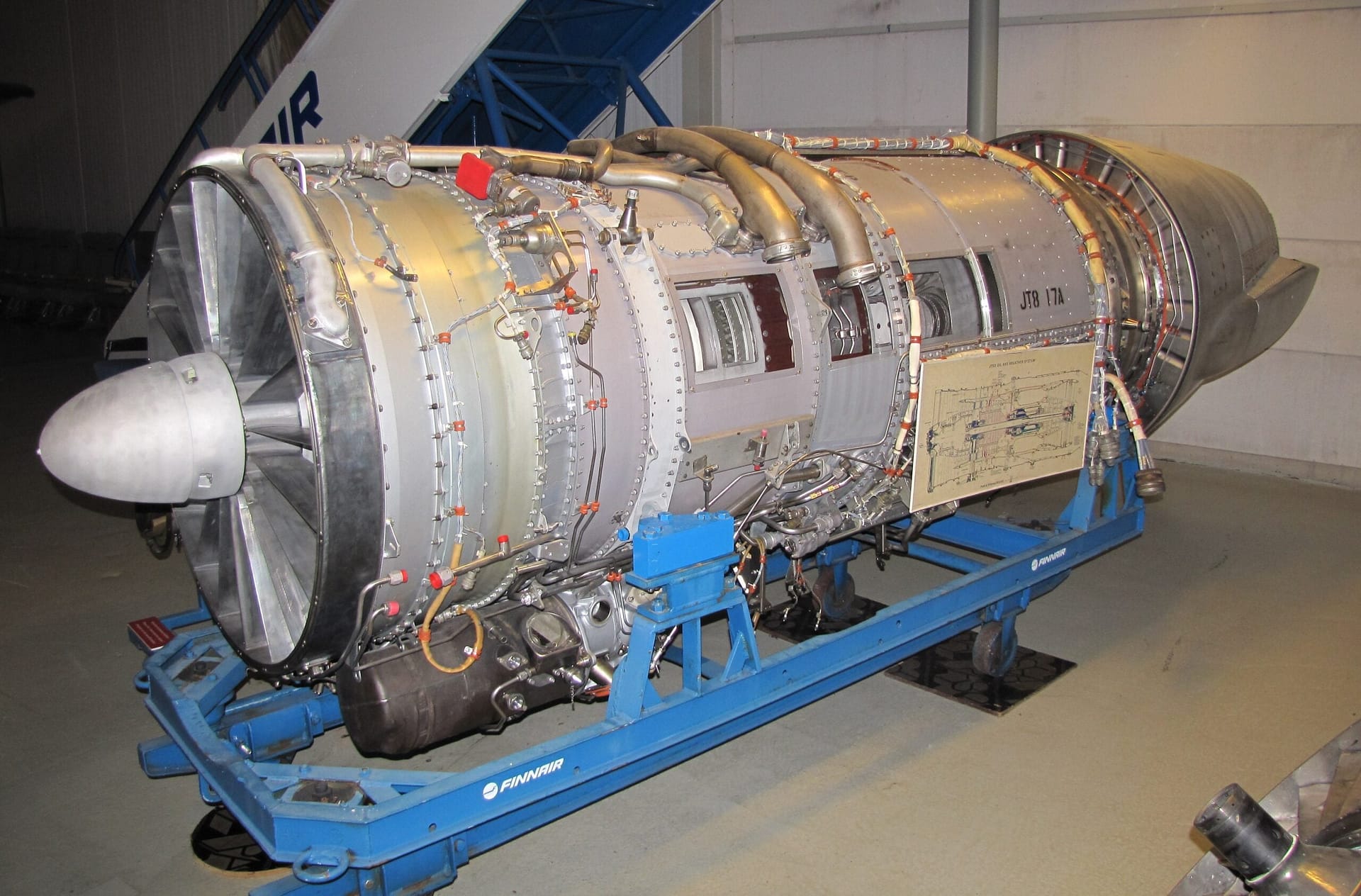
When the pilot pulls the reverser levers (mounted on the back of the throttle levers in the 737-200 cockpit), hydraulic pressure drives an actuator on each door. The two doors rotate simultaneously — the upper door hinges downward, the lower door hinges upward — and they close together to form a wall behind the engine. The exhaust gas, which can no longer escape rearward, is forced through the two side openings the deployed clamshells create. Those openings are angled forward.
The result, on the runway, is a hugely visible blast of exhaust gas vented forward and outward from each engine — and a corresponding deceleration force on the aircraft itself, which is now being braked by its own thrust as well as by the wheel brakes. On a wet runway the forward-vented exhaust kicks up a curtain of spray that is one of the most photographed sights in 1970s aviation.
The geometry problem
The clamshell only worked on the early 737s because the JT8D was a slim, low-bypass-ratio turbofan. The whole engine was only 1.04 metres in diameter at the cowling. The 737's low-slung mounting put the engine almost in physical contact with the ground at full strut compression — clearance under the engine at touchdown was well under a metre. A reverser that pivoted out into that narrow gap was just possible. A larger-diameter modern engine simply could not have done it.
Why the design got replaced
The first 737 generation — the -100 and -200 — was built around the JT8D from the start. Boeing's own engineering data, however, said the clamshell was a sub-optimal solution. The 727's tail-mounted JT8Ds had the same reversers and the same problem: at full reverse thrust, a large share of the engine's exhaust energy was never redirected forward at all, escaping at an angle close to 90 degrees and contributing almost nothing to deceleration. Boeing's wind-tunnel data showed that a "target" reverser — a single rotating deflector positioned downstream of the exhaust plug — was significantly more effective at low engine pressure ratios — which is exactly the fix the 737 received in 1969.
When Boeing redesigned the 737 around the CFM56-3 high-bypass turbofan in the early 1980s, the engine was simply too large to use a clamshell at all. The CFM56-3 has a 1.52-metre (60-inch) fan diameter — roughly one and a half times the JT8D's intake. There was not enough vertical clearance under the wing for a clamshell to pivot. The -300, -400 and -500 instead used cascade-style fan reversers: sliding sleeves on the outer engine cowling that, when deployed, exposed vents in the casing through which the high-volume fan airflow was redirected forward. Almost every modern airliner uses the same architecture today.
The 30 aircraft still flying
The 737-200 should, by every economic measure, be extinct. Its JT8D engines burn roughly 20 per cent more fuel per seat-mile than a CFM56-7B-powered 737-800 of equivalent size. Its noise signature is far higher than any modern airliner. And spare-part inventories for the airframe peaked around 2005 and have been shrinking ever since.
And yet, roughly forty 737-200s are still in regular service in 2026, about a dozen of them in Canada. Nolinor Aviation operates a fleet of eight in Quebec — the largest 737-200 fleet in the world. Air Inuit, also Quebec-based, flies the type for cargo and passenger service to remote settlements, as do Buffalo Airways and Glencore Canada. (Canadian North, long the other big Arctic operator, retired its last gravel-kitted 737-200 in May 2023.) A handful of operators in Africa and Latin America keep small fleets running. The reason is almost always the same: the 737-200 can land on gravel strips and short unpaved runways that no modern airliner can touch. The clamshell reverser, with its forward-blasting exhaust visible from kilometres away, kicks up vast curtains of gravel as the aircraft slows.
It is one of those design choices that has outlived its own logic. The clamshell was the cheap answer in 1963. It became the standard answer for two decades. It was replaced in 1984. And it is now, in 2026, the principal reason a fifty-year-old Boeing airliner can still earn revenue on routes where no younger Boeing can fly. The geometry that constrained the 737-200's reverser at its launch is also the geometry that lets it keep operating somewhere a CFM56-powered aircraft can never go: a short gravel strip in Inukjuak, with an engine slung so low that a deployed clamshell is almost in contact with the surface itself.
Sources: Thrust reversal Wikipedia entry; Federal Aviation Administration "Lessons Learned" Boeing 737-275 case study; b737.org.uk Powerplant page.
Related Questions
What is a thrust reverser on a jet?
A thrust reverser redirects a jet engine's exhaust forward after landing to help slow the aircraft. The Boeing 737-200 used a target, or bucket-style, reverser — clamshell doors that swing into the exhaust — a 1960s design still flying on the type in 2026.
Why are some Boeing 737-200s still flying in 2026?
A handful of rugged 737-200s — around 40 airframes — remain in service in 2026 with operators like Nolinor, valued for their ability to use gravel and remote runways. They still use the original bucket-style thrust reverser design dating back to the late 1960s.
How does a bucket thrust reverser work?
A bucket, or target, reverser uses hydraulically driven clamshell doors that close behind the engine after landing, blocking the jet exhaust and deflecting it forward. That forward thrust pushes against the aircraft's motion, helping it slow on the runway.
When was the 737-200's thrust reverser designed?
Its target-style reverser traces back to the Boeing 727's 1963 clamshell design, redesigned by Boeing and Rohr in 1969. Later 737 Classics switched to cascade-style reversers, but the older bucket design lives on in the surviving 737-200 fleet.
When was the last Boeing 737-200 built?
The final 737-200 rolled out in 1988, delivered to Xiamen Airlines. Decades later, around 40 remain in service, prized for short, rough and gravel airstrips that newer jets can't easily use.
0 Comments