
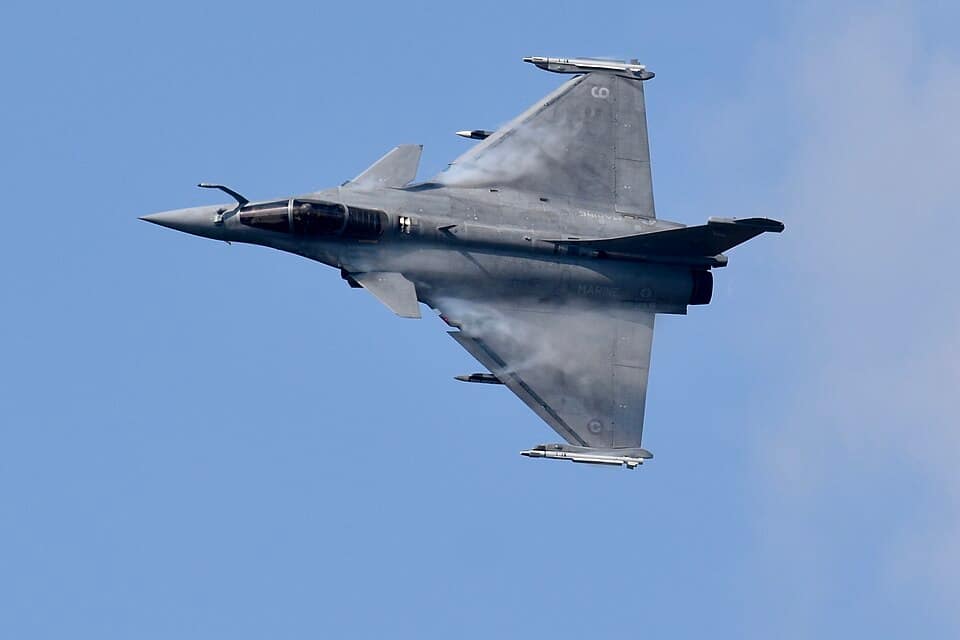
Somewhere at a Dassault Aviation facility in southern France, Indonesian Air Force pilots are learning to fly one of Europe’s most capable fighters. The training has been underway since 2025, and a second phase of domestic instruction is now running in parallel back in Indonesia. When it is done, Indonesia will become the first Southeast Asian nation to operate the Rafale — and Dassault will have added another flag to a growing list of export customers that includes India, Egypt, Qatar, Greece, the UAE, and Croatia.
The deal, signed in 2022 and valued at approximately €8.1 billion for 42 aircraft, represents Indonesia’s most ambitious fighter procurement in decades. The country’s existing fleet — ageing F-16A/B Block 15s and Russian Su-27/30 variants — is showing its years. The Rafale replaces them with a jet that can do everything: air superiority, precision strike, maritime attack, nuclear delivery, and reconnaissance, all from a single airframe with a single crew type.
For Dassault, Indonesia is more than a sale. It is a foothold in the Indo-Pacific arms market that could unlock further deals across ASEAN. For Indonesia, the Rafale is a statement: Jakarta is a serious military power with serious equipment, and it no longer depends on Moscow for its frontline fighters.
Quick Facts
- Deal: 42 Dassault Rafale fighters for Indonesia, ~€8.1 billion
- Training: Indonesian AF pilots training in France since 2025; domestic phase underway
- Significance: First Southeast Asian Rafale operator
- Replaces: Ageing F-16A/B Block 15s and Russian Su-27SK/Su-30MK2 fleet
- Other Rafale operators: France, India, Egypt, Qatar, Greece, UAE, Croatia
- Deliveries expected: First aircraft to arrive in Indonesia by 2027-2028
From Flankers to Rafales
Indonesia’s fighter fleet tells the story of post-Cold War non-alignment. Jakarta bought American F-16s in the 1980s, then turned to Russia for Su-27SKs and Su-30MK2s when Washington imposed human-rights-related arms embargoes in the late 1990s. The result is a maintenance nightmare — two entirely different supply chains, two sets of spare parts, two pilot training pipelines, and two sets of weapons that cannot be shared between platforms.
The Rafale solves this by replacing both legacy types with a single Western platform. The transition away from Russian equipment is particularly significant. Spare parts for the Sukhois have become increasingly difficult to source since 2022, and Indonesia has no interest in the geopolitical complications that come with depending on Moscow for military hardware during a European war.
Dassault’s Export Machine
The Rafale spent its first two decades as a commercial disappointment — technically brilliant, diplomatically cursed, unable to win a single export order until India broke the drought in 2016. Since then, the export list has exploded. Egypt, Qatar, Greece, Croatia, the UAE, and now Indonesia. Serbia may follow. Saudi Arabia is evaluating.
What changed was partly price (Dassault became more competitive), partly geopolitics (European states wanted alternatives to the F-35), and partly performance. The Rafale’s combat debut in Libya, Mali, Iraq, and Syria demonstrated that the jet could do what Dassault promised. India’s deployment of Rafales along the Chinese border, and their reported performance in the 2025 India-Pakistan skirmish, added combat credibility that no brochure can match.
The Indo-Pacific Stakes
Indonesia’s Rafale acquisition does not happen in a vacuum. The South China Sea remains one of the world’s most contested waterways, and Indonesia’s Natuna Islands sit directly on the edge of China’s Nine-Dash Line claim. A Rafale armed with Exocet anti-ship missiles or SCALP cruise missiles gives Jakarta a long-range maritime strike capability it has never had before.
The training in France is the first step. The pilots learning the aircraft now will become the instructors who build an entire Rafale squadron culture from scratch. By the time the first jets arrive in Indonesia, these pilots will have hundreds of hours on type — and Dassault will have proven, once again, that the Rafale’s second act is far more successful than its first.
Sources: Saab/Dassault press releases, Defense News, Air & Space Forces Magazine, Indonesian Ministry of Defence

 English
0 Comments