

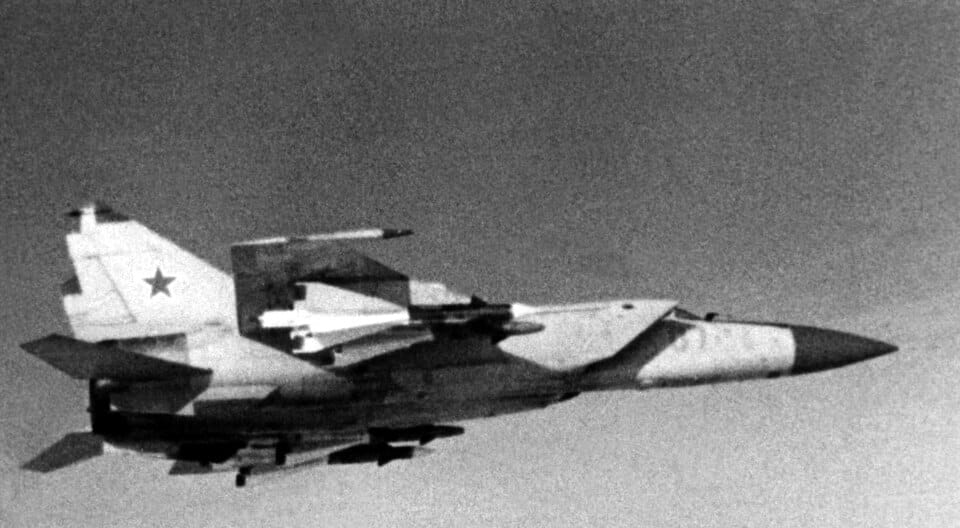
Most aviation enthusiasts know the story of Viktor Belenko’s dramatic defection — how on September 6, 1976, a 29-year-old Soviet lieutenant flew his MiG-25 Foxbat to Hakodate Airport in Japan, delivering the West its first close look at the aircraft that had terrified NATO planners for a decade. We’ve covered the defection itself and the panic the MiG-25 caused before. But what happened after Belenko stepped out of his cockpit is a story just as remarkable — and far less often told.
The Intelligence Bonanza
George H. W. Bush, then Director of Central Intelligence, called Belenko’s arrival an “intelligence bonanza.” He wasn’t exaggerating. For years, Western intelligence agencies had operated on dangerously wrong assumptions about the MiG-25. Satellite photographs and fragmentary intelligence had led analysts to believe the Foxbat was a highly maneuverable air superiority fighter — a plane that could outperform anything in NATO’s arsenal.
Belenko’s defection demolished that assessment in a matter of days. The MiG-25, he explained, was an interceptor, not a dogfighter. Its enormous speed — Mach 2.83 in operational use, with a theoretical maximum even higher — came at the cost of maneuverability. The airframe was built largely of nickel steel rather than titanium, making it heavy. The avionics relied on vacuum tubes rather than solid-state electronics, a choice the Soviets made deliberately for resistance to electromagnetic pulse but which Western analysts initially interpreted as technological backwardness.
But Belenko offered far more than a single aircraft. During five months of intensive CIA debriefings, he provided a comprehensive picture of Soviet Air Force culture, training methods, morale problems, and operational procedures. He revealed that pilot training was shockingly limited by Western standards, that spare parts shortages plagued operational units, and that his own base at Chuguyevka in Primorsky Krai was in severe disrepair. These human intelligence insights proved arguably more valuable than the technical data from the aircraft itself.
Becoming Viktor Schmidt
President Gerald Ford granted Belenko political asylum, and a trust fund was established to support him. But the Soviet Union did not take the defection lightly. Moscow spread a string of disinformation stories: Belenko had been killed in a car accident, Belenko had secretly returned to Russia, Belenko had been arrested and executed. The KGB had a long memory, and Belenko knew it.
He took the surname Schmidt and disappeared into small-town America. He moved frequently, mostly settling in Midwestern communities far from the media spotlight. He married Coral Garaas, a music teacher from North Dakota, and they had two sons before eventually divorcing. He worked as a consultant to aerospace companies and government agencies, drawing on his intimate knowledge of Soviet aviation doctrine.
Quick Facts
- Defection date,September 6, 1976
- Aircraft,MiG-25P Foxbat (Red 31)
- Landing site,Hakodate Airport, Hokkaido, Japan
- US citizenship,Granted by private act of Congress, signed October 14, 1980
- American alias,Viktor Schmidt
- Autobiography,MiG Pilot: The Final Escape of Lieutenant Belenko (1980)
- Death,September 24, 2023, Red Bud, Illinois (age 76)
A Life in the Shadows
Belenko almost never gave interviews during his decades in America. In a rare and informal conversation at the EAA AirVenture show in Oshkosh around 2000, he offered one of his few public reflections on his adopted country. Americans, he said, had something he had never experienced in the Soviet Union: tolerance. “They have tolerance regarding other people’s opinion,” he remarked. “In certain cultures, if you do not accept the mainstream, you would be booted out or might disappear. Here we have people — you know, who hug trees, and people who want to cut them down — and they live side by side!”
In 1980, Congress passed a private law — S. 2961 — granting Belenko U.S. citizenship, signed by President Jimmy Carter. It was one of the rarest forms of legislation: a law passed for a single individual. The same year, he co-authored his autobiography, MiG Pilot: The Final Escape of Lieutenant Belenko, with Reader’s Digest writer John Barron. The book became a bestseller and remains the definitive first-person account of a Cold War defection.
The MiG-25’s Journey Home
Meanwhile, the aircraft Belenko had delivered sat in pieces at Hyakuri Air Base, where American and Japanese experts had stripped it down to the last rivet. The Japanese government billed the Soviet Union $40,000 for crating services and runway damage at Hakodate. The Soviets, outraged, demanded to send their own Antonov An-22 transport to collect the aircraft. Japan refused. Eventually Moscow submitted, and on November 15, 1976, the MiG-25 — in 30 crates — sailed from the port of Hitachi aboard the Soviet cargo ship Taigonos. Soviet technicians who inspected the crates found 20 parts missing. They attempted to bill Japan $10 million. Neither country’s bill was ever paid.
A senior diplomat described the Soviet position as “sulky about the whole affair.”
The End of a Quiet American Life
Viktor Belenko feared for his safety until the day he died. On September 24, 2023, he passed away in a nursing home in the small town of Red Bud, Illinois, at the age of 76. There was no memorial service. His death went unreported for two months — journalists only learned of it in late November, when one of his sons confirmed that his father had died after a short illness.
It was a fittingly quiet end for a man who had spent nearly half a century trying to be invisible. Belenko’s nine minutes over the Sea of Japan in September 1976 changed the Cold War’s balance of power. The 47 years that followed were spent ensuring that the Cold War wouldn’t claim one more life — his own.


 English
0 Comments