
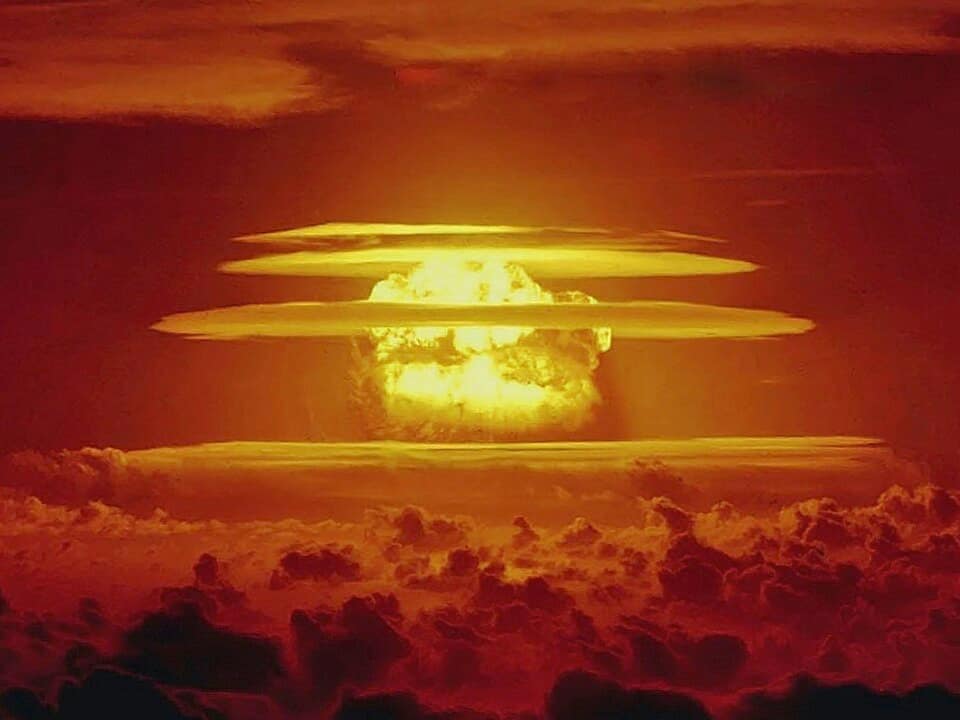
On November 1, 1952, the world’s first hydrogen bomb vaporized the island of Elugelab in the Marshall Islands. The explosion — designated Ivy Mike — produced a fireball three miles wide and a mushroom cloud that punched into the stratosphere. And while most sane people would have been heading in the opposite direction at maximum speed, four F-84G Thunderjet pilots were doing exactly the opposite. Their mission was to fly directly into the radioactive cloud and bring back samples.
The Accidental Pioneer
The story of deliberate nuclear cloud penetration begins with an accident — or at least something that was officially described as one. On May 15, 1948, Lieutenant Colonel Paul H. Fackler was piloting a WB-29 weather reconnaissance aircraft during the Zebra shot at Enewetak Atoll. His job was to track the mushroom cloud from at least ten miles away, using special filters to catch radioactive debris drifting downwind.
Instead, Fackler flew directly into the cloud. Whether this was deliberate or genuinely accidental, nobody ever determined for certain. What mattered was the result. “No one keeled over dead, and no one got sick,” Fackler reported. The experience proved that a manned aircraft could penetrate an atomic cloud and survive — and that the samples collected by a pilot who could see what he was doing and adjust his flight path in real time were vastly superior to anything recovered by remote-controlled drones.
Fackler had opened a door that would not be closed for fifteen years.
Red Flight Into the Hydrogen Age
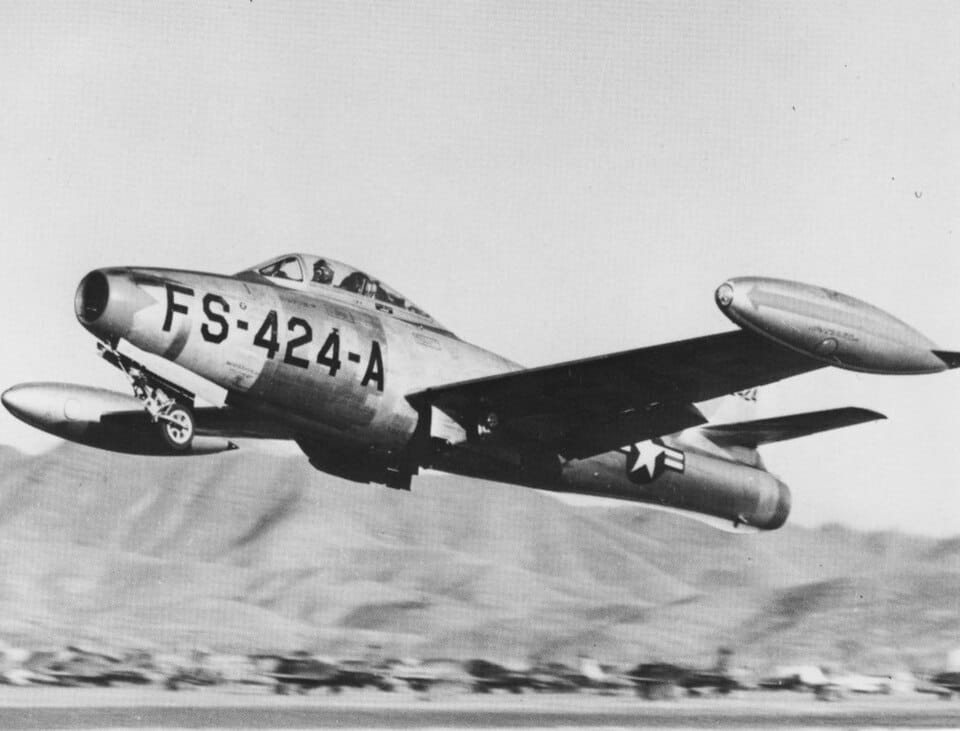
By the time of Operation Ivy in 1952, cloud sampling had evolved from Fackler’s improvised solo into a structured military operation using jet fighters. The F-84G Thunderjet was chosen for the mission: fast enough to minimize time in the radioactive environment, maneuverable enough to navigate the violent turbulence inside a nuclear cloud, and adaptable enough to carry sample collection equipment on its wingtips in place of external fuel tanks.
Red Flight, led by Lieutenant Colonel Virgil Meroney, consisted of four F-84Gs. Their target was the mushroom cloud from Ivy Mike — the first thermonuclear device ever detonated, with a yield of 10.4 megatons, nearly a thousand times more powerful than the Hiroshima bomb.
Meroney and his wingman penetrated the cloud’s stem at approximately 40,000 feet, about ninety minutes after detonation. Inside, the world turned a dull, glowing red — the color of nitrogen dioxide and iron oxides created by the nuclear reactions. Every radiation instrument in Meroney’s cockpit pegged to its maximum reading. After five minutes in the cloud, he and his wingman executed a 90-degree turn and escaped.
Quick Facts
- First cloud penetration,May 15, 1948 (Lt. Col. Paul Fackler, WB-29)
- First H-bomb sampling,November 1, 1952 (Ivy Mike, Red Flight)
- Red Flight leader,Lt. Col. Virgil Meroney
- First fatality,Captain Jimmy Robinson, Ivy Mike sampling, 1952
- Dedicated unit,4926th Test Squadron (Sampling), est. April 1, 1953
- Primary aircraft,F-84G Thunderjet, Martin B-57 Canberra
- Radiation limit,3.9 roentgens per 3 months (frequently exceeded)
- Program ended,1963 (Limited Test Ban Treaty)
The Death of Captain Robinson
Red 3 and Red 4 followed Meroney into the cloud. Captain Bob Hagan flew Red 3. His wingman, Captain Jimmy Robinson, flew Red 4. Inside the cloud, Robinson became disoriented. His autopilot disengaged, the F-84 stalled, and he lost control, tumbling thousands of feet before recovering at 20,000 feet.
Both pilots were now dangerously low on fuel. The F-84Gs could not carry wingtip fuel tanks — that space was occupied by sample collection filters — and the extended time at lower altitude had burned through their reserves. Hagan managed to reach Enewetak and landed with his fuel gauge reading empty. His right tire blew out on the hard landing.
Robinson was not so fortunate. His engine flamed out at 13,000 feet. He jettisoned his canopy but apparently decided to try for a water landing rather than bail out — the sampling pilots wore lead-lined vests that would have made survival in the water extremely difficult. His F-84 hit the ocean, skipped across the surface, struck a wave, and flipped. A rescue helicopter hovering overhead watched the jet sink rapidly. Robinson’s body was never recovered. He was 28 years old.
It was not until 2002 — fifty years after his death — that Captain Jimmy Priestly Robinson received a memorial stone at Arlington National Cemetery.
The 4926th Test Squadron
Fackler’s persistent lobbying paid off on April 1, 1953, when the Air Force established the 4926th Test Squadron (Sampling) as a dedicated unit for nuclear cloud penetration. The squadron would fly missions through every American atmospheric nuclear test for the next decade, transitioning from F-84s to Martin B-57 Canberras — twin-engine jet bombers that could reach 60,000 feet, essential for sampling the ever-larger clouds produced by hydrogen bombs.
The mission profile was simple in concept and terrifying in execution. After detonation, the sampling aircraft would be vectored toward the mushroom cloud by a control aircraft circling at a safe distance. The pilot would depressurize the cabin — the crew breathed pure oxygen to avoid inhaling radioactive particles — and fly directly into the cloud. Inside, they navigated by instruments alone through violent turbulence and an eerie red glow, collecting debris on filters mounted on the aircraft’s exterior.
After exiting, the entire aircraft was contaminated. Pilots could not touch the exterior of their planes. Ground crews in decontamination suits would approach with forklifts, raising platforms to cockpit level so the crews could step out without touching the radioactive skin of the aircraft. Pilots stripped immediately and showered repeatedly until Geiger counters stopped clicking.
The Radiation Question
Throughout the program, the question of how much radiation was too much remained bitterly contested. The Atomic Energy Commission set limits — initially 3.9 roentgens over three months — but the Air Force routinely pushed to relax them. The official history of the sampling program acknowledged the tension with remarkable candor, noting “outright rebellion by Air Force operational leaders” who argued that safety measures were excessive.
The sampling crews absorbed more radiation than anyone else in the testing program. They were irradiated during the cloud penetration itself, then continued to absorb radiation all the way home, sitting in a cockpit coated with radioactive debris. Aircraft could never be fully decontaminated — engine interiors were impossible to reach — and the relentless testing schedule meant planes were often returned to service before residual radiation had fully decayed.
As one pilot told journalist Carole Gallagher: “They should have been burned along with our clothes.”
The End of the Cloud Runners
The Limited Test Ban Treaty of 1963, which prohibited atmospheric nuclear testing, ended the sampling missions. The 4926th Test Squadron was absorbed into the Air Force Military Air Transport Service. The men who had flown into mushroom clouds went on with their lives, many never speaking publicly about what they had done.
As the Smithsonian’s Air & Space Magazine noted, quoting journalist Eileen Welsome: “Perhaps no humans got closer to the exploding heart of a nuclear weapon than the sampler pilots.” They did it not out of recklessness but because the physics of nuclear weapons design required direct analysis of the debris produced by each detonation — and in the 1950s, the only way to collect that debris was to send a man to fly through the cloud and bring it back. It was, by any measure, one of the most dangerous sustained flying assignments in the history of military aviation.
 English
0 Comments