
QUICK FACTS
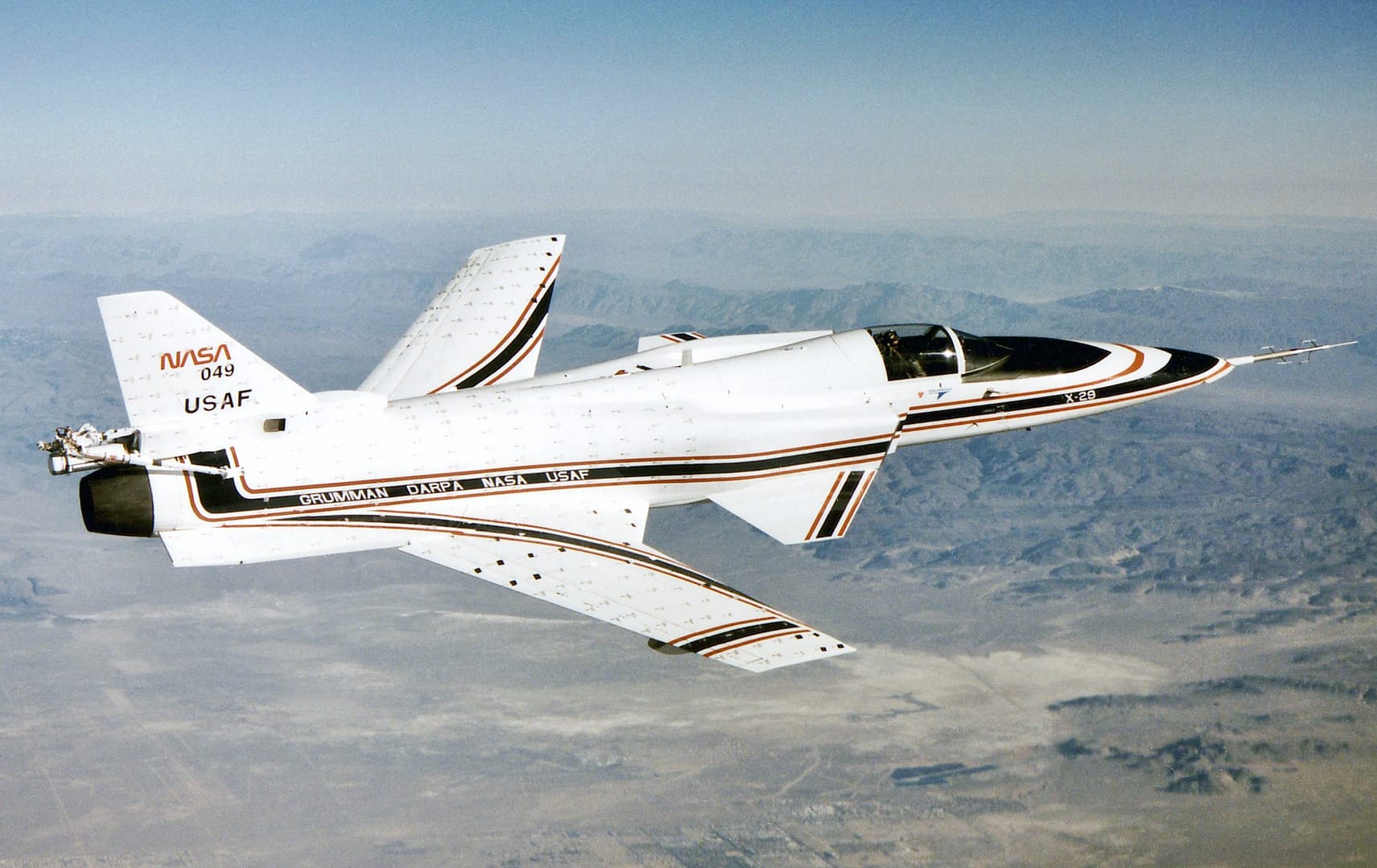
| Manufacturer | Grumman Aerospace Corporation |
| First Flight | December 14, 1984 |
| Test Pilot (First Flight) | Chuck Sewell (Grumman Chief Test Pilot) |
| Wing Sweep | -33.73° (forward) |
| Control Surfaces | Three-surface: canards + wing + tailplane |
| Built | 2 aircraft (82-0003, 82-0049) |
| Total Flights | 422 research flights |
| Max Angle of Attack | 67 degrees demonstrated |
The Problem With Forward Sweep
Engineers had known since the 1940s that forward-swept wings offered tantalizing aerodynamic advantages. The airflow over a forward-swept wing moves inward toward the fuselage rather than outward toward the wingtips, which means the ailerons retain effectiveness at high angles of attack — precisely the regime where conventional swept-back wings lose control. A forward-swept wing also generates less drag at transonic speeds and provides better low-speed handling. The problem was structural. At speed, aerodynamic loads try to twist a forward-swept wing upward — a phenomenon called aeroelastic divergence. The faster you fly, the more the wing twists, which increases lift, which increases twist further, until the wing tears itself apart. With metal construction, the only solution was to make the wing enormously heavy, which negated all the aerodynamic benefits. The solution arrived in the form of advanced composite materials — specifically, graphite epoxy. By carefully orienting the carbon fiber layers in the wing structure, Grumman’s engineers could create a wing that resisted the twisting loads of aeroelastic divergence while remaining light enough to be practical. This technique, called aeroelastic tailoring, made the X-29 possible.Built From an F-5’s Bones
To save costs, Grumman built the X-29 around the forward fuselage and nose landing gear of a Northrop F-5A Freedom Fighter, with control-surface actuators and main landing gear taken from the F-16. The General Electric F404-GE-400 turbofan engine — the same powerplant used in the F/A-18 Hornet — was installed in the rear. But from the intake forward, everything was new. The three-surface control arrangement was unprecedented. Close-coupled canards ahead of the wing provided primary pitch control and worked in concert with the wing and the aft strake flaps to manage the aircraft’s extreme instability. The flight control computer — a triple-redundant digital fly-by-wire system — made 40 corrections per second to keep the aircraft stable. Without those computers, the X-29 would have departed controlled flight within 0.2 seconds.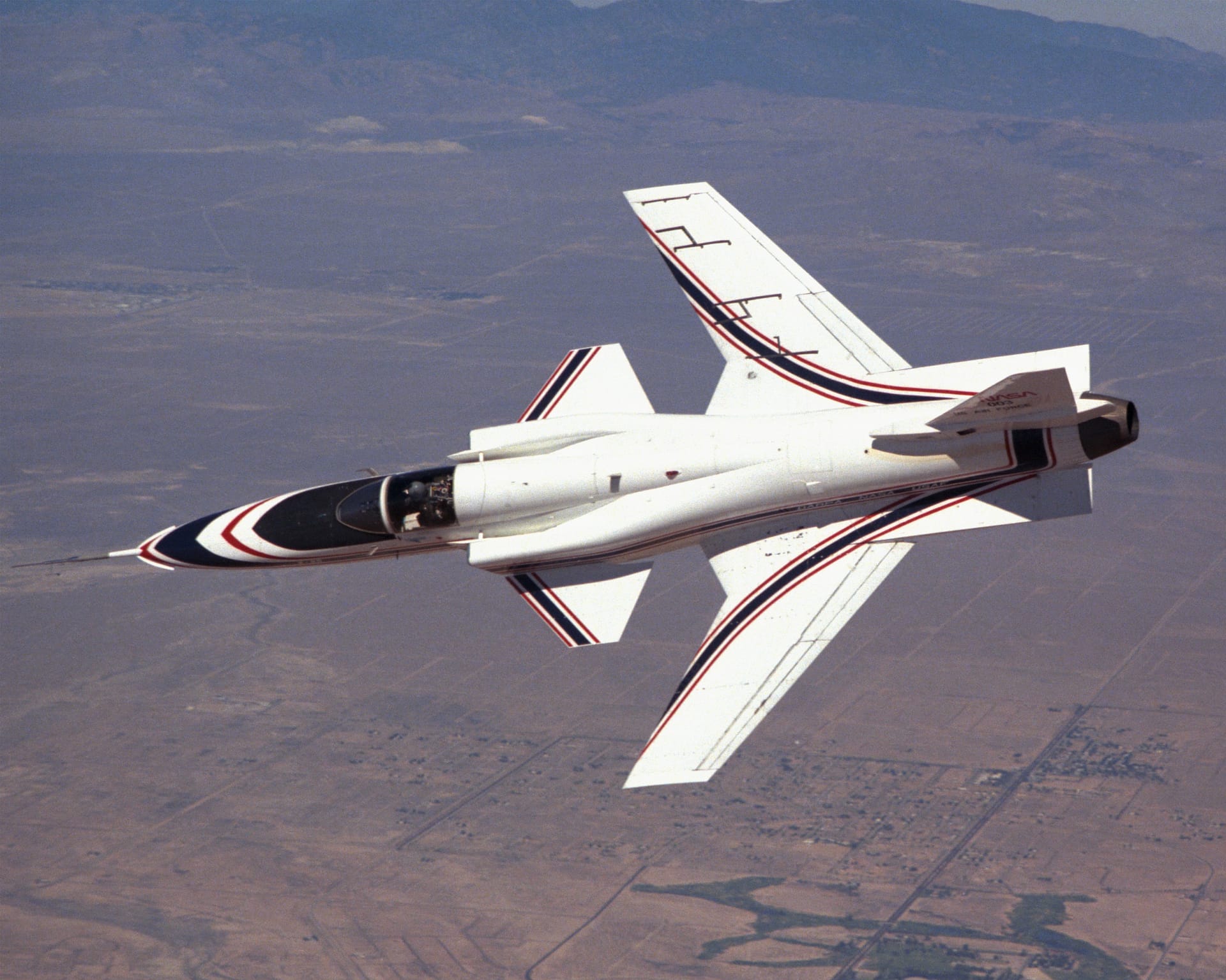
422 Flights Into the Unknown
On December 14, 1984, Grumman Chief Test Pilot Chuck Sewell lifted the X-29 off the runway at Edwards AFB for its maiden flight. The aircraft handled beautifully — so well, in fact, that Sewell asked ground control for permission to perform a roll during the early test flights, an unusually enthusiastic response for a first flight of an experimental aircraft. Phase 1 testing (1984–1988) explored the flight envelope and validated the forward-swept wing concept. The X-29 demonstrated that a forward-swept wing fighter could indeed be controlled through a wide range of speeds and altitudes, and that the composite wing successfully resisted aeroelastic divergence up to the design limits. NASA research pilots found the aircraft notably responsive, with the forward-swept wing retaining excellent control at high angles of attack where a conventional fighter would have been in deep trouble. Phase 2 (1989–1992) used the second X-29 to explore extreme high-angle-of-attack flight. The aircraft was pushed to an extraordinary 67 degrees angle of attack — nearly pointing its nose straight up — while maintaining controlled flight. This was well beyond what most conventional fighters could achieve.Why It Never Became a Fighter
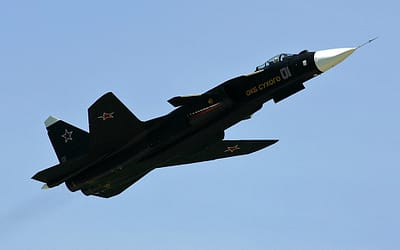
Despite its success, the X-29 never entered production. The forward-swept wing’s advantages, while real, were not dramatic enough to justify the complexity and cost of composite wing construction for a production fighter. The F-22 Raptor and F-35 Lightning II, which entered development in subsequent years, achieved comparable high-alpha performance through thrust vectoring and advanced flight control laws with conventional swept-back wings. But the X-29’s legacy lives in every modern composite airframe. The aeroelastic tailoring techniques pioneered on its wings became standard practice in aircraft design. And the concept of extreme instability controlled by fly-by-wire computers — validated to a degree no other program had attempted — informed the design of every subsequent generation of fighter aircraft. Russia, notably, pursued its own forward-swept wing fighter — the Sukhoi Su-47 Berkut, which flew in 1997 and bore a striking resemblance to the X-29’s basic concept. Though the Su-47 also remained a one-off demonstrator, it confirmed that both superpowers had recognized the same aerodynamic promise in wings that flew “backwards.”Sources: NASA Dryden Flight Research Center, Grumman History Office, DARPA, Air & Space Smithsonian
Related Posts
- The Strangest and Weirdest Planes on Earth — featuring the Su-47 Berkut, Russia’s forward-swept answer to the X-29
 English
0 Comments