
Quick Facts
- Program: Undergraduate Jet Training System (UJTS)
- Replacing: Boeing T-45C Goshawk (in service since 1991)
- Aircraft needed: 216 new jet trainers
- EMD cost cap: ~$1.8 billion
- Contract award: March 2027
- Competitors: Boeing T-7B, Lockheed/KAI TF-50N, Leonardo M-346N, SNC Freedom

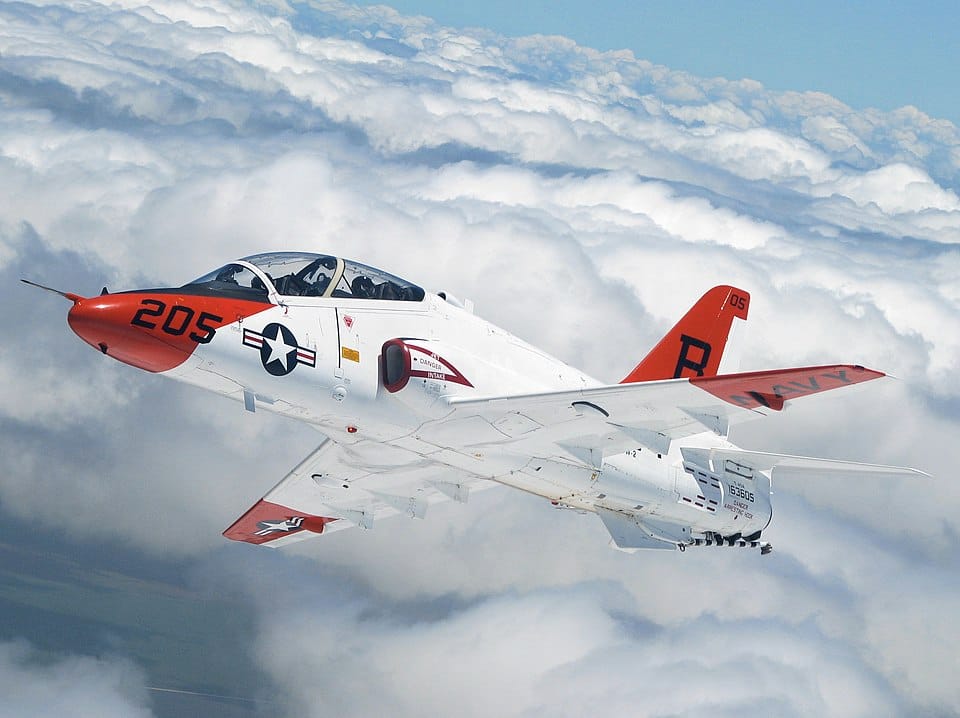
Every Navy and Marine Corps pilot who has landed on an aircraft carrier in the last three decades learned how in the same aircraft: the T-45 Goshawk. Now the jet that trained a generation of naval aviators is being replaced — and four companies are fighting over a contract worth more than $10 billion.
The U.S. Navy released its final Request for Proposals for the Undergraduate Jet Training System on March 26, kicking off the biggest trainer aircraft competition in decades. Proposals are due June 29, and the Navy expects to award the contract in March 2027. The winner will build 216 aircraft to replace the ageing T-45C fleet — and reshape how the Navy trains its pilots for the next 30 years.
Four Fighters for the Contract
The competition is a four-way dogfight, and every contender brings something different to the table.
Boeing T-7B Red Hawk. The frontrunner, at least on paper. The T-7A is already the U.S. Air Force's next-generation trainer, and Boeing is pitching a navalized variant called the T-7B with strengthened landing gear, corrosion protection, and carrier-procedure software. Boeing projects an operating cost of $7,200 per flight hour — a significant cut from the T-45C's $10,700. The Air Force connection gives Boeing a massive advantage in logistics and spare parts.
Lockheed Martin / KAI TF-50N. South Korea's T-50 family is the most operationally proven platform in the race. With over 250 airframes delivered to air forces in South Korea, Poland, Iraq, and beyond, the supersonic TF-50N offers a mature production line and a single GE F404 engine capable of pushing it past Mach 1.5. It's the only contender that can go supersonic — a significant training advantage.
Leonardo / Textron M-346N. The Italian-built M-346 "Master" is a twin-engine trainer already in service with the Italian, Israeli, Polish, and Singaporean air forces. The naval variant, the M-346N, is being adapted specifically for U.S. Navy requirements. Its twin-engine configuration offers redundancy over water — an important selling point for carrier aviation training.
Sierra Nevada Corporation Freedom. The wildcard. SNC's Freedom is a clean-sheet design built from scratch for this competition, partnered with Northrop Grumman and General Atomics. It's the only contender explicitly designed to perform carrier touch-and-go landings — a capability the Navy no longer requires but that SNC clearly believes will impress the evaluators.
The Carrier Landing Revolution
Here's the most surprising detail buried in the RFP: the Navy's next trainer will not land on aircraft carriers. It won't even perform full field carrier landing practice touch-and-goes ashore. That's a seismic shift.
The T-45 Goshawk was built specifically for carrier operations. Student pilots used it to make their first arrested landings on a flight deck — one of the most demanding skills in all of aviation. Under the new system, pilots will learn carrier procedures through advanced simulation and then transition directly to frontline aircraft at Fleet Replacement Squadrons for their actual carrier qualifications.
The Navy is betting that modern simulators can replicate the terror and precision of a carrier trap well enough to prepare a pilot for the real thing. It's a gamble, but it dramatically opens up the competition — any reasonably capable jet trainer can now compete, not just purpose-built carrier aircraft.
The Stakes
The numbers are staggering. The Navy wants 216 aircraft to deliver 76,300 annual flight hours. Engineering and manufacturing development bids above $1.8 billion will be rejected outright. The first four EMD aircraft are expected by 2032, with production ramping to 25 aircraft per year by 2035. Meanwhile, the existing T-45C fleet — roughly 190 airframes plagued by engine, oxygen-system, and structural problems — will limp along with a service-life extension program running through 2036.
For the companies involved, losing this competition means being locked out of U.S. Navy training for the next three decades. For the Navy, picking the wrong jet means a generation of pilots trained on a compromised platform. The pressure cuts both ways.
Proposals close June 29. By this time next year, we'll know which jet wins the right to train the next generation of carrier aviators — even if, for the first time in history, it never touches a flight deck.
Sources: Breaking Defense, The War Zone, Air Data News, Flight Global, Aviation Week
Related Questions
What is the Navy's UJTS program?
The Undergraduate Jet Training System (UJTS) is the U.S. Navy's program to replace its aging Boeing T-45C Goshawk jet trainers. The Navy needs about 216 new trainers, with an engineering and manufacturing development cost cap near $1.8 billion and a contract award targeted for March 2027.
What aircraft is the Navy's UJTS replacing?
The Boeing T-45C Goshawk, which has trained U.S. naval aviators since 1991. After more than three decades of service, the Navy wants a modern replacement better suited to preparing pilots for advanced carrier aircraft.
Which jets are competing for the Navy trainer contract?
Four contenders: the Boeing T-7B, the Lockheed Martin/KAI TF-50N, the Leonardo M-346N, and the SNC Freedom. The Navy plans to pick a winner around March 2027 to build roughly 216 trainers.
How much is the Navy's new trainer program worth?
The overall effort is valued at around $10 billion, with the initial engineering and manufacturing development phase capped near $1.8 billion. The Navy needs about 216 aircraft to replace the T-45C Goshawk fleet.
Why does the Navy need a new jet trainer?
The T-45C Goshawk has flown since 1991 and is increasingly costly and dated. A modern jet trainer with updated avionics better bridges student pilots toward fifth-generation carrier jets, which is why the Navy launched the UJTS competition.
0 Comments