
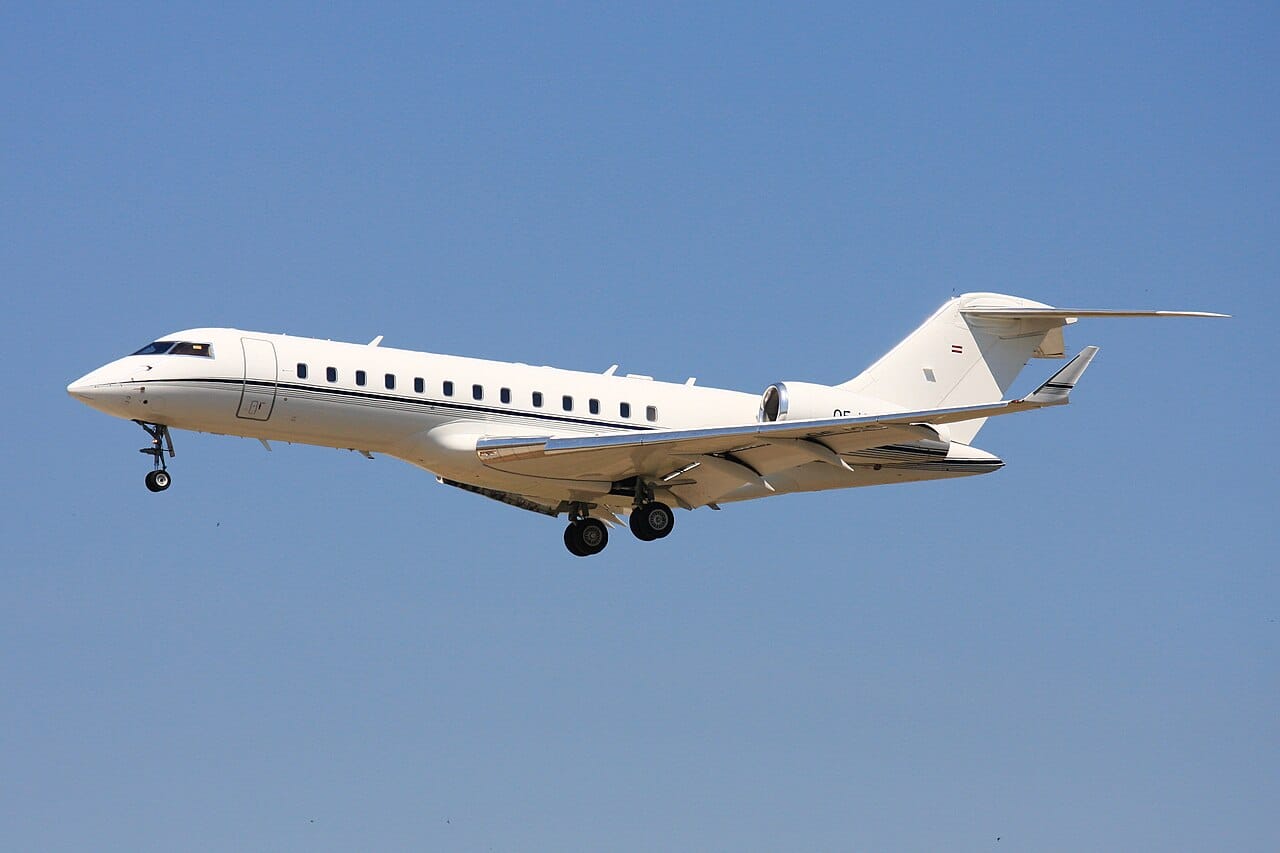
NetJets Gets the World's Longest-Range Business Jet
| QUICK FACTS |
|---|
| Aircraft: Bombardier Global 8000 | Range: 8,000 nm (14,800 km) | Speed: Mach 0.94 | Power: 2× Rolls-Royce Pearl 10X | Cabin Zones: 4 living spaces | Operator: NetJets Inc. | First Delivery: March 2026 |
When Warren Buffett's NetJets took delivery of the first Bombardier Global 8000 in late March 2026, the world's largest fractional jet ownership company didn't just gain another aircraft. They acquired a machine that rewrites what "distance" means in business aviation.
This isn't incremental. The Global 8000 cruises at Mach 0.94—faster than any production civil aircraft since Concorde. Its 8,000-nautical-mile range means nonstop flights from New York to Singapore. From London to Sydney. From Tokyo to San Francisco. For executives accustomed to planning around refueling stops, this jet erases the map.
NetJets operates over 750 aircraft—larger than many commercial airlines. The Global 8000 isn't replacing that fleet. It's extending it into a new tier of possibility. And for the ultra-wealthy clients who split ownership through NetJets, the implications are profound.
The Longest Reach, the Fastest Pulse
Bombardier's Global family has always pushed boundaries. The Global 7500, which debuted in 2018, set the template for ultra-long-range business jets. But the Global 8000 takes that DNA and amplifies it.
The numbers tell the story. Eight thousand nautical miles. That's not a marketing figure—it's a real-world distance verified by industry bodies. With a single fuel load, the Global 8000 can connect continents in ways that fundamentally alter how global business operates. No intermediate stops. No refueling delays. Just uninterrupted flight across half the planet.
Speed amplifies the advantage. At Mach 0.94, the cabin is pressurized to 4,850 feet even while cruising at 43,000 feet—meaning passengers experience less fatigue and arrive fresher. The flight time from London to Hong Kong shrinks to under 16 hours. For comparison, commercial airlines require 11+ hours plus layovers.

Two Rolls-Royce Pearl 10X engines power the Global 8000. These aren't generic turbofans—they're engineered specifically for this platform, delivering 17,500 pounds of thrust each with fractional turbo efficiency that squeezes every nautical mile from each gallon of Jet A fuel. The engines are so efficient that despite the aircraft's size and weight, fuel costs per passenger mile rival aircraft half its size.
A Flying Penthouse Reimagined
But speed and range mean nothing without comfort. The Global 8000's cabin spans 43 feet—longer than many corporate offices. It's divided into four separate living zones, each designed with ergonomics that commercial airlines can only envy.
The forward cabin includes a full-size galley kitchen—not the microwave-and-coffee-maker affairs you'll find on most jets. Executive chefs can prepare multi-course meals in-flight. There's a dedicated crew rest area aft, soundproofed from the main cabin. For ultra-long flights, select Global 8000 configurations include a permanent bedroom with a flat-sleeping surface that actually feels like a bed.
The main cabin can be configured as a boardroom, sleeping quarters, or spa-like retreat. Twelve passengers can fly in layouts that would feel spacious on a mansion yacht. Seat-to-seat spacing exceeds first-class on international carriers. Windows are pressurized and electronically tinted.
"The Global 8000 isn't just a new aircraft—it's a redefinition of what fractional ownership makes possible. Executives can now commute globally in a way that was impossible a decade ago."
Military Heritage, Commercial Promise
Bombardier's Global Express family has deep roots in military aviation. The U.S. Air Force operates the E-11A BACN (Battlefield Airborne Communications Node)—a combat-adapted Global Express that serves as an airborne relay station for forward military units. It's proven itself across two decades of operations in Afghanistan, Iraq, and beyond. That pedigree—that combat-proven reliability—informs every system in the Global 8000.
Meanwhile, the USAF flies C-37s (Gulfstream V variants) and C-40s (Boeing 737 variants) to transport senior government officials—cabinet secretaries, joint chiefs, dignitary delegations. These aircraft operate under the same constraints as civilian jets but demand military-grade redundancy. The Global 8000's systems architecture borrows heavily from this philosophy. Every critical system has backup. Avionics are triply redundant.
This cross-pollination between military and civilian aviation accelerates innovation. Bombardier's investment in composite materials, systems integration, and engine technology is driven by both defense contracts and the ultra-high-reliability demands of business aviation. NetJets benefits from decades of combat-proven engineering.
The Fractional Revolution
NetJets pioneered fractional ownership in 1986. Before that, owning a jet meant $50 million capital outlay, $1.5 million annual fixed costs, and crews sitting idle between flights. NetJets said: own the fraction, pay for utilization, let us handle the logistics.
The Global 8000 represents the apex of that model. A one-eighth share doesn't come cheap—around $35-40 million—but for a global executive, it's transformative. Four-hour notice to departure. No commercial airport congestion. No security theater. Direct flights to secondary airports near business destinations. The math works for C-suite executives who value time over cost.
NetJets maintains a fleet large enough to ensure aircraft are always available. That scale creates efficiency. The company operates 90+ bases worldwide, each staffed with pilots, maintenance technicians, and crew coordinators. Add the Global 8000 to the roster, and suddenly 8,000-nautical-mile jaunts become routine.
Certification Completed, Operations Ramping
The Global 8000 received type certification in late 2025 after years of testing. Bombardier proved every claim—the range, the speed, the environmental compliance. First deliveries rolled out in early 2026, with NetJets securing the first slot.
Certification matters for operations. It's not just bureaucracy. It means crew training standards are established. Maintenance protocols are written. Supply chains for spare parts are activated. Operators can deploy the aircraft with confidence, knowing that thousands of flight hours and regulatory scrutiny have already exposed—and solved—edge-cases.
More Global 8000s are arriving at NetJets throughout 2026. By year-end, the company expects to operate a full fleet of Global 8000s across multiple ownership shares. The ripple effects will be visible in where global executives appear—suddenly accessible locations will host board meetings, deal-closings, and diplomatic summits that once required commercial flight infrastructure.
What This Means for the World
The Global 8000 in NetJets hands is more than luxury hardware. It's infrastructure for a certain class of global economy. Executives can now operate continuously across time zones in ways that dissolve the concept of "home." A CEO based in New York can hold a board dinner in Singapore, wake up for a morning call in London, and close a deal in Dubai—all within 72 hours, without commercial aviation's friction.
This concentrates power and mobility in ways that reshape dealmaking and influence. Not everyone flies global business jets. But those who do will increasingly operate with advantages—speed, stamina, discretion, reach—that commercial aviation can't match. The Global 8000 accelerates that divergence.
For aviation enthusiasts, the Global 8000 is simply magnificent. A machine that turns physics into capability. Rolls-Royce engines pushing near-supersonic speeds. Composite structures that save weight without sacrificing strength. Avionics systems that would impress military test pilots. And yet it lands on 5,000-foot regional airfields where commercial jets fear to tread.
NetJets has just acquired the aircraft that redefines global reach for those who can afford it. The question now is: how many others will follow?
Related Questions
What is the Bombardier Global 8000?
The Global 8000 is Bombardier's flagship business jet and the longest-range purpose-built business jet in the world, able to fly 8,000 nautical miles (about 14,800 km) nonstop. Powered by two Rolls-Royce Pearl 10X engines, it cruises at up to Mach 0.94 and offers four separate cabin living zones for long intercontinental flights.
How fast is the Bombardier Global 8000?
The Global 8000 cruises at up to Mach 0.94, making it the fastest production civil aircraft since Concorde. That speed, combined with its 8,000-nautical-mile range, lets it fly routes like New York to Singapore or London to Sydney nonstop, effectively erasing the refuelling stops that shaped earlier long-haul business travel.
How far can the Global 8000 fly nonstop?
The Global 8000 has a range of 8,000 nautical miles, roughly 14,800 kilometres, enough for nonstop flights from New York to Singapore, London to Sydney or Tokyo to San Francisco. That range puts it at the very top of business aviation, ahead of most rivals such as the Gulfstream G800.
Who is NetJets?
NetJets is the world's largest fractional jet ownership company, part of Warren Buffett's Berkshire Hathaway, operating a fleet of more than 750 aircraft, larger than many commercial airlines. In late March 2026 it took delivery of the first Bombardier Global 8000, adding the longest-range business jet in the world to its lineup.
Why does Mach 0.94 matter for a business jet?
Cruising at Mach 0.94 means the Global 8000 flies closer to the speed of sound than almost any civil aircraft has since Concorde, trimming hours off ultra-long routes. For executives, faster cruise plus 8,000-nautical-mile range means reaching distant cities nonstop and sooner. The last civil jet to chase such speeds was Concorde's rival, the Tu-144 Konkordski.

0 Comments