
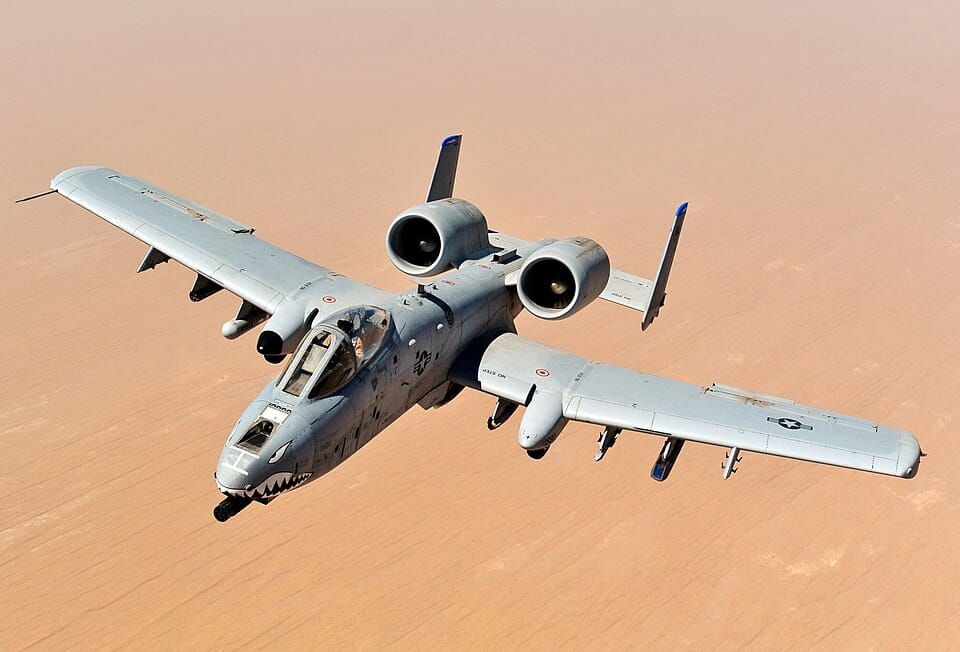
Related: Dozens of Warthogs Gear Up for Iran
Four weeks into the air campaign against Iran, the United States has struck more than 10,000 targets. Roughly 80 percent of Tehran’s integrated air defence network lies in ruins. Its navy has been functionally destroyed. By every traditional measure of aerial dominance, American air power has won.
And yet the Strait of Hormuz — the 33-kilometre-wide chokepoint through which a fifth of the world’s oil once flowed — remains effectively closed. Tankers aren’t moving. Insurance rates have gone vertical. The global economy is bleeding.
How can you own the sky and still lose control of the water beneath it?

Air Denial: The Cheap Counter to Air Superiority
Writing in Defense News, analysts Maximilian K. Bremer and Kelly A. Grieco argue that the Strait of Hormuz is offering a brutal real-time lesson in a concept most air forces have been slow to internalise: air denial. It is not the same thing as air superiority, and the distinction matters enormously.
Air superiority means controlling the sky — owning it so completely that your aircraft can operate freely while the enemy’s cannot. Air denial is the opposite strategy: you don’t need to control the sky yourself. You just need to make it too dangerous, too costly, and too unpredictable for the other side to use it effectively. The barriers to achieving air denial are dramatically lower than those required for air superiority. And Iran has figured that out.
Tehran is flooding the air littoral above the strait with waves of cheap drones and short-range missiles, capable of reaching oil tankers and naval vessels in minutes. Each individual weapon is expendable. Together, they create a persistent threat blanket that no amount of precision strikes on Iranian territory can fully eliminate — because the launchers are mobile, distributed, and easy to hide.


The Red Sea Playbook, Scaled Up
The pattern should look familiar. Between 2024 and 2025, Houthi forces in Yemen used exactly this approach in the Red Sea. Cheap, distributed drones and missiles fired at commercial shipping created a crisis that more than 800 American airstrikes couldn’t eliminate. The Houthis were an Iranian proxy running an Iranian playbook. Now Iran itself is running the same playbook — with better weapons, more launchers, and shorter ranges to target.
The core problem is mathematical. A single drone costs a fraction of the interceptor missile used to shoot it down. Waves of drones exhaust defensive inventories faster than they can be replenished. And while the US Air Force can destroy launch sites, mobile launchers move. Destroying them all requires persistent surveillance and rapid-response strike capability over an enormous area — a combination the Pentagon has systematically underinvested in.
Bremer and Grieco identify four specific capability gaps: large numbers of low-cost, attritable systems to continuously attack dispersed launch sites; mobile air defences deployable near threatened waterways; low-cost persistent airborne platforms for detecting and destroying drone swarms; and interceptors that can sustain high engagement rates without burning through their magazines.
What This Means for the Future of Air Power
The Strait of Hormuz crisis is reshaping assumptions that have underpinned Western air doctrine since the Gulf War. In 1991, air superiority was decisive. In 2003, it was assumed. In 2026, it has been achieved — and it is not enough.
The lesson is stark: a technologically inferior adversary, using cheap and plentiful weapons, can deny the practical use of airspace above a critical chokepoint even after its conventional military has been shattered. That is a problem not just for the Persian Gulf. Any future conflict in the Taiwan Strait, the Baltic, or the South China Sea will feature the same dynamic — distributed, expendable weapons making traditional air superiority harder and harder to translate into strategic results.
“By that measure, the United States does not have air superiority where it counts.”
— Maximilian K. Bremer and Kelly A. Grieco, Defense News
For anyone who has ever sat in a fighter jet cockpit — or dreamed of doing so — this is a sobering reminder. The age of unopposed air dominance may be ending. The sky still belongs to the fast, the skilled, and the brave. But holding it now demands a fundamentally different kind of arsenal.
Sources: Defense News, Air & Space Forces Magazine, The War Zone
Related Questions
What is the Strait of Hormuz?
The Strait of Hormuz is a narrow waterway about 33 kilometers wide at its tightest point, connecting the Persian Gulf to the open ocean. Roughly a fifth of the world's oil once flowed through it, making it one of the most strategically important chokepoints on Earth.
What is the difference between air superiority and air denial?
Air superiority means controlling the sky so completely that your aircraft operate freely while the enemy's cannot. Air denial is the opposite, cheaper strategy: rather than controlling the sky yourself, you make it too dangerous and costly for the other side to use. The barriers to achieving air denial are far lower than those for air superiority.
Why can't air power alone reopen the Strait of Hormuz?
The article argues that even after U.S. forces destroyed most of Iran's air defences and navy, the strait stayed closed because mines, fast attack boats and shore-based missiles can deny the waterway cheaply. Owning the sky does not automatically grant control of the sea beneath it - a real-time lesson in air denial.
What is the A-10 Warthog used for?
The A-10 Thunderbolt II, nicknamed the Warthog, is a U.S. Air Force close-air-support jet built around a powerful 30 mm cannon and designed to attack ground and surface targets at low altitude. In the Hormuz campaign, A-10s were used to hunt Iranian fast boats. The Air Force once tried to retire the A-10 but kept it flying.
Has Iran shot down any US aircraft?
Yes. The campaign saw losses on the U.S. side - our report on the full cost of Operation Epic Fury details the totals, and Iran has downed drones such as the MQ-1 Predator. These losses show how air denial raises the cost of operating even against a degraded opponent.
0 Comments