
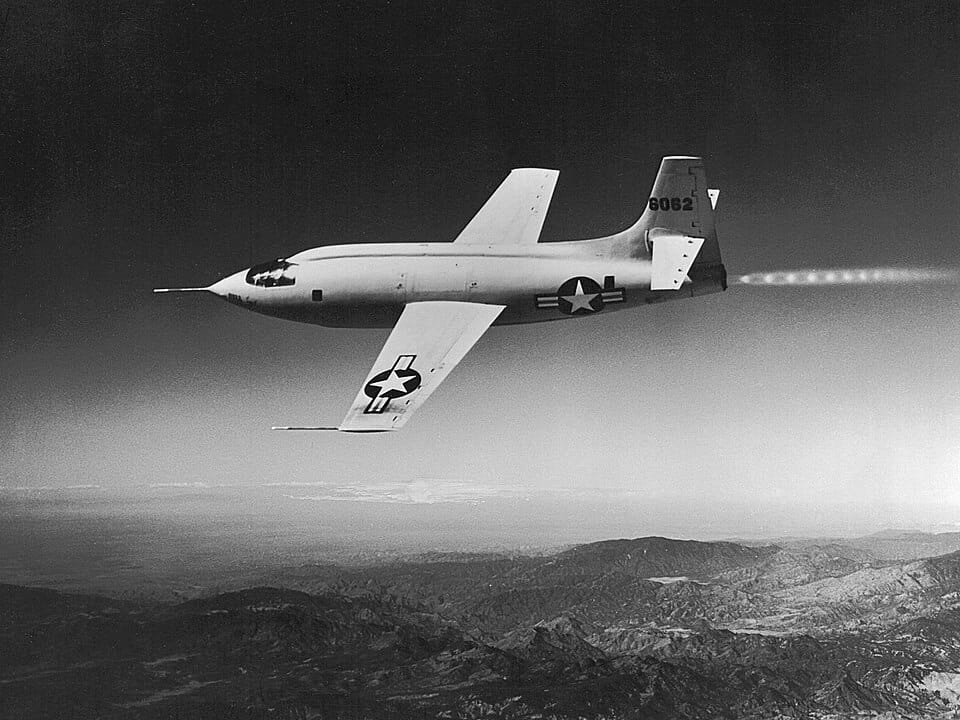
| Quick Facts | |
| Pilot | Captain Charles "Chuck" Yeager, United States Air Force |
| Date | October 14, 1947 |
| Aircraft | Bell X-1 (serial 46-062), nicknamed "Glamorous Glennis" |
| Speed Achieved | Mach 1.06 (700 mph / 1,127 km/h) at 43,000 feet |
| Launch Method | Air-dropped from a modified Boeing B-29 Superfortress at 25,000 feet |
| Engine | Reaction Motors XLR-11 — four-chamber liquid-fuelled rocket engine |
| Secret | Yeager had two broken ribs from a horse-riding accident two days earlier |
| Classification | The flight was classified SECRET until June 1948 |

Two days before the most important flight in aviation history, Chuck Yeager fell off a horse. He hit the ground hard, cracked two ribs on his right side, and faced a problem that had nothing to do with aerodynamics: he couldn't close the X-1's cockpit door. The locking handle was on the right, and his broken ribs made it impossible to reach across and pull it shut with the force required.
He didn't tell the flight surgeon. He didn't tell the programme director. He told a veterinarian friend in a bar, then went to a hardware store and bought a ten-inch piece of broomstick. On the morning of October 14, 1947, he carried it into the cockpit, used it as a lever to close the door, and dropped into the sky beneath a B-29 bomber with two broken ribs and a stick of wood as his most critical piece of equipment.
Ninety minutes later, a sonic boom rolled across the Mojave Desert — the first one ever created by an aircraft in level, controlled flight. Chuck Yeager had just done what half the world's engineers said would kill anyone who tried.
The Wall That Wasn't
By 1947, the "sound barrier" had become aviation's most feared concept. As aircraft approached Mach 1, the air ahead of them compressed into shockwaves that caused violent buffeting, loss of control, and structural failure. Several pilots had died in high-speed dives when their aircraft broke apart. British test pilot Geoffrey de Havilland Jr. was killed in 1946 when his DH.108 Swallow disintegrated over the Thames Estuary during a speed attempt.

The Bell X-1 was purpose-built to punch through. It was shaped like a .50-calibre bullet — because bullets were the only man-made objects known to travel supersonically with stability. The fuselage was reinforced to handle 18 G of aerodynamic loading. The wings were thin, straight, and enormously strong. The aircraft carried no fuel for takeoff; instead, it was hoisted beneath a modified B-29 and released at 25,000 feet, already moving at 250 mph.
The Reaction Motors XLR-11 rocket engine fired in the thin, cold air above the Mojave. Yeager lit the four chambers one at a time, accelerating through Mach 0.85, 0.90, 0.95. The buffeting increased. The controls grew mushy. Conventional wisdom said this was the point where the aircraft would come apart.
Through the Other Side
The Machmeter needle climbed past 0.98, hit 1.0, and kept going. The buffeting stopped. The ride smoothed out. Yeager later described it as punching through a wall of turbulence into perfect calm — "as smooth as a baby's bottom," he said. The Machmeter read Mach 1.06. The sound barrier was broken, and the man who broke it had two broken ribs and a sawed-off broomstick in his cockpit.
On the ground, the sonic boom startled workers at Muroc Army Airfield (now Edwards Air Force Base). They had no idea what they were hearing. The flight was immediately classified SECRET by the Air Force, and the news didn't reach the public until Aviation Week broke the story eight months later — reportedly without official authorisation.
Yeager was 24 years old. He was already a double ace from World War II — he'd shot down 11.5 German aircraft, including one of the first Me 262 jet fighters destroyed in combat. He went on to fly the X-1A to Mach 2.44 in 1953, narrowly surviving a violent tumble at the edge of space. He retired as a brigadier general, lived to 97, and never once stopped insisting that the X-1 flight was just a day's work.
It wasn't. It was the day the sky stopped having a speed limit.
Sources: NASA, Smithsonian Air & Space Museum, Edwards AFB History Office
Related Questions
Who was the first person to break the sound barrier?
American test pilot Chuck Yeager became the first person to break the sound barrier in level flight on October 14, 1947. Flying the rocket-powered Bell X-1 over California's Mojave Desert, he reached Mach 1.06 at 43,000 feet, producing the first sonic boom ever created by an aircraft and proving that supersonic flight was survivable.
What aircraft broke the sound barrier first?
The Bell X-1, a bullet-shaped rocket plane nicknamed "Glamorous Glennis," was the first aircraft to exceed the speed of sound. Air-dropped from a Boeing B-29 bomber at 25,000 feet, it was powered by a four-chamber Reaction Motors XLR-11 liquid-fuelled rocket engine and flown by Chuck Yeager on October 14, 1947.
How fast did Chuck Yeager fly to break the sound barrier?
Chuck Yeager reached Mach 1.06 — about 700 mph (1,127 km/h) — at an altitude of 43,000 feet. That was just past the speed of sound, enough to generate the first sonic boom rolled across the desert by a piloted aircraft in level, controlled flight.
Did Chuck Yeager have broken ribs when he broke the sound barrier?
Yes. Two days before the flight, Yeager fell from a horse and cracked two ribs on his right side. Unable to reach across to lock the X-1's cockpit door, he secretly used a sawn-off broomstick as a lever to seal it. He told neither the flight surgeon nor the programme director.
What is the sound barrier?
The sound barrier is the sharp rise in aerodynamic drag and buffeting an aircraft encounters as it approaches Mach 1, the speed of sound. In the 1940s engineers feared the shock waves could tear an aircraft apart, which is why crossing it was considered so dangerous until Chuck Yeager and later pilots proved it could be done.
How was the Bell X-1 launched?
The Bell X-1 did not take off from a runway. It was carried aloft tucked beneath a modified Boeing B-29 Superfortress and air-dropped from around 25,000 feet, then fired its rocket engine to climb and accelerate. This saved fuel for the short, high-speed research flights.
Why was the sound-barrier flight kept secret?
Yeager's October 1947 flight was classified SECRET by the US military and not made public until June 1948. Cold War sensitivities around cutting-edge aircraft research meant the achievement, one of the most important in aviation history, stayed hidden for roughly eight months.
Who was Bob Hoover?
Bob Hoover was a legendary American test and airshow pilot who served as Yeager's backup for the sound-barrier flight and flew the chase plane that day. Yeager called Bob Hoover the greatest stick-and-rudder pilot alive, and Hoover went on to a celebrated career demonstrating aerobatics.
0 Comments