
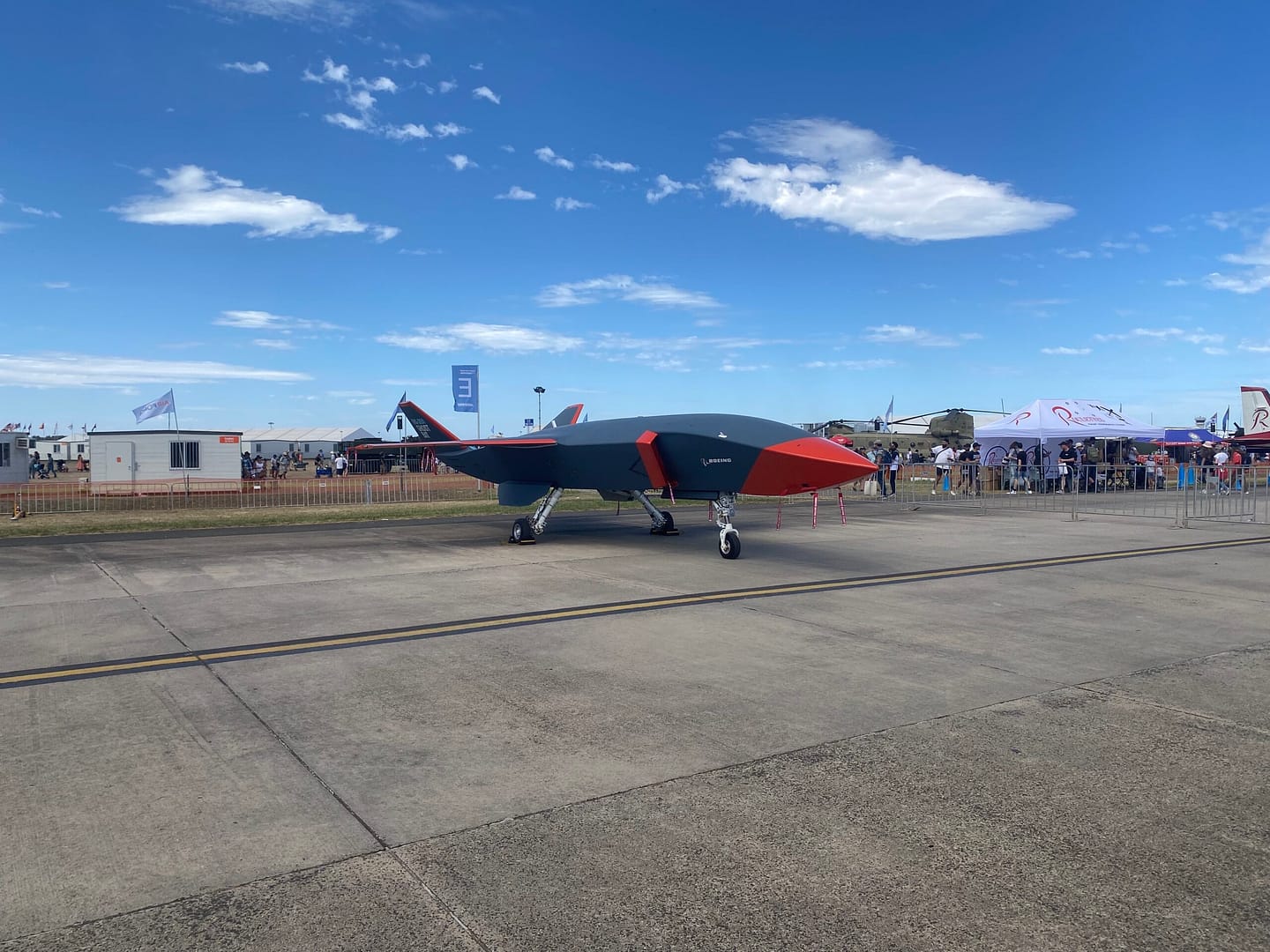
Boeing has pulled back the curtain on one of the most closely guarded metrics in military aviation: the radar cross section of its MQ-28 Ghost Bat. Announced on June 1, 2026, in Brisbane, the company confirmed it has completed comprehensive RCS testing of the autonomous combat drone in an anechoic chamber — and is sharing the validated results with prospective customers. In the world of stealth aircraft, this level of transparency is virtually unprecedented for an unmanned platform.
The disclosure arrives at a strategic moment. The Ghost Bat has now completed over 150 flights, conducted its first operations on U.S. soil at Point Mugu in late May 2026, and successfully demonstrated an AIM-120 live-fire engagement in December 2025. With Block 3 unveiled at ILA Berlin on June 10 featuring a 25-percent larger wing and internal weapons bays, the MQ-28 is methodically transitioning from experimental demonstrator to combat-ready platform.
For the growing number of nations evaluating collaborative combat aircraft (CCA) programmes, Boeing’s decision to publicly validate the Ghost Bat’s stealth performance changes the procurement calculus entirely.
Quick Facts: MQ-28 Ghost Bat
- RCS Testing Announced: June 1, 2026 (Brisbane)
- Method: Anechoic chamber, aircraft suspended on cables
- Total Flights: 150+
- First U.S. Flight: May 27, 2026 (NAS Point Mugu, Ventura County)
- AIM-120 Live Fire: December 2025
- Block 3 Revealed: June 10, 2026 (ILA Berlin)
- Dimensions: 38 feet long, modular 1.5 m³ nose bay
- Range: 2,000+ nautical miles
- Rheinmetall Partnership: Signed March 31, 2026
Inside the Anechoic Chamber
RCS testing is the definitive measure of an aircraft’s detectability by radar. During the test campaign, a complete MQ-28 airframe was suspended on cables inside Boeing’s anechoic chamber — a room lined with radar-absorbing material that eliminates reflections and simulates free-space conditions. Engineers then measured the aircraft’s radar return across multiple axes: elevation, azimuth, and roll.
The methodology is standard for manned stealth platforms like the F-35 and B-21, but applying it to an unmanned CCA and then publicly disclosing the results represents a significant departure from industry practice. Boeing did not release specific RCS figures — that data is classified and shared only with cleared customers — but the decision to validate and publicise the testing confirms that the results met or exceeded design specifications.

From Australia to America: The Expanding Footprint
The Ghost Bat programme began as an Australian initiative — developed and built by Boeing Australia for the Royal Australian Air Force. The first flight took place in February 2021, and the platform has since accumulated over 150 test flights from the Woomera Range Complex in South Australia.
The programme’s geographic expansion accelerated in May 2026 when the MQ-28 conducted its first flights on U.S. soil at Naval Air Station Point Mugu in Ventura County, California, on May 27. The move to American airspace signals Boeing’s intent to position the Ghost Bat for U.S. military procurement — potentially as a complement to or competitor with the Collaborative Combat Aircraft programmes being developed under the U.S. Air Force’s Next Generation Air Dominance ecosystem.
Block 3: A Substantially More Capable Aircraft
At ILA Berlin on June 10, Boeing unveiled the Block 3 configuration of the MQ-28. The most immediately visible change is a 25-percent increase in wing area, which improves range, payload capacity, and loiter time. More significantly, Block 3 introduces internal weapons bays — a critical requirement for maintaining the aircraft’s low radar cross section during combat operations.
The modular 1.5-cubic-metre nose section remains a key feature. This interchangeable bay can be configured for electronic warfare, intelligence/surveillance/reconnaissance sensors, or additional weapons carriage depending on mission requirements. The ability to reconfigure the nose between sorties gives operators tactical flexibility that fixed-configuration platforms cannot match.
The German Connection
On March 31, 2026, Boeing and Rheinmetall formalised a partnership to offer the MQ-28 to the German Bundeswehr. Germany has set a 2029 target date for an operational CCA capability — an ambitious timeline that effectively rules out clean-sheet development. The Ghost Bat, with its demonstrated flight record and now-validated stealth performance, positions itself as the lowest-risk option for Berlin’s accelerated timeline.
The Rheinmetall partnership is structured to include significant German industrial participation — a political necessity for any major Bundeswehr procurement. Final assembly, integration, and potentially component manufacturing would take place in Germany, creating the domestic industrial base that Berlin demands while leveraging Boeing Australia’s proven design.
What the RCS Data Means for Customers
By providing prospective customers with validated, repeatable RCS data, Boeing has removed one of the largest uncertainties from the procurement equation. Air forces evaluating the MQ-28 can now model precisely how it will perform against specific threat radars, calculate detection ranges, and develop tactics with quantified confidence rather than manufacturer estimates.
For a platform priced at a fraction of a crewed fifth-generation fighter, validated stealth performance transforms the value proposition. If the MQ-28 can operate in contested airspace with acceptable survivability — and the RCS data suggests it can — then the economics of the loyal wingman concept become extremely compelling: expendable enough to accept losses, capable enough to be worth deploying.
Sources: The Aviationist, Boeing, The Defense Post, Aerospace Testing International, The War Zone

 English
0 Comments