
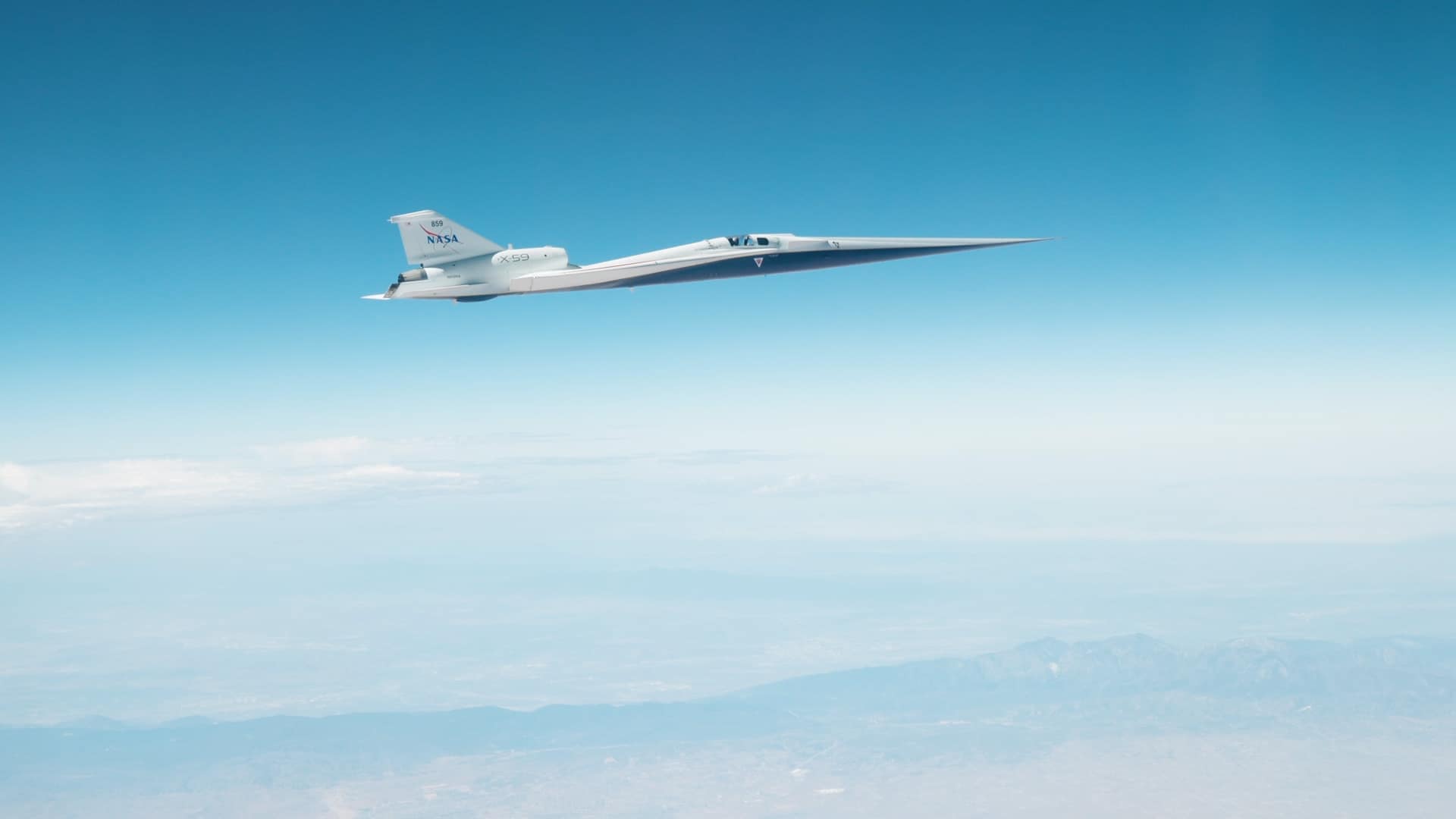
NASA's X-59 Quesst aircraft has reached the speed and altitude it was built to fly. On June 12, 2026, test pilot Jim "Clue" Less pushed the needle-nosed experimental jet to Mach 1.4 at 55,000 feet over Edwards Air Force Base — the exact conditions under which it will soon fly over American communities to prove that supersonic flight does not have to mean sonic booms.
The milestone came just one week after the X-59 broke the sound barrier for the first time at Mach 1.1 on June 5. In a program that spent years on the ground dealing with structural and systems issues, the flight test campaign has now achieved in days what once seemed years away. Sixteen flights in 90 days preceded the supersonic breakthrough.
If the X-59 delivers on its promise, it could overturn a federal ban on civilian supersonic overland flight that has stood since 1973 — opening the door to a new generation of quiet supersonic airliners.
Quick Facts: X-59 Quesst
- Speed Achieved: Mach 1.4 (~924 mph) at 55,030 feet
- Date: June 12, 2026
- First Supersonic Flight: June 5, 2026 (Mach 1.1)
- Test Pilot: Jim "Clue" Less
- Base: Edwards Air Force Base, California
- Sonic Thump Target: ~75 EPNdB (comparable to a car door closing)
- Built By: Lockheed Martin Skunk Works
- Supersonic Ban: 14 CFR 91.817, in effect since 1973
The Sound That Changes Everything
The X-59's entire reason for existence is acoustic. When a conventional aircraft exceeds Mach 1, the resulting shockwaves coalesce into a sharp, double-crack sonic boom that can rattle windows and frighten livestock for miles. The Concorde generated booms measuring approximately 105 EPNdB — loud enough that the U.S. and most other nations banned supersonic flight over land, effectively killing the commercial supersonic market everywhere except over oceans.
The X-59 takes a fundamentally different approach. Its elongated nose — the aircraft is 99.7 feet long but remarkably slender — is shaped to prevent shockwaves from merging. Instead of a boom, observers on the ground should hear only a gentle "thump" measuring approximately 75 EPNdB, roughly equivalent to a car door closing at a moderate distance.
From Subsonic Crawl to Supersonic Sprint
The path to Mach 1.4 was neither quick nor easy. The X-59 made its first flight on October 28, 2025, but remained subsonic for months as engineers methodically expanded the flight envelope. The aircraft completed 16 flights in 90 days before its first supersonic run — a pace that reflects both the careful incrementalism of NASA flight testing and the urgency of a program running behind its original schedule.
That understated cockpit experience is precisely the point. If the pilot cannot feel the transition to supersonic flight, the aircraft's shockwave management is working as designed. The real test, however, will come when ground-based microphones measure what people on the surface actually hear.
Community Overflights: The Real Mission
Reaching Mach 1.4 at 55,000 feet was not just a performance milestone — it was a prerequisite. These are the approximate conditions under which the X-59 will fly over selected communities across the United States. NASA will deploy arrays of ground-based microphones to record the aircraft's acoustic signature, then survey residents to gauge their response to the quieter sonic "thumps."
This data will be shared with both the FAA and the International Civil Aviation Organization (ICAO) to inform the establishment of new, data-driven acceptable noise thresholds for supersonic overland flight. If the results confirm what NASA expects — that the X-59's shaped sonic signature is acceptable to communities — regulators could rewrite the rules that have grounded supersonic airliners over land for more than half a century.
Related Questions
What is the NASA X-59?
The X-59 Quesst is an experimental aircraft built for NASA by Lockheed Martin's Skunk Works to demonstrate quiet supersonic flight. Its long, needle-like nose is shaped to spread out the shockwaves that normally merge into a loud sonic boom, turning the noise into a soft "sonic thump" instead.
How fast can the X-59 fly?
On June 12, 2026, the X-59 reached its design speed of Mach 1.4 — about 924 mph — at just over 55,000 feet above Edwards Air Force Base in California. It had first broken the sound barrier a week earlier, on June 5, 2026, at Mach 1.1.
How does the X-59 reduce the sonic boom?
Its shape is carefully sculpted so the shockwaves from different parts of the aircraft do not coalesce into one sharp crack. The goal is a "sonic thump" of around 75 EPNdB, roughly as loud as a car door closing, compared with the Concorde's booms of about 105 EPNdB.
Why is supersonic flight banned over land?
Since 1973, U.S. rule 14 CFR 91.817 has effectively banned civil supersonic flight over land because of disruptive sonic booms. That ban helped end the commercial supersonic market — the same pressures that grounded projects like the Soviet Concorde — and the X-59 aims to show it could safely be revisited.
Who built the X-59?
The X-59 was built by Lockheed Martin's Skunk Works, the famed advanced-projects division behind aircraft such as the SR-71 Blackbird. It flies as part of NASA's Quesst (Quiet SuperSonic Technology) mission to gather community noise data for regulators.
What This Means for the Future of Flight
The commercial implications are enormous. Companies like Boom Supersonic, with its Overture airliner in development, are watching the X-59 program intently. A reversal of the supersonic overland ban would dramatically expand the viable route network for supersonic airliners — turning what is currently an ocean-only proposition into a genuinely transformative mode of air travel.
For now, the X-59 will continue its flight test program at Edwards AFB, refining its supersonic performance before the community overflight phase begins. After 53 years of enforced silence, the skies over America may soon hear something new — and barely notice it.
Sources: NASA, Scientific American, The Aviationist, Engadget, TechBriefly
Related Posts
- X-59: Son of Concorde Goes Quiet Supersonic
- Boom Supersonic Overture: Where Things Stand
- The Concorde: A Legend of Aviation
0 Comments