
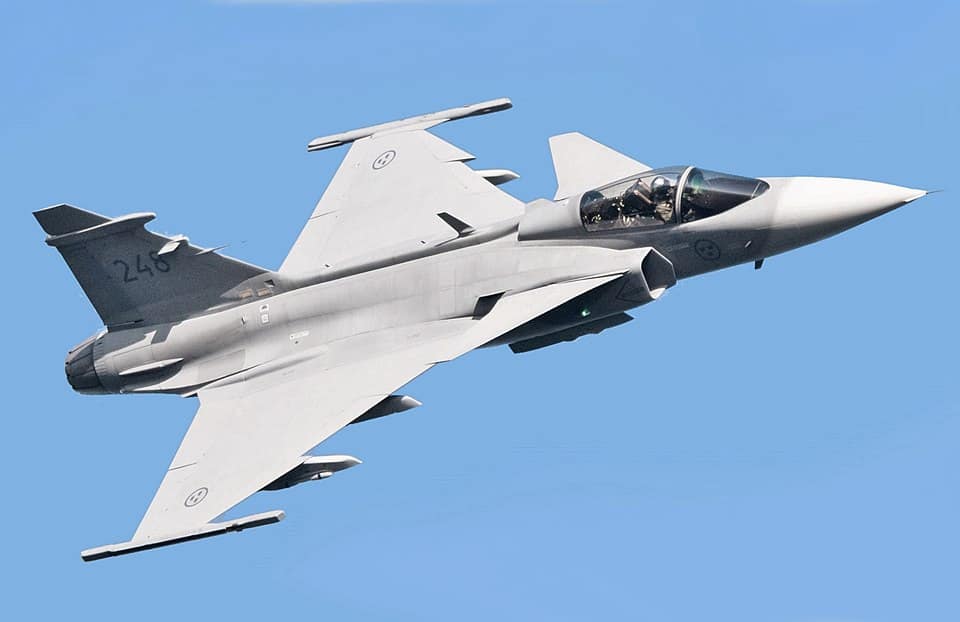
On the second of June, under the pale Swedish summer sky of Linköping, Saab pulled back the curtain on something the fighter aviation world has been watching for years: the Gripen F, the world’s first two-seat variant of the Gripen E-series. The ceremony, hosted at Saab’s facilities in the city that has built Swedish fighters since the Second World War, drew an audience that included Saab CEO Micael Johansson, Brazilian Minister of Defence José Múcio, Swedish Defence Minister Pål Jonson, and the commander of the Brazilian Air Force, Lieutenant-Brigadier Marcelo Kanitz Damasceno.
This was not merely a rollout — it was the culmination of a decade-long industrial partnership between Sweden and Brazil, one that has trained hundreds of Brazilian engineers and technicians while producing a fighter jet that both nations can call partly their own. The Gripen F will carry the Brazilian designation F-39F, and when it enters operational service, it will be the most advanced two-seat fighter produced in Europe outside the Eurofighter Typhoon programme.
For Saab, the timing could not be better. With Gripen orders now confirmed from Thailand and Colombia, and Ukraine taking steps toward acquisition, the Gripen F transforms from a Brazilian bespoke into a genuine multi-customer product.
Quick Facts
- Aircraft: Saab Gripen F — two-seat variant of the Gripen E
- Rollout: 2 June 2026, Linköping, Sweden
- Launch customer: Brazilian Air Force (FAB), designation F-39F
- Contract: 36 aircraft total — 28 Gripen E + 8 Gripen F (signed 2014)
- Delivered so far: 11 aircraft to Brazil since 2020
- Dimensions: 15.9 m length (+70 cm over Gripen E), 8.6 m wingspan, 16,500 kg MTOW
- Engine: GE F414G turbofan, 98 kN afterburning thrust
- Additional orders: Thailand and Colombia
More Than a Trainer With Two Seats
One must dispel immediately the reflex to call the Gripen F a “training variant.” That framing misses the point entirely. Unlike the two-seat versions of older fighters — the F-16D, the MiG-29UB — which sacrificed fuel, range, or weapons stations to accommodate an instructor, the Gripen F was designed from inception as a combat aircraft that happens to seat two.
The airframe retains the Gripen E’s maximum take-off weight of 16,500 kilograms. It uses the same General Electric F414G turbofan engine, delivering 98 kN of afterburning thrust. The avionics suite, including the Selex ES-05 Raven AESA radar and the comprehensive electronic warfare system, remains identical. What the second cockpit provides is not a compromise — it is operational flexibility: a weapons systems officer for complex strike missions, a mission commander for networked operations, or yes, an instructor for conversion training.
“Unlike traditional two-seat fighters that primarily serve training purposes, the Gripen F was conceived as a fully combat-capable aircraft capable of conducting the same operational missions as the single-seat Gripen E while providing additional operational flexibility through a second crew member.”
Saab Defence
Official Gripen F programme description
The single concession is the internal Mauser BK27 cannon, which is omitted to accommodate the extended fuselage. The Gripen F’s length grows by 70 centimetres, from 15.2 to 15.9 metres. Everything else — the 10 weapon stations, the data-link architecture, the in-flight refuelling capability — carries over.

Brazil’s Fighter, Sweden’s Engineering
The Gripen F story is inseparable from the broader Brazil-Sweden defence relationship. When Brasília signed the 2014 contract for 36 Gripens — 28 single-seat Es and eight two-seat Fs — it was not simply buying aircraft. It was buying a technology transfer programme of remarkable scope. Hundreds of Brazilian engineers rotated through Saab’s facilities in Linköping. Embraer established a Gripen production line in Gavião Peixoto. The first Brazilian-assembled Gripen E was unveiled earlier in 2026.
This partnership has made Brazil the only nation outside Sweden with deep structural knowledge of the Gripen platform. It has also given Saab a foothold in Latin America’s largest defence market and, more importantly, a co-development partner whose ambitions keep pushing the programme forward. The Brazilian government has announced plans to invest 2.1 billion reais in the Gripen programme in 2026 alone, and reports suggest Brasília is eyeing an additional order of 20 Gripens to replace its ageing F-5 fleet.
“The roll-out of Gripen F represents a shared achievement between Saab, Brazilian industry and the Brazilian Air Force, reflecting the deep trust we have built together over many years. It represents not only a highly capable fighter for the Brazilian air force, but also the tangible outcome of sustained joint development and shared ambition.”
Lars Tossman
Head of Business Area Aeronautics, Saab
A Growing Order Book
Perhaps the most strategically significant detail to emerge from the Linköping ceremony was confirmation that the Gripen F’s customer list now extends beyond Brazil. Thailand and Colombia have both placed orders for the two-seat variant, turning what began as a Brazilian requirement into a multi-nation programme.
Saab CEO Micael Johansson expressed confidence during the press conference that Colombia will maintain its order despite an upcoming change of government. He also offered an intriguing aside: Saab is developing unmanned aerial vehicles that will fly in the near future, raising the prospect of manned-unmanned teaming operations with the Gripen as the command platform.
With Ukraine and Sweden taking formal steps toward a Gripen acquisition — and Canada recently revisiting its fighter options — the Gripen E/F family may be entering the most commercially productive period in its history. The two-seat variant gives Saab something its main competitors in the light-fighter market have struggled to offer: a modern, fully combat-capable tandem cockpit without the political complexity of an American or European consortium programme.
Sources: Saab Press Release, FlightGlobal, Defence Blog, Airforce Technology, Nordic Defence Sector, Aviation A2Z, Army Recognition
 English
0 Comments