

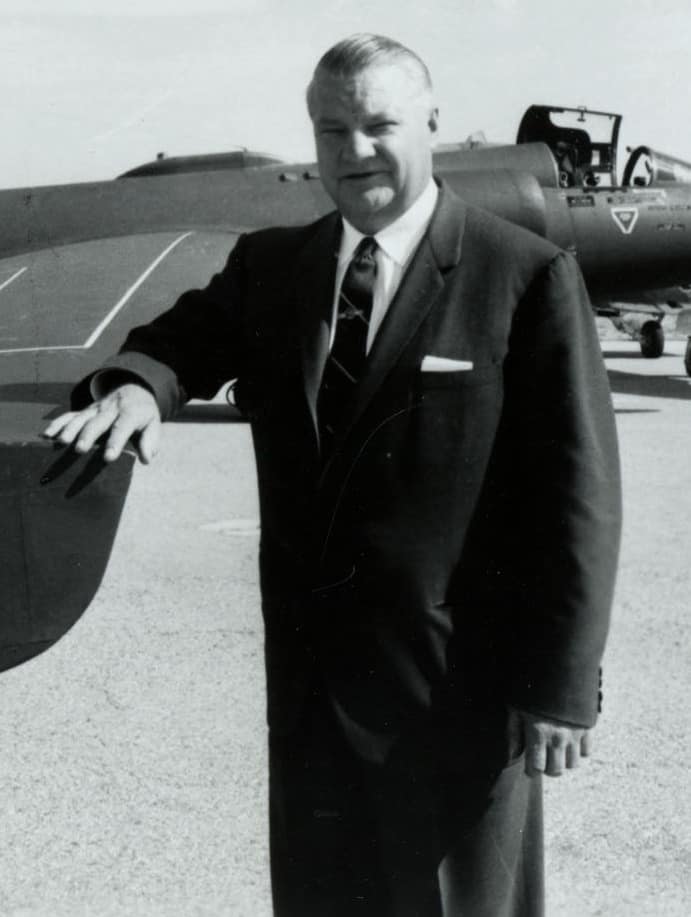
In December 1951, Clarence “Kelly” Johnson — the most brilliant aircraft designer America ever produced — sat in a cold briefing room at a forward air base in Korea. Around him, combat pilots fresh from tangling with MiG-15s over the Yalu River told him exactly what they wanted: a small, fast, simple fighter that could climb like a rocket and outrun anything in the sky. No committees, no compromises, no multi-role bloat. Just speed and altitude.
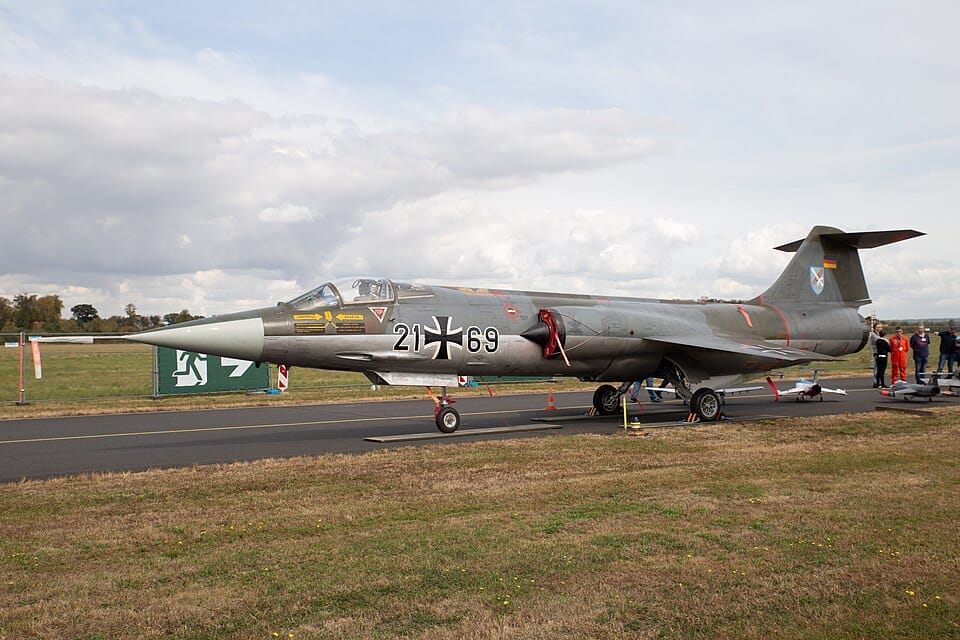
Johnson went back to Lockheed’s Skunk Works in Burbank and drew them a missile with a man in it. The result was the F-104 Starfighter — an aircraft so radical it looked like it had been designed for a different planet. Its fuselage was a needlepoint. Its wings were so thin and sharp they needed protective covers on the ground to prevent ground crews from cutting themselves. It was the first operational fighter to sustain Mach 2 in level flight, the first to hold simultaneous world records for speed and altitude. It was, by any measure, a masterwork of aeronautical engineering.
It was also, in the hands of some operators, one of the deadliest aircraft of the Cold War — though the reasons for that had almost nothing to do with Kelly Johnson’s design.
Quick Facts
- First flight: 4 March 1954 (XF-104)
- Manufacturer: Lockheed, Burbank, California
- Powerplant: 1 × General Electric J79-GE-11A turbojet, 15,800 lbf with afterburner
- Maximum speed: Mach 2.0 (1,328 mph / 2,137 km/h)
- Wingspan: 21 ft 11 in (6.68 m)
- Length: 54 ft 9 in (16.69 m)
- Service ceiling: 58,000 ft (17,700 m)
- Total built: 2,578
- Operators: 15 nations
- Nicknames: “The Missile with a Man in It,” “Witwenmacher” (Widowmaker), “Erdnagel” (Tent Peg), “The Flying Coffin”
Kelly Johnson’s Perfect Interceptor
The F-104 was designed for exactly one mission: climb fast, intercept high, destroy the target, go home. Kelly Johnson stripped away everything that did not serve this purpose. The wing was absurdly small — just 196 square feet, giving the aircraft a wing loading of roughly 105 pounds per square foot, far higher than any fighter before it. The leading edges were machined to a thickness of just 0.016 inches (0.41 mm). At that thinness, they functioned more like knife blades than airfoils. Ground crews genuinely needed to be careful not to cut themselves.
The fuselage was essentially a tube built around the massive General Electric J79 turbojet — at the time, the most powerful engine available for a single-engine fighter. With afterburner, the J79 produced 15,800 pounds of thrust, enough to push the 22,000-pound aircraft past Mach 2 in level flight. The cockpit was a cramped afterthought perched on top of the intake duct, giving the pilot an excellent forward view but precious little else.
In its original USAF role as a high-altitude interceptor, the F-104A performed brilliantly. It set world records: on 7 May 1958, Major Howard C. Johnson reached 91,243 feet in a zoom climb. Nine days later, Captain Walter Irwin set a speed record of 1,404.19 mph. For a brief, shining moment, the Starfighter was the fastest and highest-flying fighter on earth.
The Deal of the Century — and the Disaster That Followed
Then NATO came calling. In the late 1950s, the alliance needed a common tactical strike fighter for its European members. Lockheed saw an opportunity to sell thousands of F-104s to allied nations, and what followed became known as the “Deal of the Century” — or, less charitably, one of the most controversial arms sales in history.
West Germany alone ordered 916 F-104G Starfighters. Canada bought 238. Italy took 360. Belgium, the Netherlands, Norway, Denmark, Greece, Turkey, Japan, Spain, and others signed up too. By the mid-1960s, the Starfighter was the backbone of NATO’s tactical air power in Europe.
There was one fundamental problem: the Europeans did not want an interceptor. They wanted a low-altitude strike fighter that could deliver nuclear weapons under the radar in Central Europe’s notoriously bad weather. The F-104G variant was accordingly modified with strengthened landing gear, additional weapons pylons, and avionics for all-weather ground-attack missions. The aircraft gained weight. Its already-tiny wing — designed for thin air at 50,000 feet — was now expected to perform at treetop level in rain, fog, and turbulence.

The Witwenmacher — Germany’s Starfighter Crisis
Germany’s experience with the Starfighter was catastrophic. Of 916 aircraft, 292 crashed — a loss rate of 31.8%. A total of 116 pilots were killed. The peak of the crisis came between February 1965 and July 1966, when a Starfighter was lost on average once every two weeks. During this period, 46 aircraft crashed and 29 pilots died. The accident rate peaked at a staggering 139 losses per 100,000 flying hours.
The German public was horrified. Newspapers dubbed the aircraft “Witwenmacher” — the Widowmaker. Others called it “Erdnagel” (tent peg, because they fell straight down), “Fliegender Sarg” (flying coffin), or, with dark humour typical of the era, “the best distributor of Lockheed spare parts in the world.” The scandal became political. The Bundestag launched investigations. Defence ministers were questioned. Careers ended.
The bribery dimension made everything worse. In 1976, it emerged that Lockheed had paid at least $22 million in bribes to foreign officials to secure Starfighter contracts. Former Lockheed lobbyist Ernest Hauser told US Senate investigators that West German Defence Minister Franz Josef Strauss and his party had received at least $10 million in connection with the 1961 purchase. Strauss denied the allegations and filed a slander suit; the charges were never formally proven. But a Bundestag committee of inquiry (1978–1979) found that most documents relating to the original procurement had been destroyed in 1962 — a detail that did nothing to ease public suspicion.
The Numbers Tell the Real Story
Here is where the Starfighter narrative becomes more nuanced than the “Widowmaker” legend suggests. Germany was by far the worst operator of the F-104, but Germany was also using the aircraft in ways it was never designed for, in weather conditions it was never intended to face, with pilots who were often transitioning from subsonic aircraft with no dedicated Mach 2 experience. The F-104’s accident record varied dramatically by country:
| Country | Fleet Size | Aircraft Lost | Loss Rate (%) | Pilots Killed |
|---|---|---|---|---|
| West Germany | 916 | 292 | 31.8% | 116 |
| Canada | 238 | 110 | 46.2% | 37 |
| Belgium | 100 | 41 | 41.0% | 36 |
| Italy | 360 | 137 | 38.0% | ~50 |
| Netherlands | 138 | ~43 | ~31% | 21 |
| Norway | 43 | 6 | 14.0% | 4 |
| Japan | 230 | ~35 | ~15% | — |
| Spain | 21 | 0 | 0% | 0 |
The contrast is stunning. Spain operated 21 Starfighters for seven years and 17,500 flight hours without a single accident. Norway’s loss rate of 14% was entirely manageable by Cold War standards. Japan, which operated the F-104J in its original interceptor role, lost roughly 15% of its fleet — comparable to other fighter types of the era.
Germany’s 31.8% looks terrible on its own, but even that figure needs context. The German F-84 Thunderjet, which the Starfighter replaced, had a loss rate of 36.2%. The RAF’s English Electric Lightning, a contemporary supersonic interceptor, had a loss rate of 17.3 per 100,000 flying hours — actually worse than Germany’s lifetime Starfighter rate of 15.08 per 100,000 hours. The Cold War was brutal on fighter fleets everywhere. NATO nations collectively lost thousands of fighters in peacetime accidents during the 1960s and 1970s.
What Went Wrong in Germany
The question is not “why did Starfighters crash?” but “why did they crash so much more often in Germany during the mid-1960s?” The answer involves a chain of compounding factors, each of which made the next worse.
First, the role change. Kelly Johnson designed the F-104 as a high-altitude interceptor — a jet that would climb vertically to 50,000 feet, fire its missiles, and return to base. Germany turned it into a nuclear-strike aircraft that would fly at treetop level over the North German Plain in weather conditions that would ground most civilian pilots. The tiny wing that worked perfectly in thin air at altitude struggled to produce adequate lift in the thick, turbulent air at 200 feet.
Second, the weight. The F-104G gained roughly 1,500 pounds over the original F-104A through additional avionics, strengthened structure, and weapons pylons. That extra weight raised the already-high wing loading to levels where any loss of speed — in a turn, during a climb, after a missed approach — could push the aircraft dangerously close to its stall speed.
Third, the training pipeline. The Bundeswehr was building an entirely new air force from scratch. Many German pilots in the early 1960s had limited jet experience and were transitioning directly to a Mach 2 fighter with handling characteristics unlike anything else in the NATO inventory. The USAF and Norway, by contrast, operated the F-104 with experienced pilots who had prior high-performance jet time.
The Era of the Crash
It is also essential to understand the broader context. The 1960s and 1970s were an era of extraordinary aircraft losses across all NATO air forces, not just those operating the F-104. Enormous fleets — tens of thousands of military jets globally — were being operated in demanding conditions with safety standards, ejection seats, and pilot training procedures that would be considered inadequate by modern standards.
The Soviet Union lost MiG-21s at a rate of roughly 30 per 100,000 flying hours. The Bulgarian MiG-19 rate reached an astonishing 100 per 100,000 hours. The USAF’s own F-100 Super Sabre had a cumulative destruction rate of 16.2 per 100,000 hours. The F-105 Thunderchief — another era-defining American fighter — came in at 15.6. Fighter aviation in the Cold War was, by modern standards, breathtakingly dangerous.
The Starfighter’s reputation as uniquely deadly is partly a product of Germany’s very public experience and partly a product of scale. Germany’s 292 losses were the single largest national total for any F-104 operator, and every crash made headlines. A Norwegian or Japanese Starfighter loss, by contrast, attracted far less international attention. The aircraft became a symbol — fairly or unfairly — of everything wrong with Cold War military procurement.
A Reliable Design, Misused
The critical point that gets lost in the Widowmaker narrative is this: the Lockheed F-104 was a sound design for its intended purpose. As a high-altitude interceptor, it was superb. Norway, Japan, and Spain proved that the aircraft could be operated safely when used within its design envelope and flown by properly trained pilots.
What Germany did was take a razor-edged high-altitude interceptor and send it into low-altitude terrain-following missions in Central European weather. That is not a design flaw — it is a doctrine problem. The F-104G was asked to be something Kelly Johnson never intended it to be, and the result was predictable in hindsight.
The Lockheed bribery scandal only deepened the tragedy. If the procurement process was corrupt, then Germany might have been better served by a different aircraft — one designed from the outset for the low-altitude strike mission. The Starfighter paid the reputational price for a political and procurement failure that had little to do with engineering.
Fly a Starfighter Today
The F-104 Starfighter is no longer a military weapon. It is a legend — and, remarkably, it is one you can still fly.
MiGFlug offers F-104 Starfighter flights from NASA’s Kennedy Space Center in Florida, operated in partnership with Starfighters Space. These aircraft are maintained to exacting civilian standards and flown by highly experienced pilots. MiGFlug’s safety record is perfect — zero incidents across more than 20 years and over 10,000 flights.
The two-day programme includes comprehensive ground training and a back-seat flight in a two-seat TF-104G Starfighter. Participants experience the raw power of the J79 engine, supersonic flight above the Florida coastline, and the visceral sensation of sitting in one of the most iconic jets ever built. It is the closest any civilian can get to the Mach 2 interceptor experience that Kelly Johnson designed in a Burbank workshop seventy years ago.
The F-104’s story is ultimately not about crashes. It is about an aircraft that was too fast, too pure, and too specialized for the messy compromises of Cold War geopolitics — and about what happens when a brilliant design is forced into a role it was never meant to fill. Today, in the hands of skilled civilian operators with a flawless safety record, the Starfighter finally gets to be what Kelly Johnson always intended: the most thrilling ride in the sky.
Sources: Purdue University Journal of Aviation Technology and Engineering (HFACS Analysis of German F-104 Accidents), Key Aero, Wikipedia, National Interest, Aviation Geek Club, International F-104 Society, joebaugher.com, 916-starfighter.de
 English
0 Comments