
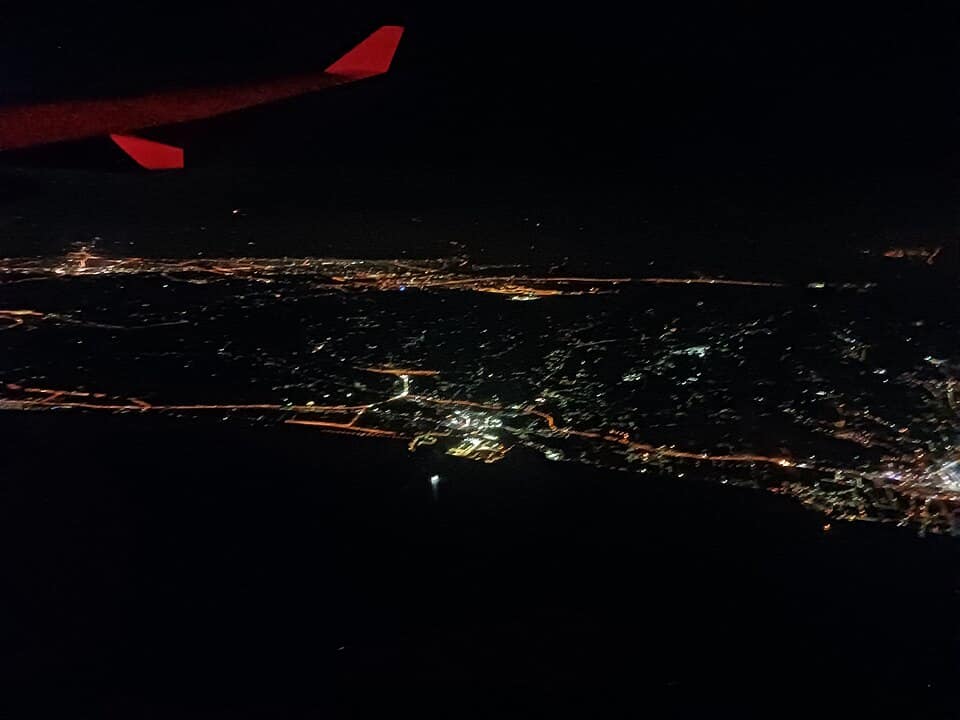
Definition of "Night" FAA: the period from the end of evening civil twilight to the beginning of morning civil twilight. For logging night landings: one hour after sunset to one hour before sunrise
Currency Rule To carry passengers at night, pilots must have made at least 3 takeoffs and landings to a full stop within the preceding 90 days, during the night period
Key Illusions Black-hole approach, autokinesis, false horizon, featureless terrain illusion
Equipment Required Position lights, anti-collision lights, landing light (if for hire), flashlight with spare batteries, and all standard day VFR instruments

The sun drops below the horizon, the sky turns from orange to purple to black, and the runway lights come on. You're about to do something most student pilots spend weeks both dreading and craving: your first night flight. Everything you thought you knew about flying is about to get turned inside out.
Night flying is not the same as day flying with the lights off. It changes the way you navigate, the way you land, the way you judge distance, and the way your own eyes and brain work. Pilots who train at night become dramatically better aviators — not because night flying is harder (though it is), but because it forces you to trust your instruments, plan ahead, and pay attention to things daylight lets you ignore.
Here's what actually happens when the sun goes down and you climb into the left seat.
Your Eyes Are Lying to You
The biggest difference between day and night flying isn't visibility — it's the way your visual system betrays you. During the day, your eyes use cone cells to see colour and detail in bright light. At night, you switch to rod cells, which are sensitive to low light but terrible at colour and detail. Rods also have a blind spot right in the centre of your vision. This means the harder you stare at something at night, the more likely it is to disappear. Pilots learn to use "off-centre viewing" — looking slightly to the side of what they want to see, letting the peripheral rods pick up the image.
Full dark adaptation takes 30 minutes. Most student pilots show up for their night lesson having just walked through a brightly lit FBO with a phone screen blazing in their face. Their eyes aren't ready. Smart instructors tell students to wear sunglasses during the preflight briefing and to avoid white light for at least 20 minutes before flying. Red cockpit lighting helps — red light doesn't reset your rod cells the way white light does.
Then there are the illusions. Autokinesis is the one that catches everyone off guard: stare at a single stationary light against a dark background — a radio tower, a distant farmhouse — and your brain will convince you it's moving. Pilots have chased "aircraft" that turned out to be stars. In featureless terrain at night, a sloping field of lights can create a false horizon, tricking pilots into banking when they're level. The black-hole approach is the most dangerous: flying an approach over dark water or unlit terrain toward a runway with no surrounding lights, the brain has zero depth cues, and pilots consistently fly too low.

The Runway Looks Different
During the day, you judge your approach by looking at the runway shape — the trapezoid gets wider as you get closer, the aspect ratio tells you if you're high or low. At night, the runway becomes two rows of white edge lights and a set of coloured approach indicators. The visual picture is completely different, and it takes practice to calibrate your brain.
The PAPI (Precision Approach Path Indicator) becomes your best friend. Four lights beside the runway glow red or white depending on your glidepath angle. Two red, two white means you're on the correct 3-degree glideslope. Three or four red? You're low — add power immediately. All white? You're high. At night, these four lights replace the entire visual approach picture that daylight gives you for free.
Landing at night also reveals a universal student pilot tendency: flaring too high. In daylight, you can see the runway surface rushing up to meet you. At night, the landing light illuminates a patch of concrete that looks oddly two-dimensional. Students lift the nose too early, float, and either balloon back up or drop in. The fix is patience — let the runway lights spread in your peripheral vision, keep the approach speed nailed, and don't flare until the lights start to blur.

Navigation Changes Everything
Flying cross-country during the day, you navigate by looking outside: follow the highway, find the lake, turn at the town with the big church steeple. At night, most of those landmarks vanish. Towns become clusters of light. Highways become strings of moving headlights. Lakes become black voids — indistinguishable from unlit farmland or forest. Pilotage — the art of navigating by visual reference — becomes unreliable.
This is where night flying makes you a better pilot. Without visual crutches, you learn to navigate properly — using VOR radials, GPS waypoints, and dead reckoning. You learn to track your position on the chart instead of winging it. You learn to plan fuel stops with more precision because "I'll just figure it out when I get there" doesn't work when "there" is a dark patch on a dark landscape.
Weather awareness sharpens too. During the day, you can see a thunderstorm from 50 miles away. At night, the same storm is invisible until you fly into it — or until lightning illuminates the cumulonimbus wall and your stomach drops. Night pilots learn to check weather more carefully, avoid marginal VFR conditions, and respect the forecast in a way that daylight flying never forced them to.
The Best View in Aviation
For all the challenges, night flying delivers something that no other flying experience can match. At 3,000 feet on a clear night, the view from the cockpit is staggering. City grids stretch to the horizon in orange and white. The Milky Way arcs overhead in a way you've never seen from the ground. The air is smooth — thermals die at sunset, and the atmosphere calms down. The radio is quiet. It's just you, the hum of the engine, and a sky full of stars.
Every pilot remembers their first night cross-country. It's usually terrifying for the first 20 minutes and transcendent for the rest. Something about seeing the world laid out in light below you, with nothing but darkness above, rewires your understanding of what flying is. Daylight flying is transport. Night flying is poetry.
If you're a student pilot reading this, don't dread the night hours. Embrace them. They'll make you sharper, more disciplined, and more precise — and they'll give you some of the most beautiful moments you'll ever have in an airplane. Just remember: let your eyes adapt, trust the instruments, and don't stare at the stars. They'll move if you do.
Sources: FAA Pilot's Handbook of Aeronautical Knowledge (FAA-H-8083-25C), Boldmethod, AOPA Flight Training resources
Related Questions
What is it like to fly an aircraft at night?
Flying at night offers spectacular views of city lights and stars, but it is more demanding than daytime flying. Pilots rely far more on instruments, judging distance and terrain is harder, and visual illusions are common. Proper training and currency make night flying safe and, for many pilots, deeply rewarding.
How much night flying is required for a pilot's license?
For the US Private Pilot Licence, the FAA requires a minimum of 3 hours of night flight training, including 10 night takeoffs and landings and a longer night cross-country flight. This ensures new pilots can safely handle an aircraft after dark before earning their certificate. Read more on learning to fly.
What counts as 'night' for pilots?
The FAA defines night as the period from the end of evening civil twilight to the beginning of morning civil twilight. For logging night takeoffs and landings, a stricter window applies: from one hour after sunset to one hour before sunrise, when it is genuinely dark.
What are the dangers of night flying?
Night flying introduces visual illusions that can disorient pilots, including the black-hole approach, autokinesis, the false horizon and featureless-terrain illusion. Reduced visibility also makes spotting obstacles and other traffic harder. Pilots counter these risks through instrument skills, good lighting and strict currency requirements.
What equipment do you need for night flying?
Night flying requires position lights, anti-collision lights, a landing light (if flying for hire), a working flashlight with spare batteries, and all the standard day VFR instruments. Reliable cockpit and navigation lighting is essential, since pilots depend heavily on their instruments after dark. A current medical certificate is also required to fly.

0 Comments