South Korea builds its own fighter jets. It builds its own tanks, its own artillery, its own warships. But it does not build its own jet engines. Every KF-21 Boramae that rolls off the line in Sacheon is powered by an American General Electric F414 — the same turbofan that drives the U.S. Navy Super Hornet. If Washington ever decided to restrict engine exports, South Korea’s entire next-generation combat aviation programme would grind to a halt.
On 26 May 2026, Seoul announced it is done accepting that vulnerability. The Korea AeroSpace Administration (KASA) formally launched a state-funded programme to develop South Korea’s first indigenous military turbofan engine, with roughly 90 billion won (approximately $65 million) in government funding allocated between 2026 and 2029. The target: a 4,500-pound-force high-bypass turbofan developed by 2029.
The programme is led by Hanwha Aerospace — the country’s largest defence conglomerate — in partnership with the Korea Aerospace Research Institute (KARI), universities, and domestic subcontractors.
Lead contractor: Hanwha Aerospace, with KARI, universities, and subcontractors
Funding: ~90 billion won (~$65 million), 2026–2029
Engine spec: 4,500 lbf high-bypass turbofan, dual civil-military use
Primary application: Future unmanned combat aircraft and collaborative combat drones
Target: Engine developed by 2029
Strategic goal: End reliance on Western engine imports for defence aviation
The Engine Gap
Jet engine design is the hardest problem in aerospace engineering. The temperatures inside a modern military turbofan exceed the melting point of the metals used to build it — the blades survive only because of intricate internal cooling channels and advanced thermal barrier coatings. The metallurgy, the aerodynamics, the manufacturing tolerances, and the control systems required to make a turbofan that reliably produces thousands of pounds of thrust in combat conditions represent decades of accumulated expertise.
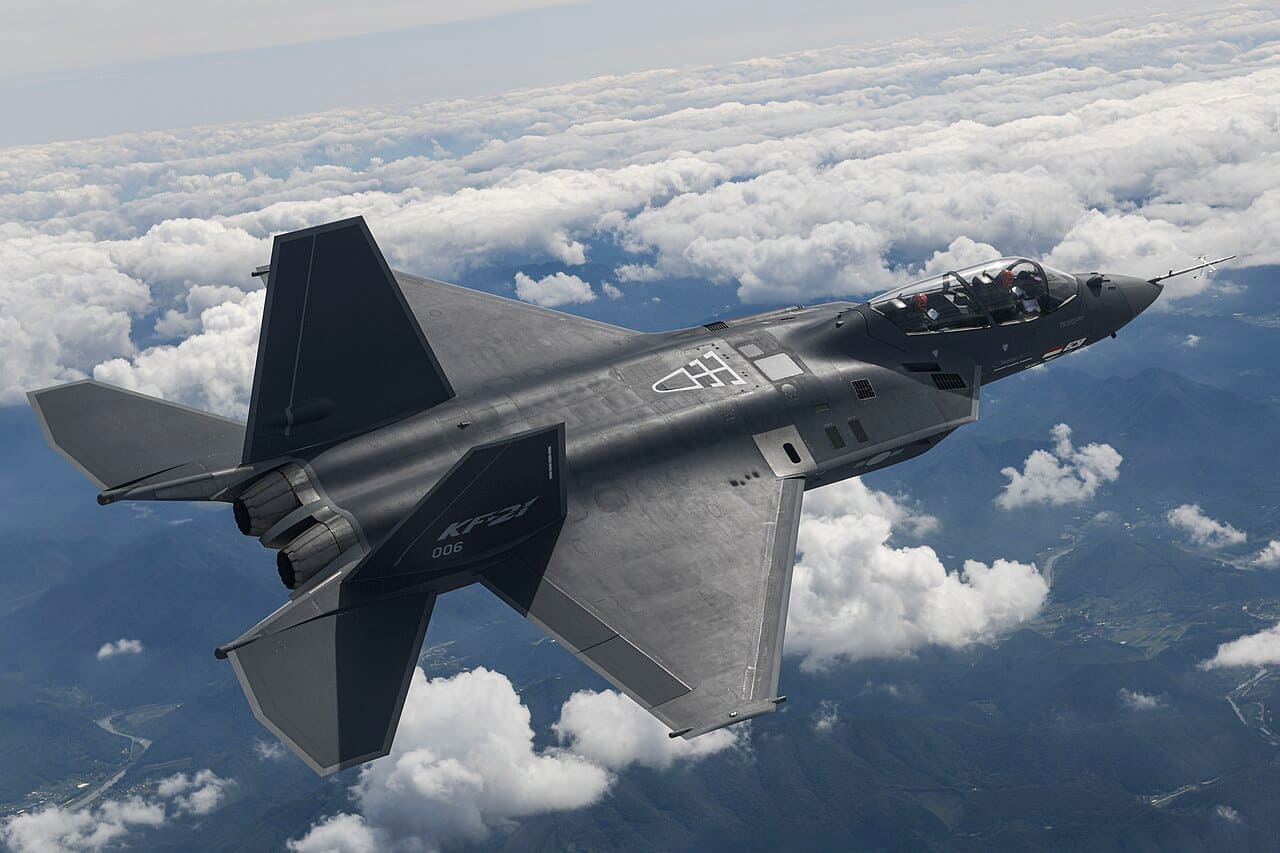
The KF-21 Boramae — currently powered by American GE F414 engines. South Korea wants to develop its own powerplant to end dependence on foreign engine suppliers. Wikimedia Commons
Only a handful of nations have mastered the technology for front-line military engines: the United States (GE, Pratt & Whitney), the United Kingdom (Rolls-Royce), France (Safran), and — with caveats — Russia and China. Every other country that builds fighter aircraft, including South Korea, Japan, India, and Turkey, relies on imported powerplants. The engine is the one component they cannot make themselves.
Seoul’s programme aims to change that, starting with a 4,500 lbf turbofan that is significantly less powerful than the 22,000 lbf F414 in the KF-21 but perfectly sized for the unmanned combat aircraft and loyal-wingman drones that South Korea sees as the future of its air force.
Why Drones First
The decision to target drone powerplants rather than attempting a full-scale fighter engine immediately is shrewd. A 4,500 lbf turbofan is a manageable first step — the engineering challenges are real but not as extreme as the 20,000+ lbf class required for manned fighters. Success at this scale builds the industrial base, trains the workforce, and proves the metallurgy before Seoul attempts the bigger engine.
The global race toward collaborative combat aircraft — AI-powered drone wingmen that fly alongside manned fighters — has created enormous demand for exactly this class of engine. The United States, Australia, the UK, Turkey, and China are all developing CCA platforms. If Hanwha can produce a reliable, affordable turbofan in the 4,000–5,000 lbf range by 2029, South Korea will have not just a domestic capability but an export product.
According to South Korean government and industry officials, indigenous propulsion capability is intended to strengthen national defense supply resilience, reduce vulnerability to external supply disruptions, and improve export competitiveness for domestically developed aircraft.
Programme launch briefing, Sacheon — 26 May 2026
The Long Game
The 90 billion won programme is just the beginning. FlightGlobal has reported that South Korea has committed $3.4 billion to develop an indigenous fighter-class engine for the KF-21 itself — a far more ambitious effort that would take the country from drone-scale turbofans to the front rank of military engine manufacturers.
A key technical focus of the current programme is the integration of a starter-generator directly into the engine’s rotating shaft — a feature that simplifies the aircraft’s electrical architecture and is increasingly important for powering the energy-hungry sensors and electronic warfare systems that modern combat aircraft demand.
Three years is not much time to develop a jet engine from scratch. But South Korea has a track record of compressing timelines that other nations consider impossible — the KF-21 went from contract to first flight in roughly six and a half years. If Hanwha hits its 2029 target, South Korea will join an extremely exclusive club. And the F414s in those KF-21s will start to look like a temporary arrangement.
Sources: The Asia Business Daily, FlightGlobal, Defence Blog, Defense Arabia, EDR Magazine
Every fighter pilot trains for it. Most pray they'll never experience it. The moment a jet engine — the machine that keeps you flying at 500 knots and 30,000 feet — stops working. Whether it's a compressor stall that sounds like a cannon going off behind your seat, a...
Luca Parmitano has lived two lives that most people only dream about. In the first, he was a fighter pilot — flying AMX Ghibli attack jets for the Italian Air Force, deployed to Afghanistan, trained to fly low and fast into hostile territory. In the second, he became...
Before the Rafale, before the Mirage 2000, before the Mirage F1 — there was the Mirage III. Dassault's first supersonic fighter was a revelation when it entered service in 1961: a sleek, tailless delta that could break Mach 2, carry a nuclear bomb, and outfight...



 English
0 Comments