
Incident Date April 6, 2026
Location Company-owned airfield, California desert
Cause Under investigation — no injuries reported
Programme USAF Collaborative Combat Aircraft (CCA) — unmanned wingman drones
Budget $996.5 million requested for CCA procurement in FY2027; over $2.3 billion total
Competitors Anduril and Northrop Grumman

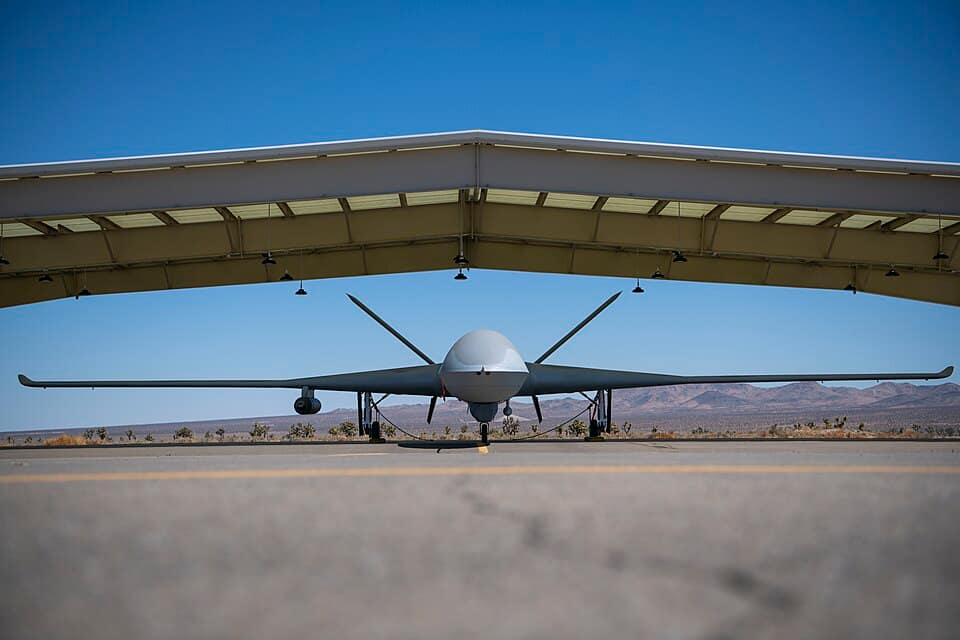
At roughly 1 p.m. Pacific on April 6, one of General Atomics' prototype YFQ-42A drones lifted off from a company airfield in the California desert, climbed briefly — and then came back down the hard way. The aircraft, a production-representative model of the Air Force's Collaborative Combat Aircraft programme, crashed shortly after takeoff. No one was hurt. Every subsequent test flight has been grounded pending an investigation.
The timing could not be worse. The Air Force is preparing to make a production decision on its CCA programme within the next six months — the single biggest procurement question in unmanned combat aviation. General Atomics is competing head-to-head with Anduril, and a crash during evaluation testing hands the competition a talking point it didn't have yesterday.
The CCA concept is deceptively simple: build semi-autonomous drone wingmen cheap enough to lose in combat, smart enough to fly alongside manned fighters, and lethal enough to matter. The Air Force wants them at under $25 million apiece — a fraction of an F-35 — so they can be deployed in numbers that overwhelm enemy air defences.
A Billion-Dollar Bet on Unmanned Wingmen
Budget documents released days before the crash show the scale of the Pentagon's ambition. The FY2027 request includes $996.5 million in CCA procurement — nearly a billion dollars — plus $150 million in advance procurement for 2028. Add $1.37 billion for continued research and development, and the total 2027 ask tops $2.3 billion.
Since fiscal year 2024, the service has spent almost $1.91 billion developing CCA. If per-unit cost stays below the $25 million target, the 2027 procurement funding alone could buy roughly 40 aircraft. The Air Force has not disclosed how many it plans to order.
General Atomics calls its CCA family "Gambit." The YFQ-42A that crashed was one of several production-representative prototypes built for Air Force evaluation — not a rough proof-of-concept, but an aircraft intended to demonstrate what the final product would look and fly like.

What Happens Next
General Atomics issued a brief statement confirming the mishap, noting that "established procedures and safeguards worked as intended." The company has paused all YFQ-42A flight testing until the cause is identified. No timeline has been given for resuming flights.
The crash comes at a particularly tense moment. In February, General Atomics completed a landmark demonstration — teaming an MQ-20 Avenger with an F-22 Raptor at Edwards Air Force Base, proving a drone wingman could coordinate in real time with America's most advanced air-superiority fighter. That success generated genuine momentum.
Whether this setback slows the programme depends on what investigators find. A software glitch or a one-off mechanical failure can be fixed. A design flaw in the airframe or flight-control system would be a different story — one that could shift the balance of the competition toward Anduril.
The Bigger Picture
CCA is not just another procurement line item. It represents a fundamental rethinking of how the Air Force fights. Instead of depending entirely on small fleets of expensive manned platforms — the F-35, the coming F-47 — the idea is to surround those jets with swarms of cheaper, expendable drones that can scout, jam, and strike.
If it works, it changes the math of air combat. An adversary that shoots down a $25 million drone instead of a $100 million fighter with a pilot inside has won a skirmish but lost the exchange. Multiply that across dozens of drones per sortie, and the calculus of air defence shifts dramatically.
One crash will not kill that vision. But it is a sharp reminder that building autonomous combat aircraft reliable enough to trust in contested airspace remains one of the hardest engineering challenges in modern aviation. The desert test range just proved it.
Sources: Air & Space Forces Magazine, Breaking Defense, Defense One, General Atomics
Related Questions
What is a Collaborative Combat Aircraft (CCA)?
A Collaborative Combat Aircraft is an unmanned "loyal wingman" drone designed to fly alongside crewed fighters, carrying weapons, sensors or jammers under the pilot's direction. The US Air Force's CCA programme aims to field large numbers of these autonomous jets cheaply, with rivals like Anduril and Northrop Grumman competing.
What is the YFQ-42A?
The YFQ-42A is General Atomics' prototype Collaborative Combat Aircraft, derived from its Gambit drone family and the MQ-20. A production-representative example crashed shortly after takeoff from a California desert airfield on April 6, 2026, with no injuries and the cause under investigation.
What is a loyal wingman drone?
A loyal wingman is an uncrewed aircraft that teams with a piloted fighter, autonomously handling tasks like scouting, jamming or attacking while the human pilot commands the formation. The concept underpins the US CCA programme and parallel efforts such as Europe's robot wingmen.
Who is building the US Air Force's CCA drones?
The Air Force selected multiple contractors for its Collaborative Combat Aircraft programme, including General Atomics (the YFQ-42A) and Anduril, with Northrop Grumman among the competitors. This multi-vendor approach mirrors how firms like Anduril are reshaping defense procurement.
How much is the US CCA programme worth?
The Air Force requested about $996.5 million for CCA procurement in fiscal year 2027, part of a programme valued at more than $2.3 billion overall. The investment reflects the service's bet that cheap, mass-producible drone wingmen will be central to future air combat.
0 Comments