
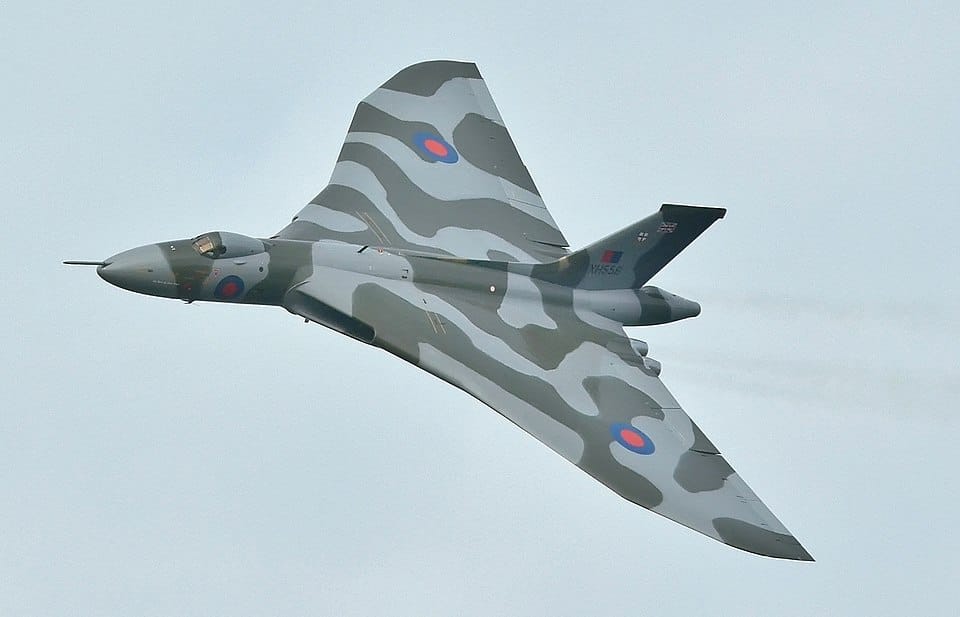
Aircraft Avro Vulcan B.2 (XM607, 101 Squadron RAF)
Crew Captain Flight Lieutenant Martin Withers
Distance ~8,000 miles round trip (Ascension Island to Port Stanley and back)
Flight Time ~16 hours
Tanker Support 11 Victor tankers, 5 mid-air refuellings each way
Weapons 21 x 1,000-lb conventional bombs
Target Port Stanley airfield runway, Falkland Islands
Result One bomb hit the runway; mission achieved strategic and psychological objectives

At 04:50 on April 30, 1982, a single Avro Vulcan bomber lifted off from Wideawake Airfield on Ascension Island, a volcanic speck in the mid-Atlantic, and turned south. Its target was 4,000 miles away — Port Stanley airfield on the Falkland Islands, occupied by Argentine forces for exactly four weeks. Getting there would require 11 tanker aircraft, five aerial refuellings, and a navigational feat that would have been ambitious in peacetime, let alone in a shooting war.
Operation Black Buck was the longest bombing mission in history at the time. It was also one of the most logistically absurd. The RAF was sending a nuclear-era strategic bomber — designed to carry a single weapon to Moscow — to drop conventional iron bombs on a runway at the edge of the known world. And the Vulcan had never been designed for aerial refuelling in the first place. The refuelling probe had been bolted on as an afterthought years earlier, then deactivated, then hastily reactivated when the Falklands War began.
Nothing about this mission made sense on paper. It worked anyway.
The Tanker Ballet
The mission's complexity was driven by a single problem: the Vulcan did not have the range. Ascension Island to the Falklands and back was roughly 8,000 miles. The Vulcan's combat radius was about 2,500 miles. Closing that gap required a cascade of aerial refuellings so elaborate it took a team of planners using a wall-sized chart to work out the sequence.
Eleven Handley Page Victor tankers — themselves converted bombers — launched alongside the Vulcan. The plan called for a chain of fuel transfers: Victors refuelling the Vulcan, Victors refuelling other Victors that would later refuel the Vulcan, and Victors turning back at calculated points as their own fuel ran low. Each link in the chain had to work perfectly. If one tanker failed, the entire sequence unravelled.
The refuelling was done at night, in radio silence, in formation, at 300 knots, using a probe-and-drogue system in which the Vulcan's pilot had to fly a probe on the nose of a 100-ton bomber into a basket trailing behind the tanker in the dark. The margin for error was measured in inches. One crew member later described it as "trying to thread a needle while riding a horse."

One Bomb on the Runway
Flight Lieutenant Martin Withers reached Port Stanley in the pre-dawn darkness. He descended to 10,000 feet, lined up on the runway, and released 21 one-thousand-pound bombs in a diagonal stick across the airfield. Of the 21 bombs, one scored a direct hit on the runway, cratering it near the centre. The rest fell across the airfield, damaging aircraft, equipment, and defences.
By precision-bombing standards, one hit out of 21 sounds like failure. But Black Buck was never about destroying the runway — the Argentines could repair a crater. It was about sending a message. Britain had just demonstrated that it could strike the Falklands from 4,000 miles away. If the RAF could hit Port Stanley, it could hit the Argentine mainland. Buenos Aires was closer to Ascension than the Falklands were.
Argentina got the message. After Black Buck, a significant number of Mirage III fighters were pulled back from the Falklands to defend the homeland — fighters that would otherwise have been available to attack the British task force. The single bomb crater on the runway paid for itself many times over in aircraft that never showed up to fight.
The Bomb Aimer Who Had Never Dropped a Bomb
Perhaps the most extraordinary detail of the mission is this: the Vulcan's bomb aimer had never dropped a live weapon before Black Buck. The Vulcan force had spent its entire operational life training for nuclear war — a mission in which the crew would release a single weapon and never see the result. Conventional bombing practice had been abandoned years earlier. When the Falklands War started, the crew had to relearn skills the RAF had let atrophy.
They practised frantically in the weeks before the mission, but the learning curve was steep. The bombing computer was designed for nuclear delivery profiles, not 21-bomb conventional sticks. The crew jury-rigged solutions, adapted procedures on the fly, and ultimately delivered a result that changed the strategic calculus of the war.
The Vulcan landed back at Ascension after 16 hours in the air, the crew exhausted, the aircraft running on fumes from its final tanker hookup. Seven Black Buck missions were flown in total during the war, including anti-radar strikes using Shrike missiles — another weapon the Vulcan had never been designed to carry. It was improvisation on a grand scale, executed under impossible time pressure, and it worked.
The Vulcan was retired from service three years later. It had been designed to destroy Moscow. Instead, it cratered a runway at the bottom of the world and scared Argentina into pulling its fighters home. Sometimes the most consequential missions are the most improbable ones.
Sources: RAF Museum, Imperial War Museum, Rowland White "Vulcan 607"
Related Questions
What was Operation Black Buck?
Operation Black Buck was a series of seven ultra-long-range RAF bombing raids during the 1982 Falklands War, flown by Avro Vulcan bombers from Ascension Island against Argentine positions on the Falklands. The first mission, on 30 April to 1 May 1982, was then the longest bombing raid in history.
How far was the Black Buck raid?
Each Black Buck mission covered roughly 8,000 miles round trip between Ascension Island and Port Stanley, taking about 16 hours. The single Vulcan needed 11 Victor tankers and five mid-air refuellings each way to reach its target and return.
What aircraft flew Operation Black Buck?
The raids were flown by the Avro Vulcan B.2, a delta-winged Cold War nuclear bomber originally designed to strike Moscow. For Black Buck 1, Vulcan XM607 of 101 Squadron RAF, captained by Flight Lieutenant Martin Withers, carried 21 conventional 1,000-lb bombs.
Did Operation Black Buck succeed?
Yes, in its main aim. On Black Buck 1 a single bomb struck the Port Stanley airfield runway, and while the physical damage was limited, the raid achieved its strategic and psychological goal, showing Argentina that mainland targets were within RAF reach during the Falklands War.
How many tankers did the Vulcan need for Black Buck?
Each Black Buck mission required 11 Victor tankers and five mid-air refuellings in each direction to extend the Vulcan's range across the 8,000-mile round trip. Coordinating that aerial-refuelling relay was as demanding as the bombing itself.
What was the Avro Vulcan?
The Avro Vulcan was a British delta-wing strategic bomber of the Cold War, built to carry nuclear weapons to the Soviet Union. By 1982 it was nearing retirement, yet it flew the record-setting Black Buck raids of the Falklands War as a conventional bomber.
0 Comments