
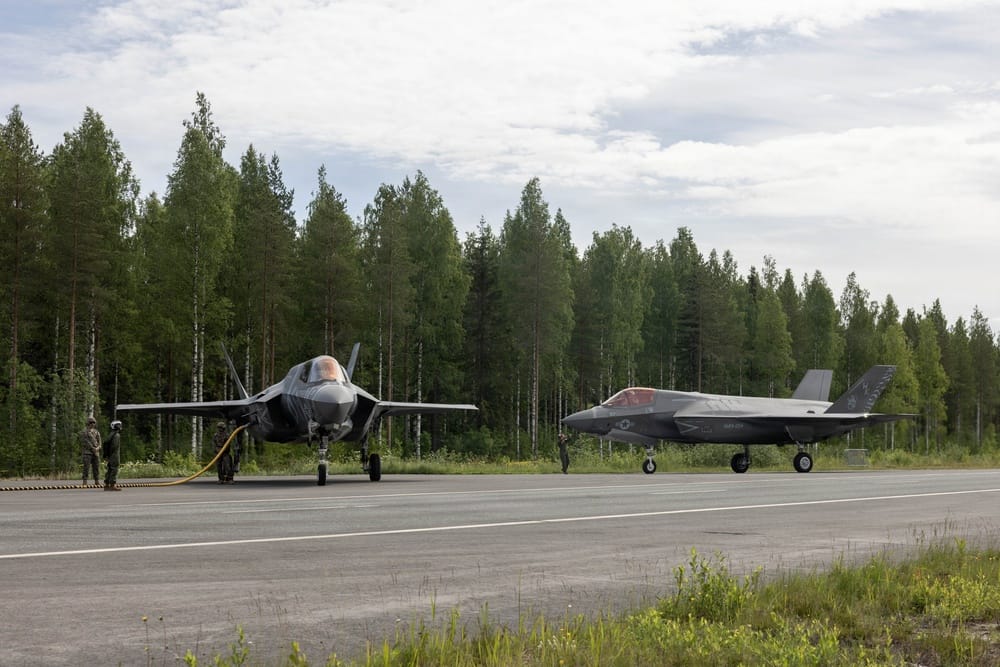
It costs north of a hundred million dollars, it is the most sophisticated fighter the United States builds, and on the morning of 9 June it was sitting on a two-lane road in the Finnish woods, taking on fuel with pine trees a wingspan away.
Two U.S. Marine Corps F-35B Lightning IIs from Marine Fighter Attack Squadron 224 — the “Fighting Bengals” — landed and took off from a highway strip near Tervo, Finland. It was the first time American Marine F-35Bs have ever operated from a Finnish road, and the first time Polish and Spanish jets have done it on Finnish soil either.
It looks like a stunt. It is the opposite. Roads are the whole point.
QUICK FACTS
| What | First USMC F-35B landing & take-off from a Finnish highway |
| When | 8–12 June 2026 (road ops 9 June) |
| Where | Highway strip near Tervo, Finland |
| Unit | VMFA-224 "Fighting Bengals", MAG-31, 2nd MAW |
| Also on the road | Polish F-16s and Spanish F/A-18s |
| Exercise | Ramstein Flag 2026 — 19 nations, 15+ sites |
| Refuel support | Marine Wing Support Squadron 272 (FARP) |
A first on a Finnish road
The operation ran from 8 to 12 June as part of Exercise Ramstein Flag 2026, with the actual road landings on the 9th. The Bengals’ short-takeoff-and-vertical-landing F-35Bs shared the strip with Spanish F/A-18s and Polish F-16s, while U.S. Marines from Marine Wing Support Squadron 272 ran a forward arming and refuelling point right there on the tarmac.
This was also the Marines’ first F-35B deployment to Finland, full stop — and it came after their planned F-35 appearance at Norway’s Exercise Cold Response in March was scrubbed. Finland, which only joined NATO in 2023, has built road-base operations into its national defence DNA for decades. Now the Alliance is borrowing the playbook.
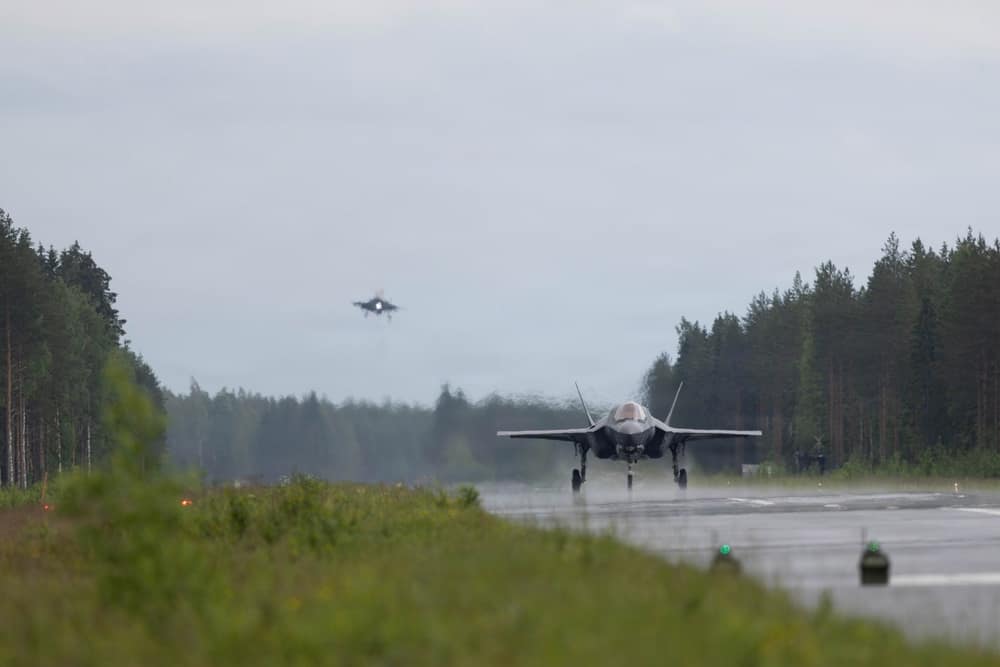
Finland’s highways are not improvised landing strips. Stretches of motorway are engineered from the start as dispersal runways — extra-wide, obstacle-free, with reinforced shoulders and pre-surveyed approaches. Drop a fighter onto one and you have an airfield that no one can find on a target map.
Why a road beats a runway
Modern air bases are juicy targets. They have fixed coordinates, long concrete runways, fuel farms and control towers — exactly the kind of thing a salvo of cruise or ballistic missiles is built to crater. Park your entire fighter wing on one and an adversary knows precisely where to aim.
The answer NATO keeps rehearsing is called Agile Combat Employment: scatter the jets, operate them from dozens of small, unpredictable sites, and keep moving. A road strip with a couple of trucks of fuel and ordnance can launch and recover fighters for hours, then vanish. The F-35B, able to land vertically and take off in a few hundred feet, is almost purpose-built for it.
That is why a refuelling crew on a Finnish back road matters more than it looks. If the Marines can turn a jet around with a FARP team and a fuel bladder in the trees, they can fight from places no targeteer has plotted.
The bigger picture
Ramstein Flag 2026 is NATO’s premier multi-domain air exercise, and the 2026 edition was vast: 19 nations and more than 15 operating locations, with scenarios stretching from the top of Norway to the south of Spain. The recently stood-up Combined Air Operations Centre in Bodø, Norway ran command and control for the highway work and the wider air-to-air and deep-strike missions.
One Bengals jet even showed up wearing a striking tiger-stripe livery — a rare bit of flash for a fleet that normally wears flat grey. But the message underneath the paint was deadly serious: NATO airpower no longer depends on a handful of big, findable bases. Give it a quiet road and a fuel truck, and it can fight from anywhere.
For a country that spent the Cold War quietly turning its motorways into runways, watching American stealth fighters use one must feel like vindication. For everyone watching from the east, it is a harder problem than it was a month ago.
Sources: DVIDS / U.S. Marine Corps Forces Europe and Africa; NATO Allied Air Command; The Aviationist; Stars and Stripes; Military Times.
Related Questions
Why did U.S. Marines land F-35Bs on a Finnish highway?
On 9 June 2026, U.S. Marine F-35Bs landed and took off from a highway strip near Tervo, Finland, during Exercise Ramstein Flag 2026. Road bases let jets disperse and keep flying if airfields are bombed — a tactic Finland has built into its national defence for decades.
What is the F-35B?
The F-35B is the short-takeoff, vertical-landing version of the F-35 Lightning II, able to operate from short, rough strips and even roads. That flexibility lets Marines fly it from a Finnish highway and lets navies fly it from converted carriers like Japan’s Kaga.
What was Exercise Ramstein Flag 2026?
Ramstein Flag 2026 was a large NATO air exercise spanning 19 nations and more than 15 sites, running 8–12 June 2026. The Finnish highway operation on 9 June was one element, with Spanish F/A-18s and Polish F-16s also using the road strip alongside the Marine F-35Bs.
Why does Finland use highways as airbases?
Finland, which joined NATO in 2023, has built road-base operations into its defence doctrine for decades, dispersing aircraft to survive attacks on fixed airfields. NATO is now adopting the approach — and Finland also hosts allied jets, including U.S. F-22 Raptors training with Finnish F-35s.
Which aircraft used the Finnish road strip?
U.S. Marine Corps F-35Bs from VMFA-224, the “Fighting Bengals,” along with Spanish F/A-18 Hornets and Polish F-16s. U.S. Marines from Marine Wing Support Squadron 272 ran a forward arming and refuelling point right on the road.
Was this the first F-35B highway operation in Finland?
Yes. It was the first time U.S. Marine F-35Bs operated from a Finnish road, and the first time Polish and Spanish jets did so on Finnish soil. It was also the Marines’ first F-35B deployment to Finland.

0 Comments