
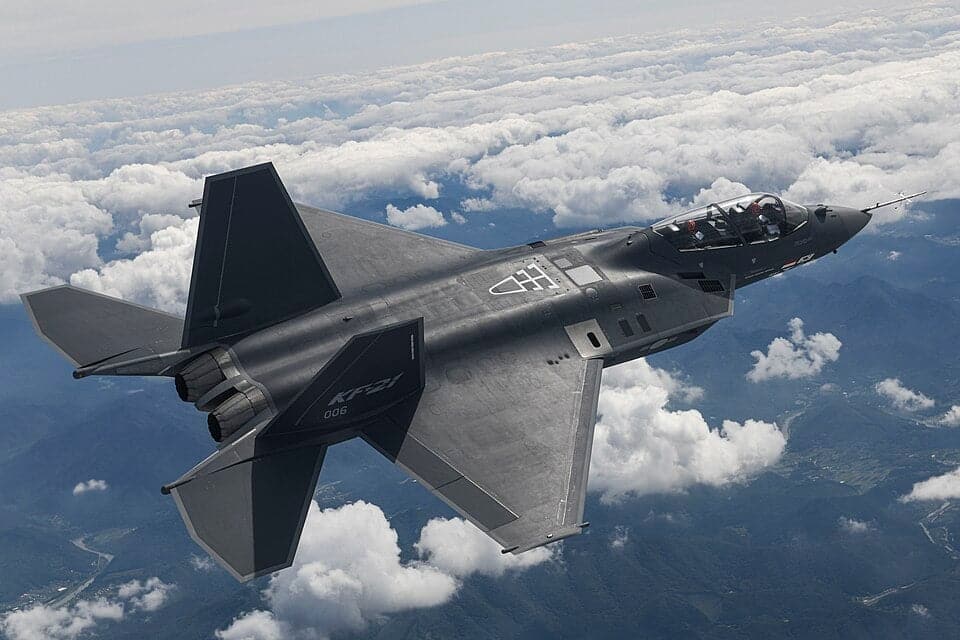
| Aircraft | KAI KF-21 Boramae ("Young Hawk") — South Korea's first indigenous 4.5-generation fighter |
| Transfer | Prototype No. 5, valued at 350 billion won ($260 million), to be shipped to Indonesia |
| Total Package | 600 billion won ($445 million) — includes prototype, technology transfer, development data, and Indonesian researcher costs |
| Export Deal | 16 KF-21 fighters for Indonesia — South Korea's first-ever indigenous fighter export |
| Summit | Presidents Lee Jae-myung and Prabowo Subianto met April 1, 2026, to accelerate the deal |
| First Flight | July 19, 2022 — mass production began in 2026 |

South Korea is about to do something it has never done before: export a fighter jet it designed and built itself. The fifth KF-21 Boramae prototype is being prepared for transfer to Indonesia as part of a revised financial settlement worth 600 billion won — and behind it sits a 16-aircraft export contract that could reshape the Indo-Pacific fighter market.
The deal, formalised in February 2026 and disclosed through documents submitted to South Korea's National Assembly, resolves years of financial friction between Seoul and Jakarta over Indonesia's participation in the KF-21 joint development programme. What started as a partnership dispute has become a commercial breakthrough.
From Partner to Customer
Indonesia was originally a 20% cost-sharing partner in the KF-21 programme, committing to fund a fifth of the estimated $7.9 billion development cost. In practice, Jakarta fell far behind on payments — at one point owing billions in arrears, prompting heated exchanges between the two governments and raising questions about whether the partnership would survive at all.
The revised deal essentially converts Indonesia from a delinquent development partner into a straightforward customer. The 600 billion won package breaks down into three components: Prototype No. 5, valued at 350 billion won; technology transfer and participation costs totalling 174.2 billion won (including salaries for Indonesian engineers who worked on the programme); and development data worth 75.8 billion won.
As of April 2026, Indonesia has paid 536 billion won of the total, with the remaining 64 billion won due by June. The physical transfer of the prototype — along with associated technical data — will happen only after the balance is settled. Seoul is not taking chances this time.
Sixteen Jets and a New Market
The prototype transfer is the appetiser. The main course is a separate contract for 16 production KF-21 fighters — South Korea's first indigenous fighter export deal. Presidents Lee Jae-myung and Prabowo Subianto discussed the acquisition during a summit on April 1, 2026, with both sides describing progress as "significant."
For Indonesia, the KF-21 fills a yawning gap. The Indonesian Air Force operates ageing F-16A/Bs and Su-27/30 Flankers, both of which are approaching the end of their useful lives. The KF-21 offers a modern AESA radar, internal weapons carriage in its planned Block 2 variant, and — critically — a supply chain that does not run through Washington or Moscow. In a region where strategic hedging is standard practice, that independence matters.

The Bigger Picture
South Korea's ambition extends well beyond Indonesia. The KF-21 is being positioned to compete against Saab's Gripen, the Eurofighter Typhoon, and Dassault's Rafale in the crowded 4.5-generation market. With a unit cost estimated at roughly $65 million — significantly less than the F-35 and competitive with the Gripen E — the Boramae offers a compelling package for air forces that want modern capability without American political strings or European price tags.
Mass production began in early 2026, and the South Korean Air Force itself has ordered 120 aircraft. Every jet that rolls off the production line strengthens the economies of scale that make the export price viable. Indonesia's 16-jet order, if finalised, would be the first proof that the KF-21 can sell abroad — and the signal that the Indo-Pacific's arms market has a new player.
South Korea built its first indigenous fighter. Now it is about to sell one. That is a milestone no amount of money can buy.
Sources: Korea Herald, Army Recognition, Defence Security Asia, Korea Times, DAPA National Assembly Documents
Related Questions
What is the KF-21 Boramae?
The KF-21 Boramae ("Young Hawk") is South Korea's first indigenously developed fighter jet, a twin-engine 4.5-generation aircraft built by Korea Aerospace Industries. It first flew on July 19, 2022, and entered mass production in 2026. The KF-21 is designed as a multirole fighter to replace older types in South Korean service and to compete on the export market.
Who builds the KF-21?
The KF-21 is built by Korea Aerospace Industries (KAI), South Korea's main aerospace manufacturer, with Indonesia as a junior development partner. The programme represents the country's bid to design and produce an advanced fighter domestically rather than buying one from the United States or Europe.
When did the KF-21 first fly?
The KF-21 Boramae made its maiden flight on July 19, 2022. After a multi-year flight-test campaign, the aircraft entered mass production in 2026, marking South Korea's transition from a fighter operator to a fighter producer and exporter.
Is the KF-21 a fifth-generation fighter?
The KF-21 is generally described as a 4.5-generation fighter rather than a full fifth-generation aircraft. It incorporates some low-observable shaping and modern avionics but, in its initial form, carries weapons externally rather than in internal bays, placing it a step below stealth fighters like the F-35.
Which countries operate or have ordered the KF-21?
South Korea is the primary operator, and Indonesia has agreed to acquire 16 KF-21 fighters in what is South Korea's first-ever export of an indigenous fighter. Indonesia has pursued a mixed fleet, also ordering Rafale fighters from France as it modernises its air force.
Which other countries build their own indigenous fighters?
A small group of nations design and build their own fighters, including the United States, Russia, China, France, Sweden and, increasingly, South Korea. India is another, developing the home-built Tejas line, while several countries are now collaborating on sixth-generation projects to share the enormous costs involved.
0 Comments