
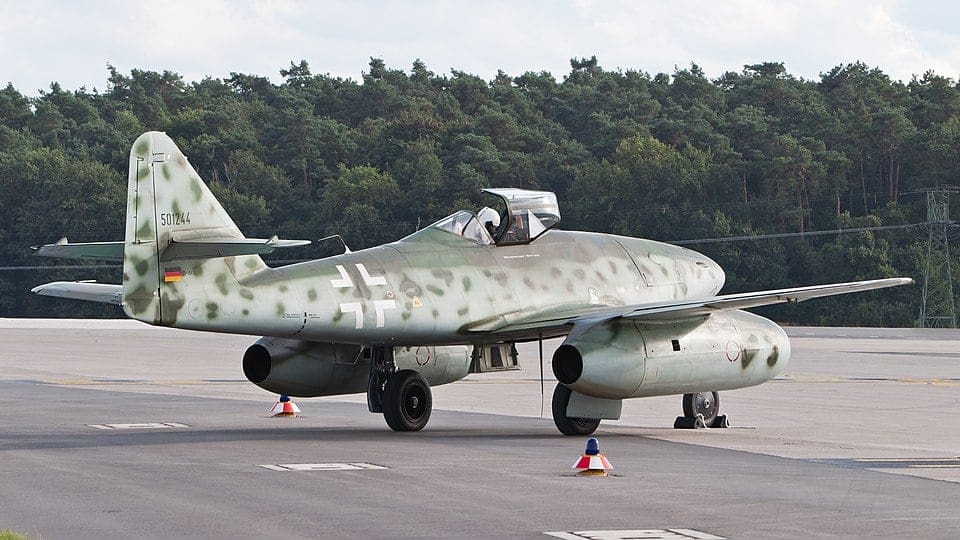
| Aircraft | Messerschmitt Me 262 Schwalbe ("Swallow") — the world's first operational jet fighter |
| First Flight | July 18, 1942 (jet-only power); entered service April 1944 |
| Top Speed | 870 km/h (540 mph) — roughly 150 km/h faster than any Allied piston fighter |
| Engines | Two Junkers Jumo 004B axial-flow turbojets — revolutionary but with an average lifespan of just 25 hours |
| Total Built | Approximately 1,430 — but fewer than 300 were ever operational at any one time |
| Combat Record | Claimed roughly 542 Allied aircraft destroyed; approximately 100 Me 262s lost in aerial combat |

In the spring of 1944, Allied bomber crews over Germany began seeing something they could not explain. A swept-wing shape, faster than anything in their escort, closing at speeds that made evasion impossible. No propeller. A high-pitched whine that sounded nothing like a piston engine. The Messerschmitt Me 262 Schwalbe — the world's first operational jet fighter — had arrived.
It was 150 km/h faster than the best Allied fighters. It carried four 30mm cannons that could shred a B-17 in a single pass. On paper, it should have swept the Allies from the skies over the Reich. In reality, it arrived too late, in too few numbers, and crippled by decisions so catastrophic they read like fiction. The Me 262 is the most tantalising "what if" in military aviation history.
The Jet That Hitler Ruined
The Me 262's airframe was ready for mass production by mid-1943. Test pilots were ecstatic. General der Jagdflieger Adolf Galland — Germany's fighter commander and himself an ace with 104 victories — flew it and immediately declared that the Luftwaffe should halt all piston-fighter production and bet everything on the jet. "It felt like being pushed by angels," he reportedly said.
Then Hitler intervened. At a demonstration in November 1943, the Fuhrer asked whether the Me 262 could carry bombs. When told it could theoretically be adapted, he ordered it developed primarily as a high-speed bomber — the "Sturmvogel" (Stormbird) — rather than the fighter the Luftwaffe desperately needed. The decision was strategic insanity. Germany was being pummelled by thousand-bomber raids. What it needed was an interceptor that could catch the bombers. What Hitler wanted was a revenge weapon that could deliver small bomb loads at high speed — a mission the Me 262 was profoundly unsuited for.
Months of production were wasted on bomber variants. By the time the order was reversed and the fighter version prioritised, the window of opportunity had narrowed to a crack.

Engines That Ate Themselves
Even without Hitler's interference, the Me 262 faced a problem that no amount of political will could solve: its engines were self-destructing. The Junkers Jumo 004B turbojet was a marvel of engineering — the first axial-flow jet engine to enter mass production. But wartime Germany lacked the nickel and chromium alloys needed for turbine blades that could withstand the extreme temperatures inside a jet engine. The substitutes used instead — mild steel with a thin aluminium coating — warped, cracked, and failed after as few as 10 to 25 hours of operation.
Twenty-five hours. A single engine might last a week of combat flying before it needed replacement. Pilots learned to handle the throttle with surgical care — a sudden advance could cause a compressor stall and engine fire. Taking off was the most dangerous phase: the engines took time to spool up, and the Me 262 was vulnerable to Allied fighters stalking jet bases at low altitude, waiting to catch the Schwalbe during its slow, fuel-hungry climb.
Allied pilots quickly learned the tactic. If you could not catch a Me 262 in the air, you caught it on the ground.
What It Did — and What It Might Have Done
Despite everything, the Me 262 was lethal when it got into action. Jagdverband 44 — the elite unit commanded by Galland himself, staffed with some of Germany's top aces — flew Me 262s in the war's final weeks and achieved a kill ratio that piston fighters could not match. The four 30mm MK 108 cannons could destroy a heavy bomber with a single well-aimed burst. Allied escort fighters had no answer to an adversary that could attack at 540 mph and disengage at will.
Approximately 1,430 Me 262s were built. Of those, only around 200–300 were ever operational at any given time — the rest were grounded by engine failures, fuel shortages, damaged runways, or the relentless Allied bombing of production facilities. Roughly 542 Allied aircraft were claimed by Me 262 pilots. About 100 Me 262s were lost in air combat.
The numbers tell the story of a weapon that worked — but not in the numbers needed to matter. Had the Me 262 entered service six months earlier, with reliable engines and adequate fuel, the air war over Europe would have looked very different. Whether it could have changed the war's outcome is debatable. That it could have made the Allied strategic bombing campaign immeasurably more costly is not.
Legacy
The Me 262 did not save the Third Reich. But it changed aviation forever. Every jet fighter that followed — from the F-86 Sabre to the F-35 Lightning II — traces its lineage back to the swept-wing, twin-engine configuration that Messerschmitt's engineers pioneered under the most desperate circumstances imaginable. The Schwalbe was the future, born in the wrong time and the wrong place, deployed by a regime too dysfunctional to use it properly.
It flew like being pushed by angels. It arrived in a world ruled by demons.
Sources: National Museum of the United States Air Force, Smithsonian National Air and Space Museum, "The First Jet Pilot" by Lutz Warsitz, aviation historian accounts
Related Questions
What was the Messerschmitt Me 262?
The Messerschmitt Me 262 Schwalbe ("Swallow") was the world's first operational jet fighter, entering Luftwaffe service in April 1944. Powered by two Junkers Jumo 004B turbojets, it was roughly 150 km/h faster than any Allied piston fighter and pointed directly toward the jet age of combat aviation.
How fast was the Me 262?
The Me 262 had a top speed of about 870 km/h (540 mph), roughly 150 km/h faster than the best Allied piston-engined fighters. That speed advantage made it nearly impossible to intercept in level flight, though it was vulnerable during takeoff and landing.
When did the Me 262 first fly?
The Me 262 first flew under jet-only power on 18 July 1942 and entered operational service in April 1944. Development was delayed by engine problems, shifting priorities and Allied bombing, so it arrived far too late to change the outcome of the war.
Why did the Me 262 fail to change the war?
Despite its huge speed advantage, the Me 262 arrived too late and in too few numbers. Of roughly 1,430 built, fewer than 300 were ever operational at once. Its Jumo 004B engines lasted only about 25 hours, and fuel and pilot shortages crippled the Luftwaffe.
What engines did the Me 262 use?
The Me 262 used two Junkers Jumo 004B axial-flow turbojets, the first mass-produced jet engines of their kind. Revolutionary but unreliable, they had an average service life of just 25 hours before needing replacement, partly because Germany lacked the rare metals for heat-resistant turbine blades.
How many Me 262s were built?
Approximately 1,430 Me 262s were built, but fewer than 300 were operational at any one time due to engine shortages, fuel scarcity and Allied attacks. The type claimed roughly 542 Allied aircraft destroyed against about 100 Me 262s lost in aerial combat.
Was the Me 262 the first jet fighter?
The Me 262 was the world's first operational jet fighter, though it was not the first jet aircraft to fly. Its combat debut in 1944 marked the start of jet-powered air warfare, a lineage traced in MiGFlug's later Soviet jet fighters like the MiG-29.
0 Comments