

Everybody talks about the F-47. Every defence reporter, every think-tank panel, every congressional hearing. Boeing’s clean-sheet sixth-generation fighter for the Air Force gets the headlines and the money and the Trump tweets. Meanwhile, across the river at Naval Air Systems Command, a different sixth-gen fighter is quietly approaching contract award — one that most Americans could not draw from memory, could not pick out of a line-up, and could not explain the purpose of if their sandwich depended on it.
It is called F/A-XX. It is the Navy’s sixth-generation carrier-based fighter. It is a programme so unusually quiet that even seasoned analysts have trouble describing what it looks like, who is building it, or when it will fly. And this month, according to Aviation Week, the Navy is finally closing in on the contract that will pick a winner.
Quick Facts
Programme: F/A-XX — Navy sixth-generation carrier fighter
Replaces: F/A-18E/F Super Hornet (after 2035)
Bidders: Boeing & Northrop Grumman (Lockheed Martin dropped out March 2025)
Projected IOC: mid-2030s
Estimated unit cost: classified · widely reported above $200M flyaway
Key feature: manned–unmanned teaming with Navy CCA drones
Why Nobody Has Heard of F/A-XX
Three reasons, mostly. First, the Navy learned from the F-35 debacle that talking about a fighter before it exists generates political enemies faster than it generates parts. F/A-XX has been deliberately kept off the public radar, with classified budget lines, minimal press briefings, and no glossy rollout renderings. There are no F/A-XX posters on Pentagon walls. There are no F/A-XX models on desks. The programme is running on operational security mode.
Second, the F-47 sucks up all the oxygen. When the Air Force announced its sixth-gen winner in March 2025 and the president personally branded it with his own designation, F/A-XX became a footnote by comparison. The Navy has been content to let the Air Force’s drama dominate the news cycle while quietly doing its own work.
Third, the thing looks different enough from the F-47 that people assume it is a less ambitious programme. It isn’t. Every indication from the Navy is that F/A-XX will match or exceed the Air Force’s jet on range, persistence and sensor fusion — the Navy just has different requirements that produce a different-looking aircraft.

What the Navy Actually Needs
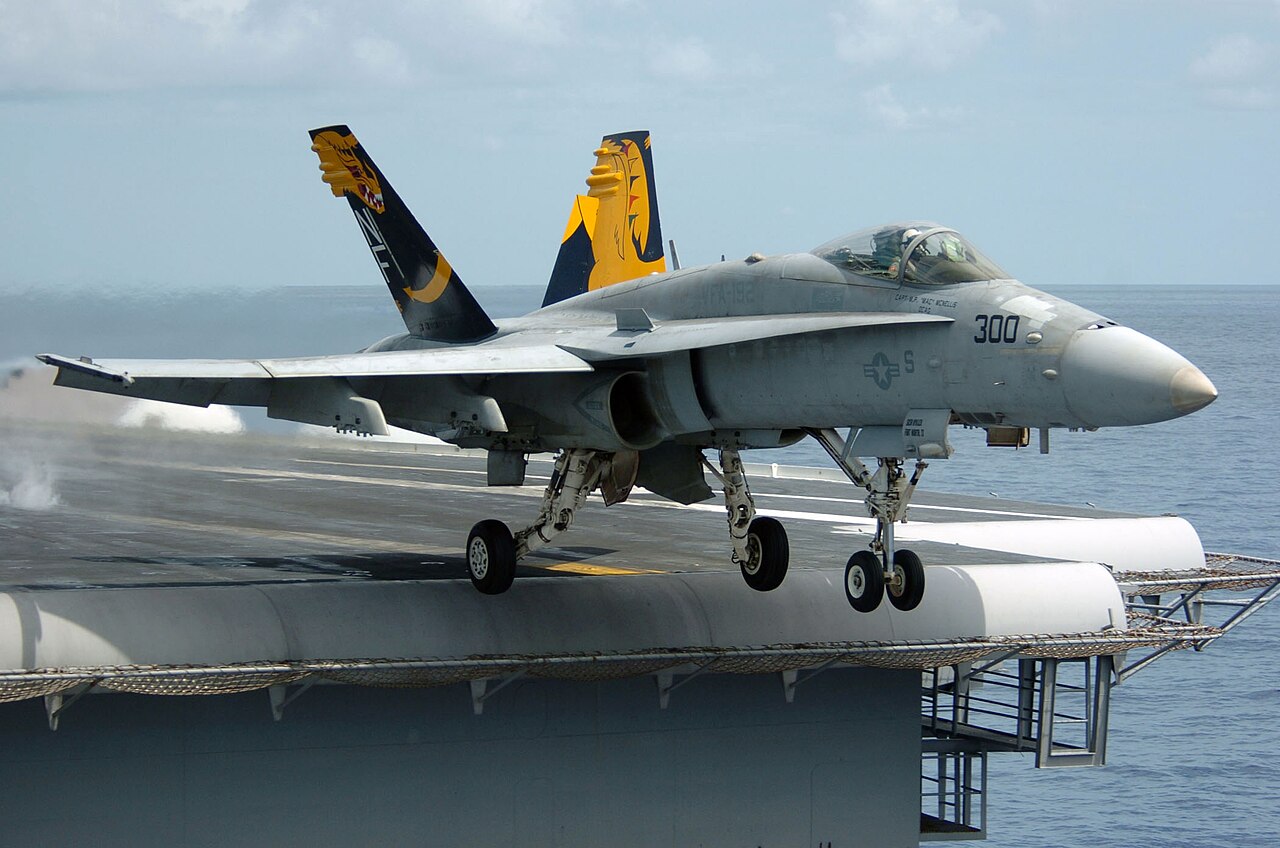
A Super Hornet does roughly 390 nautical miles of unrefuelled combat radius in a typical strike loadout. That number was barely adequate in 2001 and is dangerously short today. The Navy’s number one worry is China, and the Pacific theatre is a range problem first, a stealth problem second, and a weapons problem third.
F/A-XX has been shaped around that range problem. The requirements, as much as we know them, call for roughly 25 percent greater unrefuelled combat radius than the Super Hornet — closer to 750 nautical miles one-way. That is enough to launch from a carrier operating outside China’s medium-range anti-ship ballistic missile envelope, strike a mainland target, and return. The Super Hornet cannot do that. The F-35C does, but barely, and only when carrying an anemic internal weapons load.
The second requirement is carrier compatibility. Everything F-47 does not have to worry about — catapult stresses, arrested landings, deck-sized wingspan, salt-water corrosion, nose gear that can take a controlled crash every flight — F/A-XX has to do every day. This is why Lockheed Martin reportedly dropped out of the competition in early 2025: their proposed design could not meet the carrier-suitability requirements inside the cost cap. Boeing and Northrop Grumman, both of whom have been doing carrier-based design for decades, stayed in.
Two Contractors, Two Philosophies
Boeing, fresh from winning the F-47, wants both. A sweep of the U.S. fighter market — both services, both airframes, both clean-sheet programmes — would put the company back in the air dominance business in a way it hasn’t been since McDonnell Douglas built the F/A-18. The Boeing proposal reportedly leans heavily on commonality with the F-47, sharing avionics, engines, and potentially a modular fuselage core scaled for carrier ops. The idea is that a single digital ecosystem supports both aircraft, driving costs down over the full sixth-gen fleet.
Northrop Grumman’s pitch is the opposite. Northrop argues that carrier fighters need to be designed ground-up for the carrier, not adapted from a land-based parent. The company has been investing in carrier-suitable stealth shaping since the X-47B autonomous demonstrator landed on a carrier in 2013 — a programme that, in hindsight, looks like a very deliberate technology-maturation effort for exactly this moment. Northrop’s sixth-gen design philosophy reportedly favours longer range, larger internal weapons bay, and a tailless planform similar to the B-21 Raider it already builds.
Both companies are well-suited. Boeing knows carriers. Northrop knows stealth. The contract decision will come down to which risk the Navy decides to take: commonality with the Air Force, or independence from it.

The Drone Wingmen Question
F/A-XX will not fight alone. The Navy, like the Air Force, is building a parallel programme of Collaborative Combat Aircraft — uncrewed drone wingmen that fly alongside the manned fighter, carrying sensors or weapons that the mothership cannot, and absorbing risk the manned crew should not. The Navy version of CCA is reportedly already flying in prototype form, though little has been publicly shown.
This matters for F/A-XX because every design trade-off in the new fighter assumes the drones are real. Internal weapons bay smaller? Fine, the drones carry extra missiles. Sensor suite simpler? Fine, the drones network additional sensors. Crew workload higher? Fine, the drones’ AI filters the firehose before the pilot ever sees it.
If the drones do not work, F/A-XX is underarmed. If they do work, F/A-XX is the most lethal carrier fighter ever built. The Navy is betting the drones work.
Budget Reality
The programme is not cheap. Industry estimates for the development phase alone run to approximately $18 billion, with production unit costs likely north of $200 million per airframe in 2026 dollars. Congress has repeatedly tried to slow F/A-XX down — partly because of cost, partly because a fighter-heavy carrier air wing looks old-fashioned in an era of long-range missiles and cheap drones.
The Navy’s response has been consistent: the carrier stays, the fighter has to match the carrier, and the fighter has to fight the missile threat by out-ranging it. Without F/A-XX, the 11-carrier fleet becomes a collection of expensive targets waiting for 2035. With F/A-XX, the carrier remains what it has been since 1942 — the most flexible piece of striking power any nation has ever put to sea.
The contract award, when it comes, will settle that argument for a generation.
Sources: Aviation Week, Breaking Defense, Congressional Research Service, Naval Air Systems Command public statements.

 English
0 Comments