
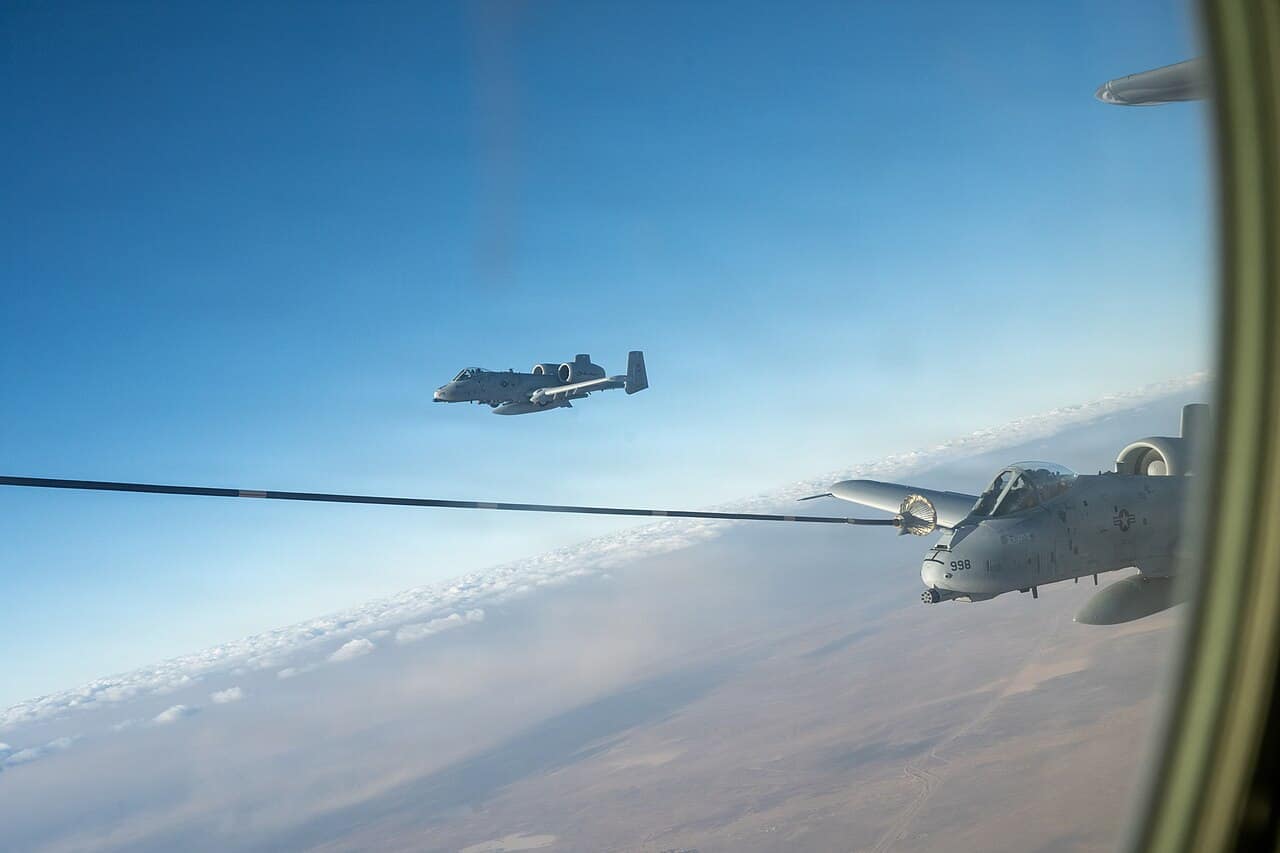
The A-10 Thunderbolt II — the Warthog, the Hog, the GAU-8 with wings — has been on death row at the Pentagon for a decade. The official retirement plan has called for the type to be fully phased out by 2028. The Air Force has gone on record dozens of times saying the airframe is too old, too slow, too vulnerable, and too obsolete for modern peer warfare. None of that mattered when, on 22 May 2026, the United States Central Command deployed Warthogs to the Middle East with two new bolt-on modifications that nobody outside Edwards Air Force Base had known were even in development.
The first modification is a brand-new in-flight refueling probe — a probe-and-drogue adapter fitted into the existing refuelling receptacle on the nose. The second is the “Angry Kitten” electronic warfare pod under the wing. Six weeks ago neither existed on an operational A-10. Today they’re both flying combat patrols.
Quick Facts
| Aircraft | Fairchild Republic A-10C Thunderbolt II — “Warthog” |
| Operator | 107th Fighter Squadron, Selfridge ANGB, Michigan |
| Deployment | U.S. Central Command area of responsibility, May 2026 |
| New addition 1 | Aerial refueling probe — probe-and-drogue adapter fitted to existing nose receptacle |
| New addition 2 | AN/ALQ-167 “Angry Kitten” electronic warfare pod |
| Time from first flight to deployment | Approximately 6 weeks |
| Original retirement date | 2028 — now under active review |
A probe nobody asked for
The A-10 was originally designed to use the USAF boom-and-receptacle refueling system — the standard configuration for nearly all American fighter and tanker aircraft. The decision to fit a separate probe-and-drogue receiver is significant: it gives the Warthog the ability to refuel from US Marine Corps and US Navy tankers (which use drogues, not booms), and from allied air forces that use drogue-only systems (Brazil, India, Sweden, the UK’s pre-Voyager fleet). Operationally, it means an A-10 can be sustained from a wider variety of tankers across a wider variety of geographical theatres. For an aircraft that may be deployed to forward operating locations with limited dedicated KC-135 / KC-46 coverage, this matters.
The adapter fits into the existing air-refuelling receptacle on the nose, just in front of the cockpit, rather than being a permanently mounted probe. It is field-configurable — flight-line crews can install it in a matter of hours and switch the aircraft back to boom refuelling without depot work. The trade-off is reduced drag during high-speed dash phases — which an A-10 essentially never does — in exchange for simplicity of design and lower cost of manufacture. The probe was reportedly produced in a small batch of fewer than fifty units, suggesting that this is an experimental retrofit on a subset of the operational A-10 fleet rather than a wholesale modification.
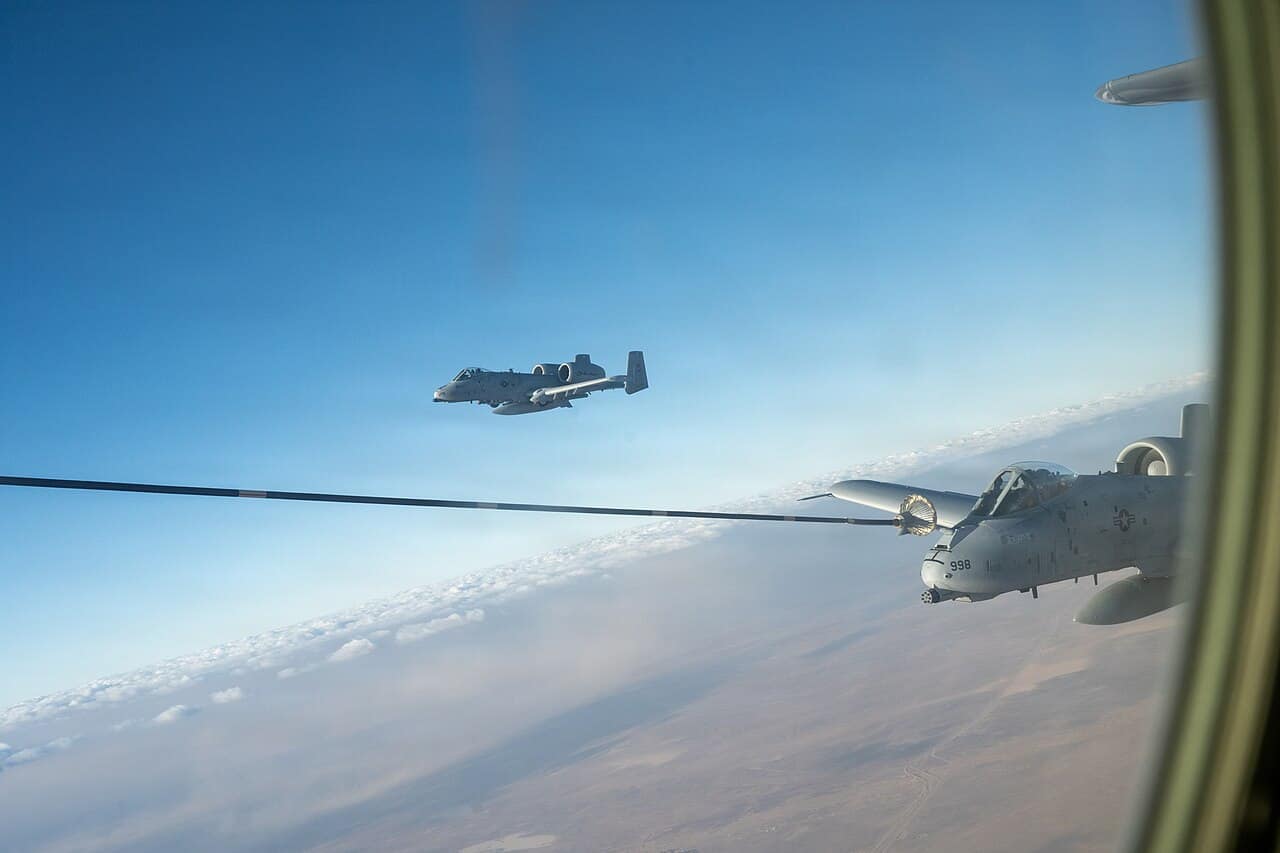
“Angry Kitten” — the pod with the indefensible name
The AN/ALQ-167 Angry Kitten electronic warfare pod was developed by the Georgia Tech Research Institute under a US Air Force Research Laboratory contract. It is a software-defined jamming pod — open-architecture hardware, with the jamming behaviour entirely defined in software, allowing operators to update threat profiles in days rather than the years required for traditional EW hardware. The pod’s name dates from internal nicknames at Georgia Tech and has stuck despite repeated attempts by senior officers to give it a more dignified designation.
What Angry Kitten does, in operational terms, is jam everything within its frequency band that the operator has classified as hostile — Russian-made SA-6, SA-8, SA-15 surface-to-air missile guidance radars; Chinese HQ-9 and HQ-12 systems; Iranian Bavar-373 and the Russian-origin Tor-M1 systems Iran has acquired. The reason it is being fitted to A-10s in particular is that the Warthog’s low-altitude profile and slow forward speed make it the platform most exposed to short-range air defences. A self-protection jammer on the wing changes the survivability calculus dramatically.
Why the A-10 keeps refusing to die
The Air Force has been trying to kill the A-10 since 2014. Every fiscal year, the service requests funding to begin retirement; every fiscal year, Congress refuses, citing close-air-support requirements. The 2026 deployment to the Middle East — with brand-new probe and EW pod — is the most aggressive operational upgrade the airframe has received in fifteen years. Industry sources suggest that an additional package of modifications, including upgraded engine controls and new IR-guided AGM-65L Maverick missiles, are also in late-stage testing at Edwards.
None of this means the A-10 is going to fly forever. The structural fatigue life of the airframe is finite, and the youngest A-10C airframe is now over 40 years old. But the official 2028 retirement date is, in the words of one senior CENTCOM officer who declined to be named, “increasingly aspirational.” The Warthog, having been written off three times in three different decades, is now actively being upgraded for a fourth.
Sources: TWZ; Air & Space Forces Magazine; The Aviationist; USAF press releases; Georgia Tech Research Institute.
Related Posts

 English
who is the manufacturing company that makes the refueling nozzle that goes on new refueling probe for the A- 10’s