
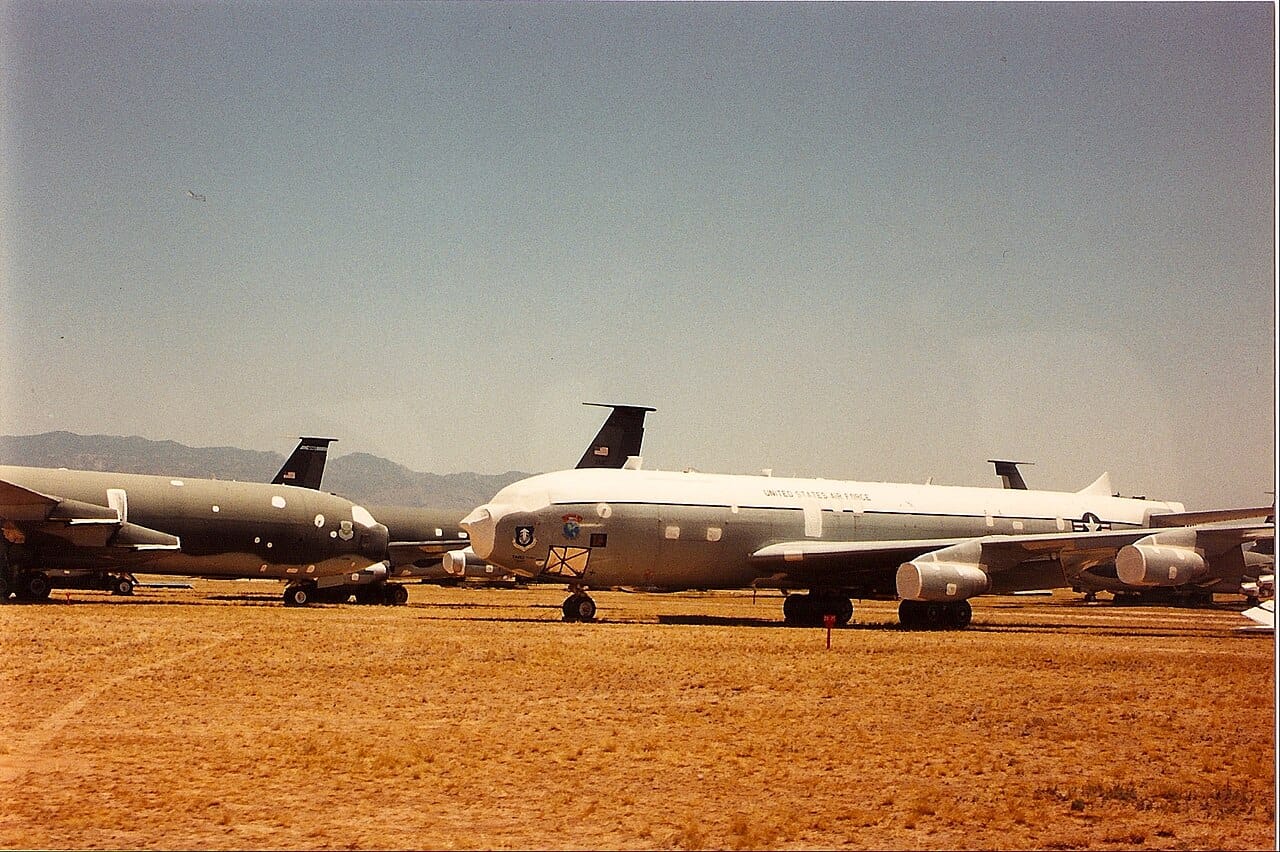
The Davis-Monthan boneyard at Tucson, Arizona is the largest aircraft graveyard in the world. Four thousand-plus airframes from every era of postwar American military aviation sit baking in the desert sun under thick layers of preservative spraylat, waiting for the day they will never be needed again. The official Air Force position has been, for thirty years, that the boneyard is a one-way destination. Once an aircraft is preserved at Davis-Monthan, it is at the end of its service life. It is not coming back.
On 2 April 2026, KC-135R tail number 58-011 was rolled out of preservation, started, and flown out of Tucson to Tinker Air Force Base in Oklahoma for depot-level overhaul. It is the first time a KC-135 has been resurrected from the boneyard in more than ten years. The Air Force decided to do it because, over the previous three weeks, two of its KC-135s had collided over western Iraq and five more had been destroyed in Iranian missile strikes against a base in Saudi Arabia. The boneyard is no longer the end. It is now reserve inventory.
Quick Facts
| Aircraft regenerated | KC-135R tail number 58-011 — built 1958, 68 years old |
| Departure | Davis-Monthan AFB, 2 April 2026 |
| Destination | Oklahoma Air Logistics Complex, Tinker AFB |
| Trigger event 1 | 12 March 2026: two KC-135s collided over western Iraq, 6 dead |
| Trigger event 2 | Iranian missile strikes destroyed 5 KC-135s on the ground in Saudi Arabia |
| Total tanker losses since Feb 2026 | 7 KC-135s — approximately 2% of the entire fleet |
| Strategic importance | Tanker shortage threatens sustained US air operations against Iran |
| Last KC-135 regenerated from boneyard | 2014 (single airframe) |
Why the Air Force runs out of tankers
The US Air Force operates roughly 400 KC-135 Stratotankers — the Boeing 707-derived aerial refueling tanker that has been the backbone of American long-range air operations since the late 1950s. Every B-2, every B-52, every F-22 deployment, every F-35 transit across an ocean depends on the KC-135 fleet. The KC-46 Pegasus is supposed to be the replacement, but just over 100 are in service and the type continues to suffer from the well-publicised remote-vision-system problems that have plagued it since first delivery. The KC-46 cannot, for now, fully replace the KC-135.
The arithmetic of the Iranian air war has been brutal for tanker operations. Each B-2 strike package against Iranian deep-buried facilities requires three KC-135s for fuel coverage to and from CONUS. Each F-22 forward deployment to the Gulf eats six to eight KC-135 sorties per day to keep four jets on station. Each E-3 / E-7 patrol off the Iranian coast requires continuous tanker coverage. By late March 2026 the USAF was running its tanker fleet at 85% utilisation — a rate that is unsustainable for more than a few months — and the operational losses started arriving.
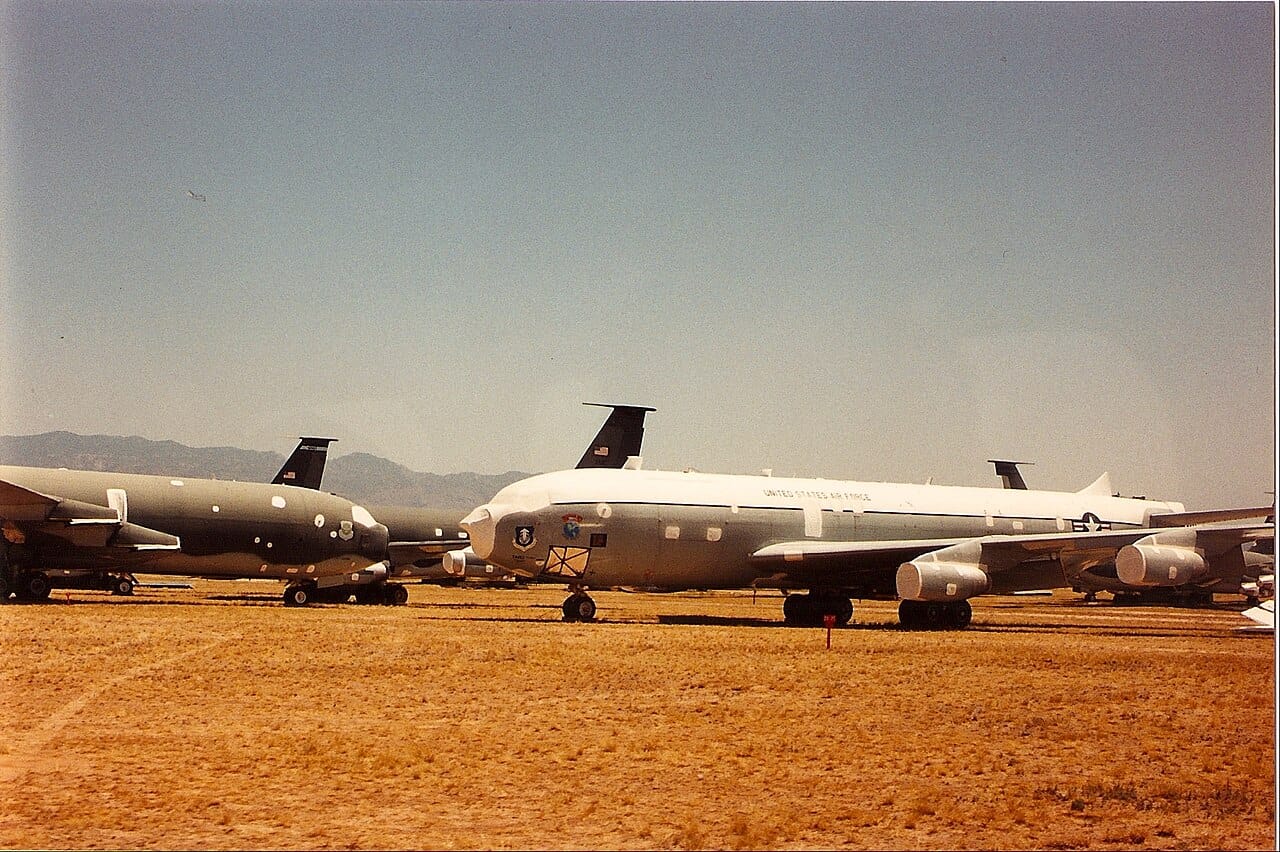
A 68-year-old returning to service
Tail number 58-011 was built by Boeing in 1958 as part of the original KC-135A production run. It was upgraded to KC-135R standard — with new CFM56-2B-1 engines, modernised cockpit, and structural reinforcement — in the late 1980s. It was retired and preserved at Davis-Monthan in November 2017. The aircraft has been sitting under desert covers for eight and a half years.
The 309th Aerospace Maintenance and Regeneration Group at Davis-Monthan removed the preservative, conducted a full hydraulic and electrical inspection, ran the four engines on the ground, and certified the aircraft as flightworthy for a single ferry sortie to Tinker. That sortie took place on 2 April 2026 with a Boeing-provided test crew. At Tinker, the aircraft will undergo six to nine months of depot-level overhaul before returning to operational status with the 22nd Air Refueling Wing at McConnell AFB. It will be operational by early 2027 — assuming the Iranian war is still ongoing, which is the working assumption inside Air Mobility Command.
What it means for the boneyard
If a tanker can come back, anything in the boneyard can come back. Air Mobility Command has reportedly evaluated additional KC-135 candidates for regeneration — at least six more airframes have been identified as candidates if the operational situation worsens. Beyond the KC-135 question, the boneyard contains preserved A-10s, F-15s, F-16s, and C-130s that could, in principle, be returned to service if the political will and the maintenance funding existed. The Davis-Monthan one-way-trip doctrine is, for the first time in decades, under operational review.
The bigger strategic question is what this tells us about the durability of American air power in extended high-intensity operations. The lesson of the Iranian air war so far is that even a regional war against a third-rate air force causes the USAF’s tanker fleet to bend within ninety days. A peer war against China would do considerably worse. The boneyard is currently the answer. It is not a satisfying one.
Sources: Air & Space Forces Magazine; FlightGlobal; The Washington Post; TWZ; Defense One; CBS News; House Armed Services Committee hearings (Wilsbach testimony).
KC-135 boneyard

 English
Really good read!