
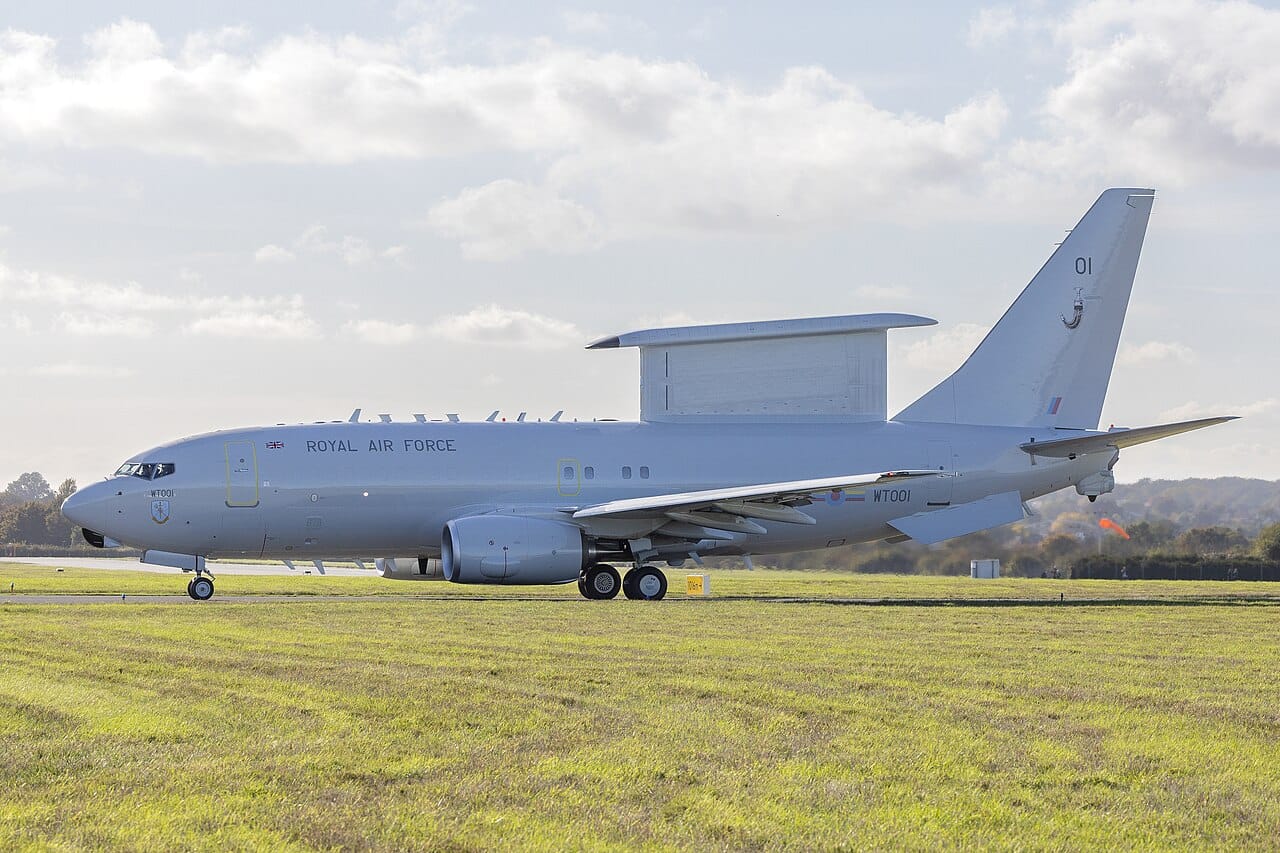
On 22 May 2026, the first Boeing E-7 Wedgetail airborne early warning and control aircraft landed at RAF Lossiemouth in northern Scotland. It is the first time the type has touched down at its operational home base. The RAF, after five years without a credible AEW capability — the Boeing E-3D Sentry was retired in 2021 with no immediate replacement — finally has its first Wedgetail in operational hands.
Three E-7s will eventually be based at Lossiemouth alongside the existing P-8A Poseidon fleet at Lossiemouth. The arrival closes one of the longest, most embarrassing capability gaps in modern RAF history, and arrives just in time for an alliance air war over Eastern Europe that even five years ago seemed entirely theoretical.
Quick Facts
| Aircraft | Boeing E-7A Wedgetail Airborne Early Warning & Control |
| Operator | RAF, eventually 8 Squadron, RAF Lossiemouth |
| Arrival date | 22 May 2026 |
| Fleet size (UK) | 3 aircraft — originally 5, cut to 3 in the 2021 IR review |
| Capability gap | September 2021 (E-3D retirement) → May 2026 (Wedgetail arrival) |
| Sensor | Northrop Grumman MESA — Multirole Electronically Scanned Array, 360° AESA |
| Crew | 2 pilots + up to 10 mission specialists |
Five years without eyes
The RAF retired its seven-strong Boeing E-3D Sentry fleet on 28 September 2021 — a decision driven by sustainment cost overruns and the assumption that the Wedgetail would be operational within 18 months. The Wedgetail programme then slipped, repeatedly: COVID, supply-chain disruption, software development overruns, and the 2021 Integrated Review’s decision to cut the order from five to three aircraft compounded each other. The promised 2023 in-service date slipped to 2024, then 2025, and finally to mid-2026.
For most of those five years, NATO’s AEW coverage of UK airspace was provided by USAF E-3s based at Mildenhall, by French E-3F Sentries operating out of Avord, and by NATO’s own E-3A fleet at Geilenkirchen in Germany. The RAF flew the equivalent of borrowed-radar missions. It was workable but increasingly uncomfortable, particularly as Russian aviation activity over the Baltic and the North Atlantic intensified after 2022.

Why the Wedgetail beats the Sentry
The classic E-3 Sentry has a Westinghouse APY-2 mechanically-rotating radar — the rotating “frisbee” dome that is the type’s visual signature. The mechanical rotation forces the system to update every contact only once per radar sweep, typically every 10 to 12 seconds. For supersonic threats this is too slow; for hypersonic threats it is useless. The Wedgetail replaces the rotating antenna with a fixed Northrop Grumman MESA — Multi-role Electronically Scanned Array — that updates every contact several times per second through electronic beam steering.
The operational consequence is that the Wedgetail can simultaneously track surface ships, low-altitude cruise missiles, supersonic fighters, and ballistic missile re-entry vehicles, all on the same scan cycle. The MESA array also operates as a passive electronic intelligence sensor — collecting and classifying enemy radar emissions in real time — and as a long-range data link relay for friendly aircraft. It is, in short, a more capable platform than the E-3 it replaces.
Three is not enough
The RAF’s honest assessment is that three Wedgetails are not sufficient to maintain full 24/7 AEW orbits during sustained operations. Industry analysis suggests a country with the UK’s geography and commitments needs five or six aircraft minimum for routine coverage. The 2021 cut from five to three was driven by Treasury pressure and the assumption that NATO partner aircraft would fill the gap. In late 2025, the Defence Committee at the House of Commons recommended that the order be increased back to five — but no budget commitment has yet been made.
For now, the Wedgetail at Lossiemouth is symbolic as much as operational. The capability is back. The capacity will be a longer conversation.
Sources: The Aviationist; Royal Air Force; Janes Defence; UK Defence Journal; House of Commons Defence Committee reports.


 English
0 Comments