
An airborne early warning aircraft is not, technically, a stealth platform. It is the opposite of stealth. The whole point of an AEW airframe is that it is up there, loud in the radio spectrum, broadcasting a powerful surveillance radar so it can see incoming threats from hundreds of kilometres away. The cost of doing this job has, for the past seventy years, been roughly equal to one large, expensive, manned aircraft — a Boeing E-3 Sentry, a Boeing E-7 Wedgetail, a Saab GlobalEye, a Beriev A-50. Each one carries a crew of 12 to 20. Each one represents a $400-600 million asset that you would prefer not to lose. Every operational doctrine for AEW operations is built around protecting the AEW.
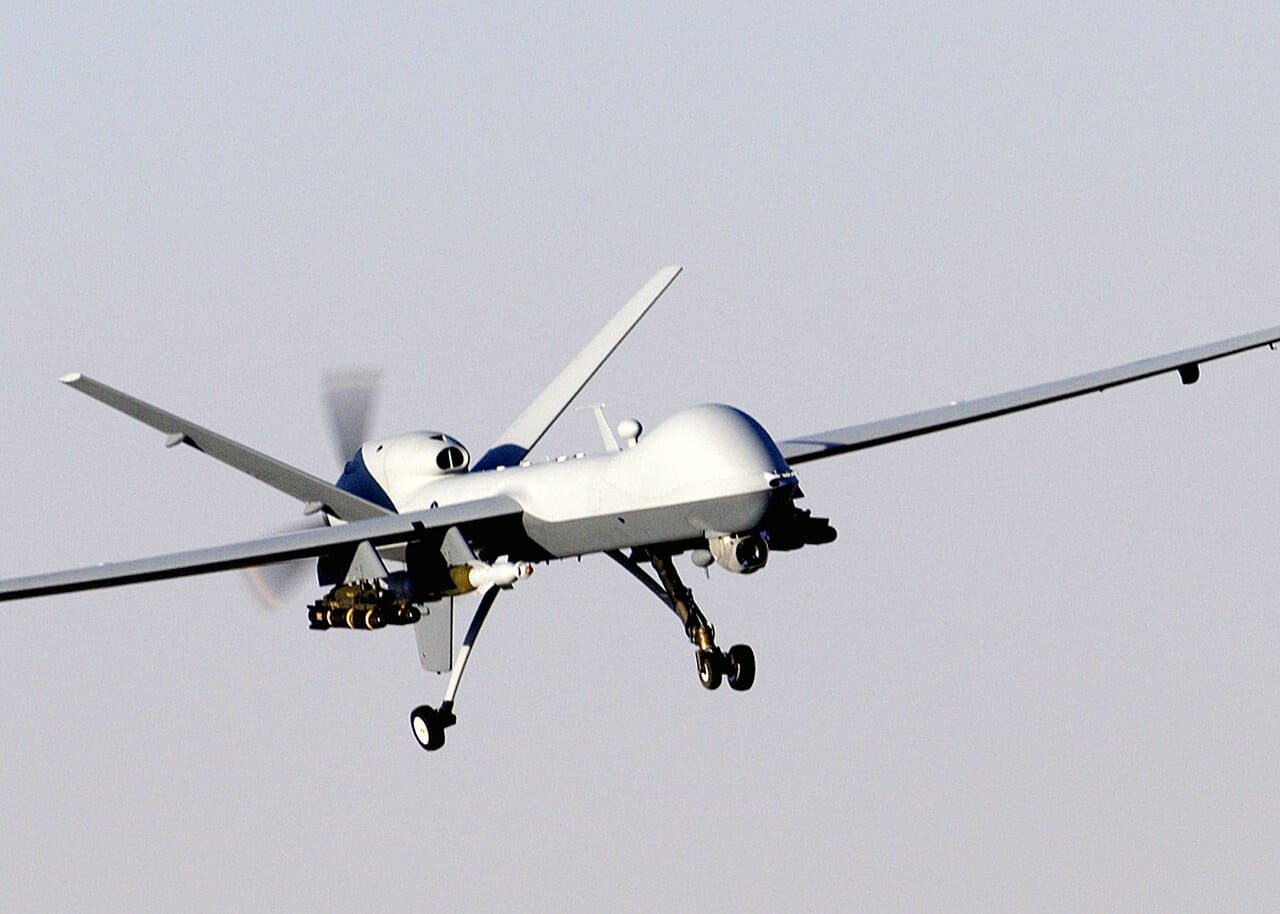
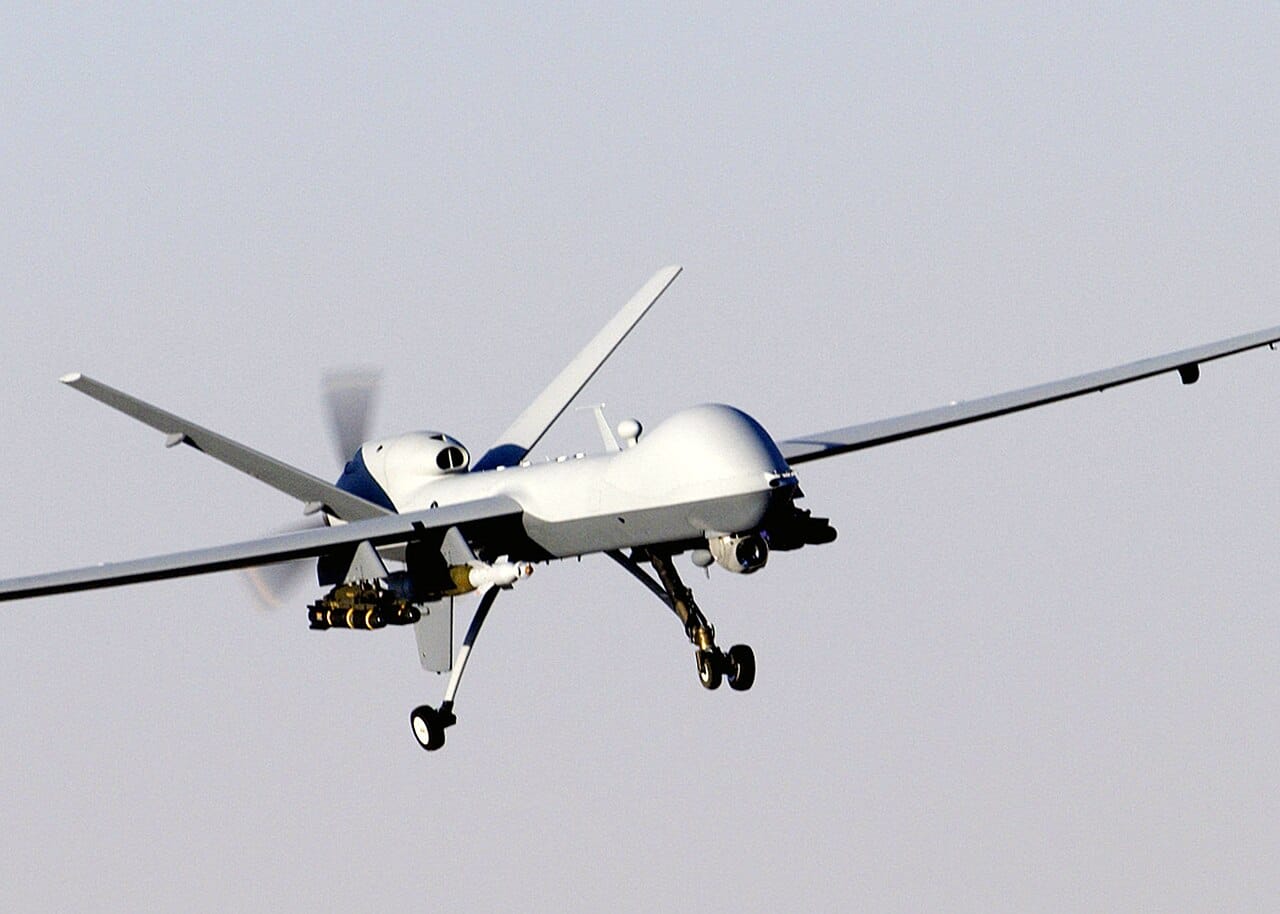
On 19 May 2026, at General Atomics’ Desert Horizon facility in Southern California, a MQ-9B SkyGuardian drone took off carrying two new pods slung beneath its wings. Inside the pods was Saab’s LoyalEye AESA radar system. There was no crew. There never will be. Saab and General Atomics have just successfully completed the first ever flight of an unmanned airborne early warning aircraft — and it changes the strategic logic of the whole AEW mission.
Quick Facts
| Airframe | GA-ASI MQ-9B SkyGuardian — civilian-certifiable derivative of the Reaper |
| Sensor | Saab LoyalEye AESA radar pod system (two pods, one under each wing) |
| First flight | 19 May 2026, Desert Horizon Flight Operations Facility, California |
| Endurance | MQ-9B has demonstrated >40 hours on station |
| Crew | Zero |
| Unit cost (drone + sensors, estimated) | ~$60-80 million — roughly 10% of an E-7 |
| Operational availability target | >90% — highest of any military aircraft class |
Why AEW used to need crews
The classic AEW orbit is six to eight hours of slow racetrack patterns at 30,000 feet, scanning a 250 km radius for any aerodynamic or low-altitude threat. The job is monotonous, the crew workload is intense in spikes, and the platform itself is a strategic asset that cannot be quickly replaced. The Boeing E-7 Wedgetail — the modern AEW reference point — uses a crew of eight or ten depending on mission. The Saab GlobalEye uses six. The E-3 Sentry uses up to 20.
Most of that crew exists to operate the radar console, classify contacts, communicate with friendly fighter formations, and manage the data link network. With sufficiently capable onboard processing, none of that needs to be done in the aircraft itself. The data can be transmitted by satellite to a ground station in a hardened facility on a different continent. Crews can be on shift work, fully rested, and rotated freely. The aircraft itself can be much smaller, much cheaper, and — most importantly — much more expendable.
What the LoyalEye sensor actually does
Saab is the company behind the Erieye family — the AESA radar it developed for the Saab 340 AEW&C, the Saab 2000 Erieye, and the Embraer R-99/EMB-145 AEW platforms — although it has not said how closely LoyalEye is related to Erieye. In the pod-based system, the two underwing pods are understood to host side-looking AESA arrays, with renderings also showing a third centerline pod for the processing units. Saab has not published detection-range figures for LoyalEye.
The crucial technical innovation is that the entire radar — antenna, transmit/receive modules, signal processing, data link, cooling — is packaged into a self-contained external store. Saab can ship the LoyalEye to any MQ-9B operator, bolt it onto an existing airframe, and stand up an AEW capability in months. No major airframe modification is required. The MQ-9B retains its standard surveillance pod, electronic-warfare pod, and weapons pylons for other mission profiles. The aircraft becomes role-configurable on a sortie-by-sortie basis.
What this means for the AEW market
The current AEW market is dominated by Boeing’s E-7 Wedgetail, the inheriting replacement for the legacy E-3 Sentry. The Wedgetail has been ordered by the UK, Australia, Turkey, South Korea, and — most recently and most contentiously — the United States, which has been arguing internally about whether to procure the E-7 at all. Each Wedgetail costs in the order of $750 million in flyaway, plus another $2 billion for the supporting infrastructure. Most countries cannot afford that.
An MQ-9B + LoyalEye combination at roughly $60-80 million is suddenly an option for those countries. Neither company has named prospective customers yet, although the UK Ministry of Defence has said the MQ-9 is under consideration for the Royal Navy’s carrier-based airborne early warning requirement. Beyond NATO, the obvious customers are India, the UAE, the Philippines, and other countries whose air forces have substantial reconnaissance budgets but no realistic path to an E-7 fleet.
The strategic upshot is the same one that the Reaper itself imposed on intelligence-surveillance-reconnaissance more than a decade ago: when the unmanned alternative to a capability costs ten percent of the manned alternative, the manned alternative does not survive in production. Boeing will continue to sell Wedgetails to the United States and Australia. Beyond that, the market is now in serious doubt.
Sources: Saab Group press releases; GA-ASI press releases; The Aviationist; FlightGlobal; AeroMorning; Aerospace Global News; Air Force Technology.
 English
0 Comments