It took losing an E-3 Sentry to Iranian missiles to make the Pentagon do what it should have done years ago. Secretary of Defense Pete Hegseth has submitted a budget amendment to the White House adding funding for the E-7A Wedgetail to the fiscal year 2027 budget request — reversing a decision made just months earlier to zero out the programme. The loss of an aging AWACS aircraft during Operation Epic Fury apparently concentrated minds.
The E-3 Sentry fleet has been in crisis for years. The aircraft — based on the Boeing 707 airframe — entered service in 1977. The oldest airframes are approaching 50 years old. Readiness rates have been abysmal: at times, fewer than half the fleet has been mission-capable. The Air Force has been trying to retire the E-3 and replace it with the E-7 Wedgetail — a modern airborne early warning platform based on the Boeing 737 — but budget fights kept pushing the timeline to the right.
Then one of them was destroyed on the ground by an Iranian missile strike.
Quick Facts
Aircraft: E-7A Wedgetail (Boeing 737-based AEW&C)
Replaces: E-3 Sentry (Boeing 707-based AWACS, in service since 1977)
Budget action: SecDef submitted FY2027 budget amendment to fund E-7
Trigger: E-3 Sentry destroyed in the Iranian missile attack on Prince Sultan Air Base during Operation Epic Fury
E-3 fleet age: Oldest airframes ~49 years old
E-7 operators: Australia (6), Turkey (4), South Korea (4), UK (3 on order)
The E-3 was not lost in the air: it was destroyed on the ground when Iranian ballistic missiles and drones struck Prince Sultan Air Base in Saudi Arabia in late March 2026. The E-3’s role — orbiting at high altitude, providing the radar picture that directs fighters and bombers to their targets — made the AWACS fleet a priority target for Tehran. Its loss immediately degraded the coalition’s ability to coordinate complex air operations in the theatre.
A Boeing E-3 Sentry AWACS. The destruction of one on the ground at Prince Sultan Air Base during Operation Epic Fury forced the Pentagon to reverse its budget deferral of the E-7 Wedgetail replacement. Photo: Wikimedia Commons
The loss also exposed a hard truth: the E-3 fleet was already too small and too old to sustain wartime operations. With one fewer aircraft, the remaining Sentries were pushed harder, and readiness — already below 50 per cent on some days — became even more precarious.
Air Force leaders have made the case bluntly for years: the E-3 has been the backbone of coalition command and control for decades, but a 1977-era aircraft is being flown into 2026 threat environments — and the E-7 is a necessity, not a luxury.
The long-standing Air Force argument — voiced by senior commanders for years
What the E-7 Brings
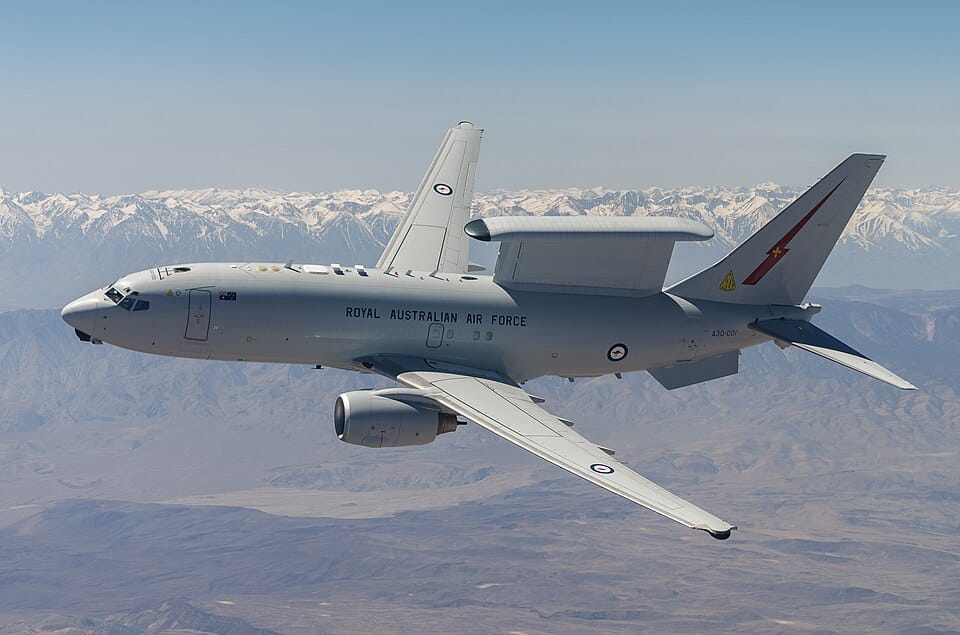
The Wedgetail is not just a newer AWACS — it is a fundamentally more capable platform. Its MESA (Multi-role Electronically Scanned Array) radar provides 360-degree coverage without the E-3’s iconic rotating dome, which creates mechanical reliability problems and blind spots during rotation. The E-7’s radar is electronically steered, meaning it can track multiple threat sectors simultaneously and switch modes in milliseconds.
Australia has operated six E-7s since 2012 and considers them a generation ahead of the E-3. Turkey, South Korea, and the United Kingdom have also ordered the type. The Royal Air Force took delivery of its first E-7 in 2025, debuting it at RIAT — an ironic footnote given today’s cancellation of that same airshow.
The Budget Reversal
Earlier this year, the Pentagon’s budget request had zeroed out E-7 funding, effectively cancelling the programme. The decision was widely criticised by Air Force leadership and members of Congress, who argued that the E-3’s declining readiness made delay unacceptable.
The Iran war changed the math. The budget amendment submitted by Hegseth does not detail the exact funding level, but it signals that E-7 procurement will be accelerated rather than stretched. The Air Force has previously estimated it needs at least 26 E-7As to replace its E-3 fleet.
For a programme that has spent years stuck in budget purgatory, losing an E-3 in combat was the grim catalyst that finally broke the logjam. The Wedgetail is coming — the only question now is how fast.
Sources: Air & Space Forces Magazine, Defense News, The Aviationist
From the fjords of northern Norway to the sun-baked runways of southern Spain, NATO is conducting the largest air exercise in Alliance history. Ramstein Flag 2026, which began on 8 June and runs through 19 June, has assembled more than 200 aircraft from 18 nations...
The numbers arrived in Brussels like a cold shower. US fighter jets allocated to NATO: cut from 150 to 100. KC-46 aerial refuelling tankers: all eight withdrawn. Maritime patrol aircraft: slashed from 26 to 15. One carrier strike group, one cruise-missile submarine,...
Forget everything you think you know about how military drones get made. Lockheed Martin's legendary Skunk Works division — the outfit that gave us the U-2, the SR-71 Blackbird, and the F-117 Nighthawk — just showed off an unmanned aircraft that was designed,...



 English
0 Comments