
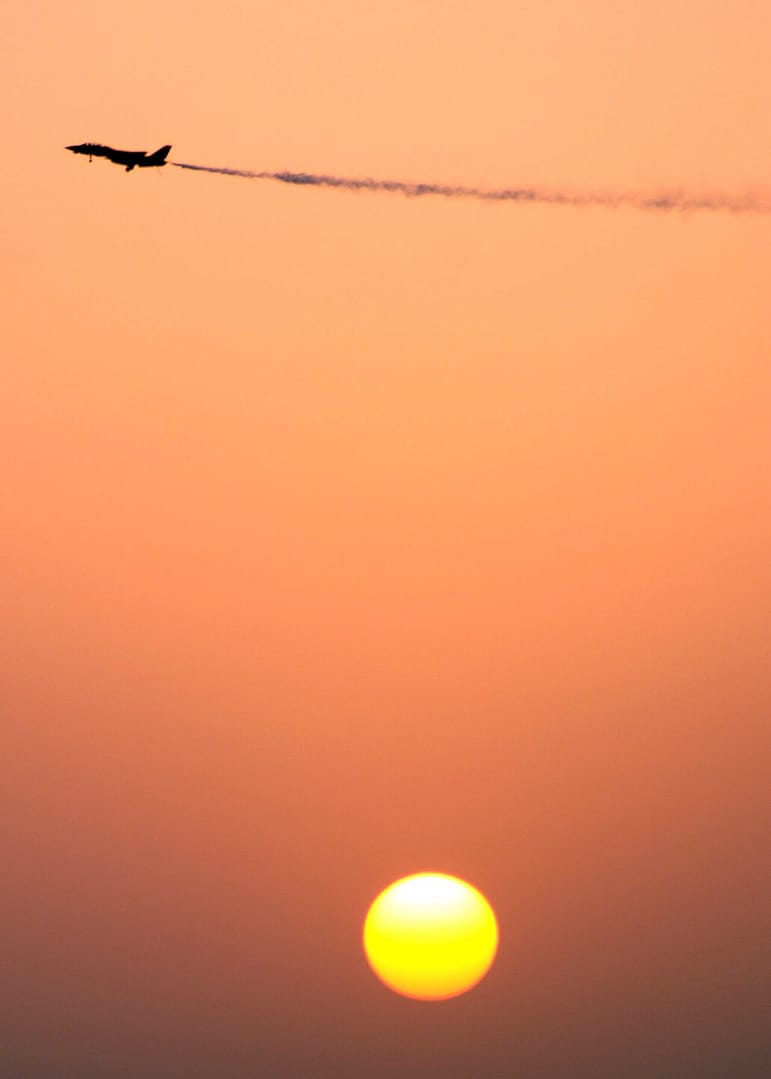
Why Maximum landing weight is lower than maximum takeoff weight — landing gear and airframe can't absorb the impact of a heavy touchdown
When Emergencies requiring an early return (engine failure, medical emergency, hydraulic problems) before fuel has burned off naturally
Minimum Altitude FAA recommends 5,000–6,000 feet AGL; minimum 2,000 feet AGL
Rate At least 1% of max takeoff weight per minute
Duration Typically 10–15 minutes from MTOW to MLW
Evaporation Kerosene disperses and evaporates rapidly at altitude — virtually none reaches the ground in liquid form
Aircraft with Dump Systems Boeing 747, 777, Airbus A380, A340; military: F-4 Phantom, F-111, F-14 Tomcat
Frequency Rare — only in genuine emergencies, never routine
The Weight Problem
Jet fuel weighs approximately 6 pounds per gallon (0.8 kg per litre). A fully fuelled Boeing 777 can carry over 170,000 litres. A fighter jet like the F-15E carries about 10,000 litres internally, plus whatever hangs on external tanks. That fuel represents a significant fraction of the aircraft's total weight — and it is weight that was supposed to be burned off gradually during a long flight. When an emergency forces an aircraft to return to the airport shortly after takeoff — an engine failure, a medical crisis in the cabin, a hydraulic leak — the aircraft may be thousands of kilograms over its maximum landing weight. The crew has two options: fly in circles for hours to burn fuel down to landing weight, or dump it. Fuel dumping systems route kerosene through valves and nozzles, typically located at the wingtips or trailing edges. Pilots activate the system from the cockpit. The fuel exits at a rate of at least 1 percent of maximum takeoff weight per minute, meaning a typical dump from MTOW to MLW takes 10–15 minutes. The FAA requires a minimum altitude of 2,000 feet AGL, though 5,000–6,000 feet is standard practice.Where Does the Fuel Go?
The environmental concern is obvious: dumping kerosene into the atmosphere sounds terrible. But the physics are more forgiving than they appear. At altitude, jet fuel — which is essentially highly refined kerosene — disperses into microscopic droplets that evaporate rapidly in the dry, cold air. At the recommended dump altitudes, virtually none of the fuel reaches the ground in liquid form. It atomises, mixes with the atmosphere, and dissipates. This is not an excuse for routine dumping, and airlines treat it as a genuine emergency procedure — not something done for convenience. FAA Order 7110.65 governs fuel dumping operations and requires separation of at least five miles from other air traffic. The decision to dump is documented and reported. It is rare, consequential, and never taken lightly.Fighters vs. Airliners
Not all aircraft have fuel dump systems. Smaller airliners — the Boeing 737, Airbus A320 — are designed with landing gear and structures strong enough to handle landings at or near maximum takeoff weight, though the aircraft must be inspected afterward. The largest wide-bodies — 747, 777, A380, A340 — have dedicated jettison systems because the gap between MTOW and MLW is too large to bridge with structural reinforcement alone. Military aircraft have their own relationship with fuel dumping. The F-111 Aardvark was famous for its "dump and burn" — igniting the fuel as it left the nozzles, creating a spectacular trail of fire behind the aircraft. It was a crowd favourite at air shows and remains one of the most visually dramatic manoeuvres in military aviation. The F-14 Tomcat, F-4 Phantom, and several other Cold War-era fighters also carried dump systems. Modern fighters like the F-16 and F-35 generally do not have dedicated fuel dump systems. They are designed to land heavy if needed, accepting the additional stress on the airframe and scheduling inspections afterward. The trade-off is simplicity: fewer valves, fewer potential leak points, less weight from plumbing that would rarely be used.What MiGFlug Customers Might See
If you fly with MiGFlug on a fighter jet experience, you might spot other military aircraft trailing fuel mist during operations at military airfields — it is a sight that catches the eye and makes you reach for your camera. The dramatic white trail against a blue sky is unmistakable. MiGFlug, however, never conducts fuel dumping during its flights. All MiGFlug operations are planned within safe weight parameters, with fuel loads calculated to ensure the aircraft lands well within its structural limits. The thrills come from the flying, not from emergency procedures.A Last Resort, Not a Routine
Fuel dumping exists because physics imposes a hard constraint: landing is harder on an aircraft than taking off. The touchdown loads, braking forces, and structural stresses of arrival demand a lighter aircraft than departure. When time does not allow fuel to burn naturally, dumping is the safest option — safer than an overweight landing that could blow tyres, collapse gear, or overshoot the runway. It looks wasteful. It looks dramatic. It looks like something that shouldn't happen. But when a pilot activates the dump system, they are making the mathematically correct decision to protect the aircraft, the passengers, and everyone on the ground. The fuel evaporates. The aircraft lands safely. And the numbers, as always, win. Sources: FAA Order 7110.65, Boeing Technical Publications, U.S. Navy, Flight Safety FoundationRelated Questions
Why do planes dump fuel before landing?
Aircraft dump fuel to get below their maximum landing weight, which is lower than their maximum takeoff weight. The landing gear and airframe are not built to absorb the impact of touching down while heavy with fuel, so when a jet must land soon after takeoff, dumping fuel brings it down to a safe landing weight.
When do pilots dump fuel?
Fuel dumping happens during emergencies that require returning to land soon after takeoff — such as an engine failure, a medical emergency, or hydraulic problems — before the fuel has burned off naturally in flight. It is a planned, controlled procedure, one of several steps crews run in the first moments of an emergency.
Is dumping jet fuel dangerous to people on the ground?
Generally no. Fuel is dumped at altitude — the FAA recommends 5,000–6,000 feet above ground level, with a minimum of 2,000 feet — where the kerosene disperses and evaporates rapidly before reaching the surface. Pilots also try to dump over unpopulated areas or water to minimise any impact.
How long does it take to dump fuel?
Reducing from maximum takeoff weight down to maximum landing weight typically takes 10–15 minutes. Aircraft jettison fuel at a rate of at least 1% of maximum takeoff weight per minute. The exact time depends on how much fuel must be shed, which is why a crew may hold for a while before returning to land.
Can all aircraft dump fuel?
No — many smaller jets and most narrow-body airliners cannot dump fuel at all. Instead, in an emergency they may land overweight or burn off fuel by circling. When such aircraft must return immediately, the crew prioritises a safe landing, much as in a total engine-failure glide to the runway.

0 Comments