India has chosen the Rafale. Again. But this time, the numbers are staggering: 114 aircraft, $39 billion, and a production line in Nagpur that will make India one of the largest Rafale operators on Earth. The Defence Acquisition Council approved the purchase in February, just ahead of President Macron’s visit to New Delhi — diplomatic choreography that Dassault’s sales team must have savoured.
For France, this is the deal of the decade. For India, it is a bet that proven fourth-generation performance matters more than fifth-generation stealth — and that a fighter already combat-tested in Libya, Mali, Iraq, Syria, and now the skies over Iran can fill the gap that has left the Indian Air Force dangerously understrength.
Quick Facts
• Aircraft: 114 Dassault Rafale (mix of single- and two-seat variants)
• Deal value: ~$39 billion (₹3.25 lakh crore) as part of a broader defence package
• Delivery: 18 flyaway from Dassault, 96 built in India (Nagpur)
• Existing fleet: 36 Rafales already operational with IAF + 26 Rafale-M for Navy
• Total Rafale fleet after delivery: 176
• IAF squadron gap: 29 active squadrons vs. 42 required
Why Rafale, Not Stealth
India evaluated alternatives. The F-35 was never formally offered — Washington has been reluctant to share its most advanced platform with a nation that also operates Russian S-400 air defence systems. The Su-57 was considered and rejected on performance and reliability grounds. The indigenous AMCA programme — India’s own fifth-generation fighter — remains years from first flight.
The Rafale won because it exists, it works, and Dassault was willing to transfer production to India. The 96 aircraft to be assembled at Nagpur represent a massive boost to Indian aerospace manufacturing — and a political win for the Make in India initiative that has defined New Delhi’s defence procurement strategy.
The combat record helps too. Rafales have flown strike missions in nearly every French military intervention of the past fifteen years. In Epic Fury, Armée de l’Air Rafales scrambled from Lithuania to intercept a Russian Il-20 over the Baltic just days after France took over the NATO Air Policing mission. The aircraft has proven it can do the job.
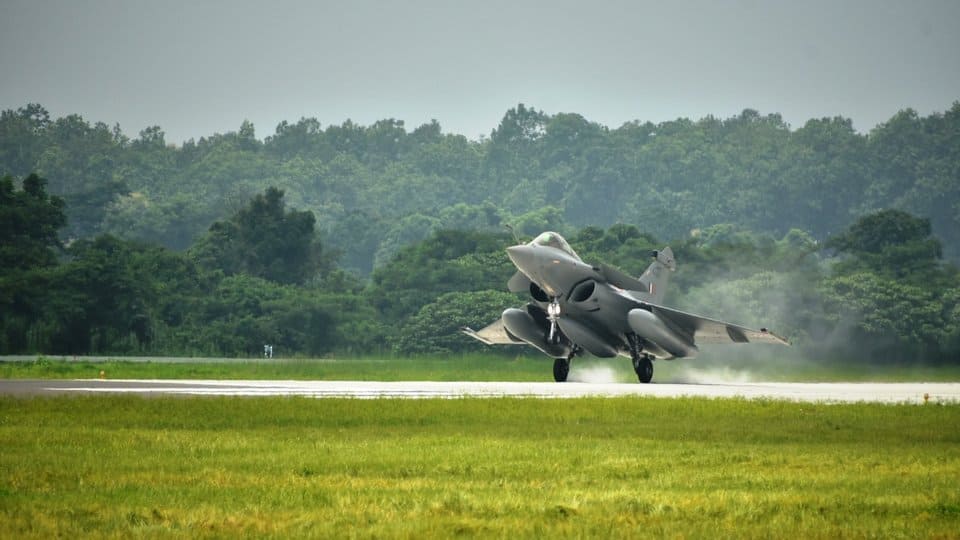
A Dassault Rafale displays at RIAT. The type has been combat-tested in Libya, Mali, Iraq, Syria, and the Baltic. Wikimedia Commons
The Source Code Question
Not everything about the deal is settled. Reports have surfaced that France is reluctant to share the Rafale’s full source code — the software that controls the jet’s mission computer, radar, and electronic warfare suite. Without source code access, India would struggle to integrate indigenous weapons like the Astra beyond-visual-range missile or the BrahMos cruise missile.
This is a familiar tension in major arms deals. The customer wants sovereignty over the weapon. The manufacturer wants to protect its intellectual property. Dassault has navigated this before — the original 36-Rafale deal involved similar negotiations — but the stakes are higher when 96 of the aircraft will be built on Indian soil by Indian workers.
Closing the Squadron Gap
India’s Air Force operates 29 fighter squadrons. A 2024 parliamentary report concluded that 42 are needed to credibly defend against a two-front threat from China and Pakistan simultaneously. That is a gap of 13 squadrons — roughly 250 aircraft.
The 114 Rafales will not close that gap alone, but they represent the single largest step toward closing it. Combined with the 36 already in service and the 26 Rafale-M variants ordered for the Navy, India’s total Rafale fleet will reach 176 — making it the second-largest operator after France itself.
For Dassault, this is vindication. For India, it is pragmatism. And for the balance of power in the Indo-Pacific, it is a shift that Beijing will be studying very carefully.
Sources: CNBC, Gulf News, Indian Defence News, Aerotime, IDRW
Every so often, a clip resurfaces online claiming that the Hollywood star Emma Stone made history as “the first civilian to fly in an F-22 Raptor.” It collects millions of views, a flurry of amazed comments, and the occasional breathless re-share. It is...
Ask almost anyone which aircraft won the Battle of Britain and you will get the same answer: the Spitfire. It is one of the most beautiful machines ever built, and it has earned its legend. But it is, at best, only half the story. The aircraft that actually shot down...
In a refrigerated room hidden beneath London’s Smithfield Meat Market in 1943, behind a screen of hanging animal carcasses, a future Nobel Prize winner was busy perfecting a recipe. Not for food — for a building material. His task: prove that you could...


 English
0 Comments