

Quick Facts
- Aircraft: Grumman F-14A Tomcat
- Operator: Islamic Republic of Iran Air Force (IRIAF)
- Original delivery: 79 aircraft, 1976–1979 (under Shah Mohammad Reza Pahlavi)
- Current status: Estimated 20–40 airframes remaining, fewer than 20 airworthy
- US retirement: September 2006 (all US Tomcats shredded to deny Iran spare parts)
- Key weapon: AIM-54 Phoenix long-range missile (Iranian-maintained stocks)
- Only other operator: None — Iran is the sole remaining F-14 operator worldwide
The Shah’s Cats
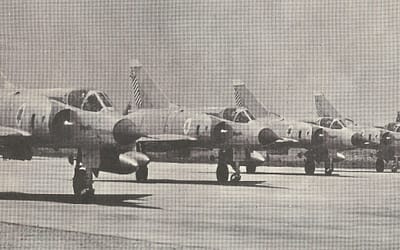
The story begins in the early 1970s, when Shah Mohammad Reza Pahlavi wanted the most advanced fighter in the world. The F-14A Tomcat, with its variable-sweep wings, AWG-9 radar, and AIM-54 Phoenix missile — capable of engaging six targets simultaneously at ranges beyond 100 miles — was exactly that. Iran ordered 80 aircraft (one was lost before delivery) at a total cost of roughly $2 billion, making it the largest single military aircraft export deal of the era. Iranian pilots trained at US Navy facilities. Grumman technicians lived at Iranian air bases. The Tomcat became the crown jewel of the Imperial Iranian Air Force, and the Shah’s pilots were widely regarded as among the best F-14 crews outside the US Navy. Then came 1979.
Revolution, War, and Survival
The Islamic Revolution ended the American relationship overnight. Grumman technicians were expelled. Spare parts deliveries stopped. Training programmes were cancelled. Overnight, the IRIAF was left with 79 of the most complex fighter aircraft ever built and no supply chain to maintain them. What happened next defied every reasonable prediction. When Iraq invaded Iran in 1980, the Tomcats went to war. Despite the parts embargo, Iranian crews kept the aircraft flying and fighting through eight years of brutal air combat. The F-14’s AWG-9 radar gave Iran an enormous advantage in beyond-visual-range engagements, and the Phoenix missile — which no other Iranian aircraft could carry — became a feared weapon in the hands of IRIAF pilots. Iranian F-14s are credited with the majority of the IRIAF’s air-to-air kills during the Iran-Iraq War. Exact figures remain classified or disputed, but Western intelligence estimates suggest between 50 and 160 aerial victories — an extraordinary record for an orphaned weapons system.The Parts Problem
Keeping the F-14 flying without American support required extraordinary measures. Iran reverse-engineered components, manufactured replacement parts domestically, and — according to numerous US federal indictments — operated extensive smuggling networks to acquire genuine Grumman parts through intermediaries. The problem was so severe that when the US Navy retired its last Tomcats in September 2006, the Pentagon ordered every single retired airframe destroyed — shredded into scrap rather than sent to the boneyard at Davis-Monthan, where they might eventually find their way to Iranian buyers through grey-market channels. It was an unprecedented step: the deliberate destruction of an entire fleet to deny parts to a single foreign operator.
Tomcats in the Current War
Whether Iran’s surviving F-14s have played any role in the current conflict remains unclear. Western intelligence estimates suggest fewer than 20 airframes are truly airworthy, and the IRIAF has largely kept its most valuable assets — including the Tomcats — sheltered in hardened bunkers rather than risk them against American air superiority. The irony is almost too perfect. The F-14 was designed to defend US carrier battle groups against Soviet anti-ship missile attacks. Now it sits in shelters while American carrier aircraft operate freely over the Persian Gulf — the very waters the Tomcat was built to dominate. If any Iranian F-14 is lost in this war, it will be the end of more than an aircraft. It will be the end of a lineage — the last of the Tomcats, built in Bethpage, Long Island, for a king who no longer reigns, maintained by a revolution that despises its maker, and outliving every American example by decades.Sources: The War Zone, National Interest, ACIG, Hush-Kit


 English
0 Comments