
Quick Facts
- Operation: Linebacker II — December 18–29, 1972 (11 days, Christmas Day pause)
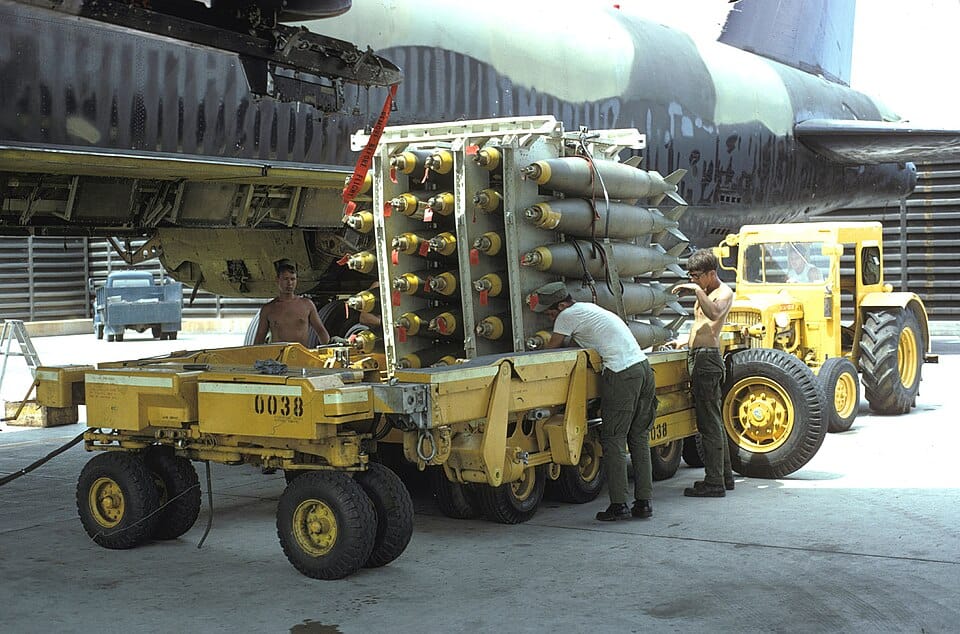
- Aircraft: 200+ B-52D/G Stratofortresses from U-Tapao (Thailand) and Andersen AFB (Guam)
- Sorties: 729 B-52 sorties + hundreds of tactical fighter and support sorties
- Ordnance: Over 20,000 tons of bombs dropped on Hanoi and Haiphong
- US losses: 15 B-52s shot down (North Vietnam claimed 34), 33 crew killed, 33 captured
- North Vietnamese defences: ~1,000 SA-2 Guideline missiles fired during the campaign
- Civilian casualties: At least 1,624 killed (Vietnamese sources)
- Outcome: Paris Peace Accords signed January 27, 1973
The Road to December
By late 1972, the Paris peace talks had collapsed. National Security Advisor Henry Kissinger’s “peace is at hand” declaration in October proved premature — North Vietnam returned to the negotiating table with new demands, and South Vietnamese President Nguyen Van Thieu was refusing to accept terms that left North Vietnamese troops on southern soil. Nixon, freshly re-elected in a landslide, faced a Congress that was about to legislate an end to the war whether he negotiated one or not. The bombing was Nixon’s last card. On December 14, he ordered Strategic Air Command to prepare for a maximum-effort campaign against military and industrial targets in the Hanoi-Haiphong corridor. The objective was not to destroy North Vietnam’s ability to wage war — seven years of bombing had failed at that — but to demonstrate that the United States could and would inflict devastating punishment at will. The message was aimed at Hanoi, at Saigon, and at Congress simultaneously.Into the SAM Belt
The crews who flew the first night missions on December 18 entered the most lethal air defence environment American pilots had ever faced. North Vietnam had rebuilt and expanded its SA-2 Guideline missile network after Linebacker I, the earlier bombing campaign that spring. Over 1,000 SA-2s would be fired during the eleven days — a density of surface-to-air missile fire without precedent in aerial warfare. The first three nights were devastating. B-52s flew predictable routes at predictable altitudes, turning on their bomb runs in ways that gave the North Vietnamese radar operators time to track, lock, and launch. The B-52’s electronic countermeasures — designed to jam older SA-2 guidance radars — were partially effective, but the sheer volume of missiles overwhelmed the jamming. Nine B-52s were shot down in the first three nights. On Night Three alone, six Stratofortresses went down. The losses were unsustainable. SAC commanders adjusted tactics dramatically. Routes were changed every night. Post-target turns — the predictable manoeuvres that had exposed the bombers to tracking — were eliminated. Altitude and timing were varied. F-111 strike aircraft were assigned to suppress SAM sites. And critically, B-52s began approaching from multiple directions simultaneously, overwhelming the defence network’s ability to concentrate fire. The tactical changes worked. On Night Four, no B-52s were lost. Over the final seven nights of the campaign, losses dropped to six aircraft — a rate the Air Force, grimly, considered acceptable.The Human Price
The numbers obscure the reality. Each B-52 carried six crew members. When a Stratofortress was hit by an SA-2 at 35,000 feet, the aircraft usually broke apart or exploded. Ejection from a disintegrating bomber at night, over enemy territory, was a terrifying lottery. Some crews ejected cleanly and were captured. Others never made it out. On the ground, the bombing killed at least 1,624 civilians, according to Vietnamese sources. Bach Mai Hospital, Hanoi’s largest, was hit on December 22, killing 28 staff members and patients. The North Vietnamese called the campaign “Điện Biên Phủ of the Sky” — framing their SA-2 defences as a repeat of the 1954 victory that ended French colonialism. The propaganda was effective internationally: condemnation was swift from European capitals, the United Nations, and the American press. But inside the negotiating room, the calculus shifted. On December 22, Nixon sent word to Hanoi: return to the October terms, or the bombing continues. On December 26, after the Christmas pause, North Vietnam signalled its willingness to resume talks. On December 29, Nixon ordered a halt. On January 8, Kissinger and Le Duc Tho sat down in Paris. On January 27, the Paris Peace Accords were signed.Legacy
Whether Linebacker II “worked” depends on what you believe it was supposed to achieve. The Peace Accords were signed — but on terms nearly identical to those available in October, before the bombing. North Vietnam agreed to release American prisoners of war — but retained its troops in South Vietnam, a concession that made the Accords’ promise of “peace with honour” a fiction. Saigon fell 27 months later. What is not disputed is the human experience. The B-52 crews who flew through the SAM belts over Hanoi during those eleven December nights carried out one of the most dangerous sustained bombing campaigns in aviation history. They lost friends, watched aircraft disintegrate beside them in formation, and continued flying the next night. The North Vietnamese missile crews, firing from positions they knew would be targeted by suppression aircraft, showed equal courage on the other side of the equation. Linebacker II was the last great strategic bombing campaign. Its lessons — about the limits of airpower, about the relationship between destruction and diplomacy, about what happens when courage meets technology — echo in every conflict since.Sources: HistoryNet, Smithsonian Air & Space, Military.com, CNN, Association for Diplomatic Studies & Training

 English
0 Comments