
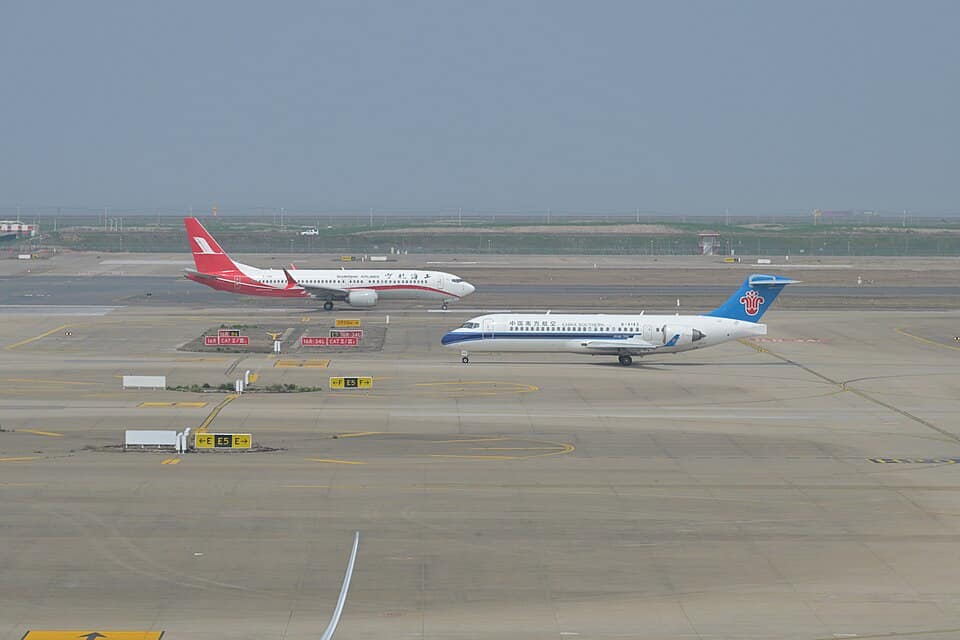
Quick Facts
- Airline: Vietjet — Vietnam’s largest low-cost carrier
- Aircraft: 10 COMAC C909 (formerly ARJ21) regional jets
- Lessor: SPDB Financial Leasing (Shanghai Pudong Development Bank subsidiary)
- Signed: April 16, 2026 — during Vietnamese state visit to Beijing
- Existing fleet: Vietjet already operates 2 C909s leased from Chengdu Airlines
- New routes: 5 new Vietnam-China routes announced alongside the deal
- C909 specs: 78–97 seats, range ~3,700 km, powered by GE CF34-10A engines
The C909 in Context
The C909 is not a new aircraft — it is a rebranded one. Originally designated the ARJ21 (Advanced Regional Jet for the 21st Century), the programme was launched in 2002 and first flew in 2008. Certification took until 2014. Commercial service began in 2016 with Chengdu Airlines. The development timeline — 14 years from programme launch to first passenger flight — reflects the enormous difficulty of building a modern airliner from scratch, even one based heavily on existing Western technology. The aircraft itself is a conventional twin-engine regional jet seating 78 to 97 passengers, powered by two General Electric CF34-10A turbofans — the same American-made engines that power the Embraer E-175. Its range of approximately 3,700 kilometres makes it suitable for domestic Chinese routes and short-haul international services. The fuselage cross-section is derived from the McDonnell Douglas DC-9/MD-80 family, a legacy of China’s 1980s partnership with McDonnell Douglas to co-produce the MD-82 in Shanghai. Over 100 C909s are now in service across Chinese airlines. Reliability has improved steadily, and the type has accumulated millions of flight hours. But the international market has remained stubbornly closed — until now.Why Vietjet, Why Now
The deal’s timing is not coincidental. Vietnam and China have been deepening economic ties, and aviation is a natural connective tissue between two countries separated by a short flight over the South China Sea. Vietjet announced five new Vietnam-China routes alongside the lease agreement — Hanoi-Enshi, Ho Chi Minh City-Guilin, Hanoi-Hangzhou, Hanoi-Huangshan, and Ho Chi Minh City-Huangshan — thin routes that a 90-seat regional jet serves more efficiently than a 180-seat A320. The finance lease structure, provided by SPDB Financial Leasing, likely includes favourable terms that make the C909 cost-competitive with used Embraer E-Jets or bombardier CRJs. For Vietjet, the calculus is pragmatic: cheap aircraft for thin routes on a network that directly connects to the Chinese market. For COMAC, the calculus is existential: every international operator validates the aircraft for the next potential customer.The Bigger Game
The C909 is not the aircraft that will challenge Boeing and Airbus. The C919 — COMAC’s narrowbody competitor to the A320neo and 737 MAX — is the one that matters industrially. But the C909 serves as a proving ground. If COMAC can demonstrate reliable international operations, responsive technical support, and competitive economics with the C909, the path to C919 exports becomes smoother. For now, ten C909s in Vietjet livery represent a crack in a door that Airbus and Boeing have kept shut for decades. Whether it opens further depends on how those aircraft perform — not in Chinese skies, where the political environment guarantees orders, but on Vietnamese routes, where Vietjet’s profit margins demand results.Sources: FlightGlobal, Bloomberg, Aerotime, Skift, South China Morning Post



 English
0 Comments