Korean Air just placed the largest widebody order any Asian carrier has ever given Boeing. One hundred and three aircraft. Thirty-six billion dollars at list prices. Deliveries stretching from 2026 to 2039. This is not a fleet refresh — it is a complete transformation of South Korea’s flagship airline, timed to absorb the full integration of Asiana Airlines and stake a claim as Asia’s dominant long-haul carrier.
The order covers four aircraft types: 20 Boeing 777-9s, 25 787-10 Dreamliners, 50 737 MAX 10s, and eight 777-8 freighters. Add spare engines from GE Aerospace and a long-term maintenance programme, and the total investment balloons to roughly $50 billion. For Boeing, still rebuilding its reputation after years of production problems and regulatory scrutiny, this is more than an order — it is a lifeline.
Total investment (incl. engines & MRO): ~$50 billion
Delivery window: 2026–2039
Context: Largest-ever Korean Air order; largest Asian widebody order for Boeing
What Korean Air Is Buying — and Why
Each aircraft type fills a specific gap. The 20 Boeing 777-9s replace the ageing 777-200ER and 747-8i fleet on Korean Air’s most demanding routes: Seoul to New York, London, Los Angeles, and São Paulo. The 777-9 carries over 400 passengers in a typical two-class layout with a range exceeding 7,200 nautical miles — enough to connect Incheon to virtually any city on earth nonstop.
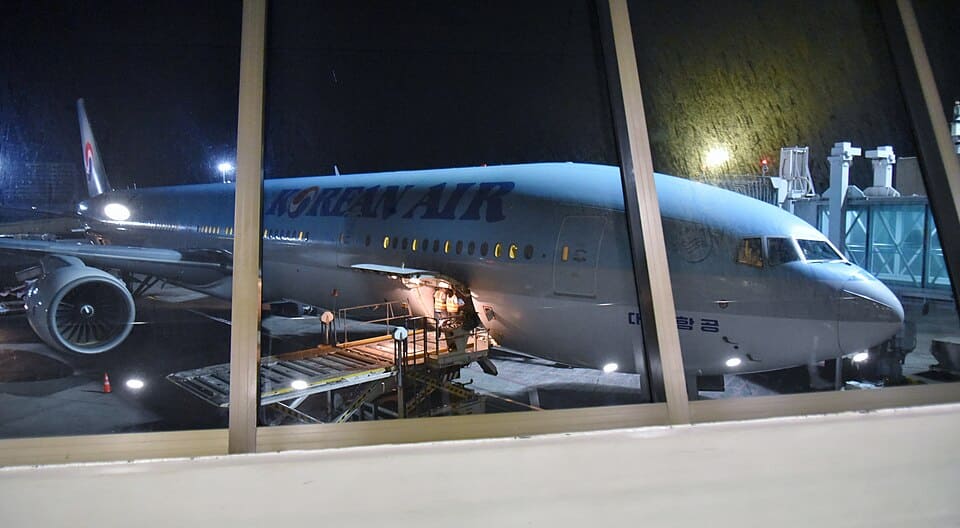
A Korean Air Boeing 777 — the airline has ordered 20 next-generation 777-9s as part of its record-breaking fleet renewal. Photo: Wikimedia Commons
The 25 Dreamliner 787-10s target the medium-haul premium market. Think Seoul to Southeast Asia, India, Australia, and the Middle East — routes where passenger volumes justify a widebody but not a 777. The 787-10 is the longest variant of the Dreamliner family, offering 15% more seats than the 787-9 while retaining the type’s excellent fuel economy.
The 50 737 MAX 10s will handle domestic Korean routes and short-haul international services to Japan, China, and the rest of Northeast Asia. This is where the Asiana integration becomes critical — combining two domestic networks onto a single narrowbody type simplifies everything from crew training to spare parts.
Finally, eight 777-8 freighters replace Korean Air’s legendary cargo fleet. Korean Air Cargo is one of the world’s largest freight operators, and the 777-8F offers 25% better fuel efficiency than the 747-400F it replaces.
The Asiana Factor
Korean Air’s current 777-200ER fleet will eventually give way to the 777-9, Boeing’s largest twin-engine jet. Photo: Wikimedia Commons
Korean Air’s acquisition of Asiana Airlines — finalised after years of regulatory battles — created Asia’s largest airline by international seat capacity. But merging two full-service carriers is brutally complex. Both airlines operated different fleet mixes, different cabin products, and different route strategies. This Boeing order is the industrial backbone of the merger: a single-manufacturer fleet strategy that simplifies operations while funding a premium cabin product capable of competing with Singapore Airlines, Cathay Pacific, and the Gulf carriers.
The timing was politically choreographed. The initial agreement was signed in Washington in August 2025 during a Korean-American business summit overseen by US Commerce Secretary Howard Lutnick. For Seoul, this is as much a diplomatic signal as a commercial transaction — deepening the US-Korean economic relationship at a time when both nations are navigating trade tensions with China.
What It Means for Boeing
Boeing needs this order badly. The manufacturer has spent the past several years managing production slowdowns, supplier issues, and the long shadow of the 737 MAX grounding. A 103-aircraft commitment from a major international carrier — with firm deliveries, not options or letters of intent — provides the kind of backlog certainty that stabilises production lines and reassures suppliers.
The 777-9 component is especially significant. Boeing’s newest widebody has faced repeated certification delays, and Korean Air’s commitment as a launch region customer for the type sends a strong market signal. If the 777-9 delivers on its performance promises, Korean Air’s endorsement could unlock further orders from airlines that have been waiting on the sidelines.
For passengers, the message is simple. Korean Air is spending $50 billion to become a different airline — newer aircraft, better cabins, more routes, and the scale to compete with anyone in the world. The first deliveries begin this year.
Sources: Boeing, ch-aviation, Korea Times, International Airport Review, One Mile at a Time
Every fighter pilot trains for it. Most pray they'll never experience it. The moment a jet engine — the machine that keeps you flying at 500 knots and 30,000 feet — stops working. Whether it's a compressor stall that sounds like a cannon going off behind your seat, a...
Luca Parmitano has lived two lives that most people only dream about. In the first, he was a fighter pilot — flying AMX Ghibli attack jets for the Italian Air Force, deployed to Afghanistan, trained to fly low and fast into hostile territory. In the second, he became...
Before the Rafale, before the Mirage 2000, before the Mirage F1 — there was the Mirage III. Dassault's first supersonic fighter was a revelation when it entered service in 1961: a sleek, tailless delta that could break Mach 2, carry a nuclear bomb, and outfight...



 English
0 Comments