China has built the largest airborne early warning aircraft in its inventory — and possibly the most capable radar plane on earth that is not American. The KJ-3000, based on the indigenous Y-20 strategic transport, represents a generational leap from the handful of ageing KJ-2000s that currently anchor the People’s Liberation Army Air Force’s surveillance fleet. Its conformal radar array, integrated directly into the airframe rather than bolted on top in a rotating disc, is designed to do something very specific: find stealth aircraft.
New ground imagery of the KJ-3000 prototype has revealed details that satellite photos and flight-test footage could not. The conformal antenna system wraps around the fuselage in a configuration that provides continuous 360-degree coverage without the mechanical rotation that limits traditional AWACS designs. For the Pentagon, which has built its Pacific strategy around stealth dominance, this is not a theoretical concern.
Quick Facts
Designation: KJ-3000 (AEW&C)
Base airframe: Xi’an Y-20B transport
Engines: 4 x Shenyang WS-20 high-bypass turbofans (indigenous)
Replaces: KJ-2000 (Il-76-based) and supplements KJ-500
Why Conformal Radar Matters
Traditional AWACS aircraft — the American E-3 Sentry, the KJ-2000, even the newer E-7 Wedgetail — carry their radar in a rotodome mounted above the fuselage. The disc spins mechanically, sweeping the sky with each revolution. It works, but it has fundamental limitations: mechanical rotation introduces scan gaps, moving parts fail under stress, and the rotodome itself creates drag and structural weight penalties.
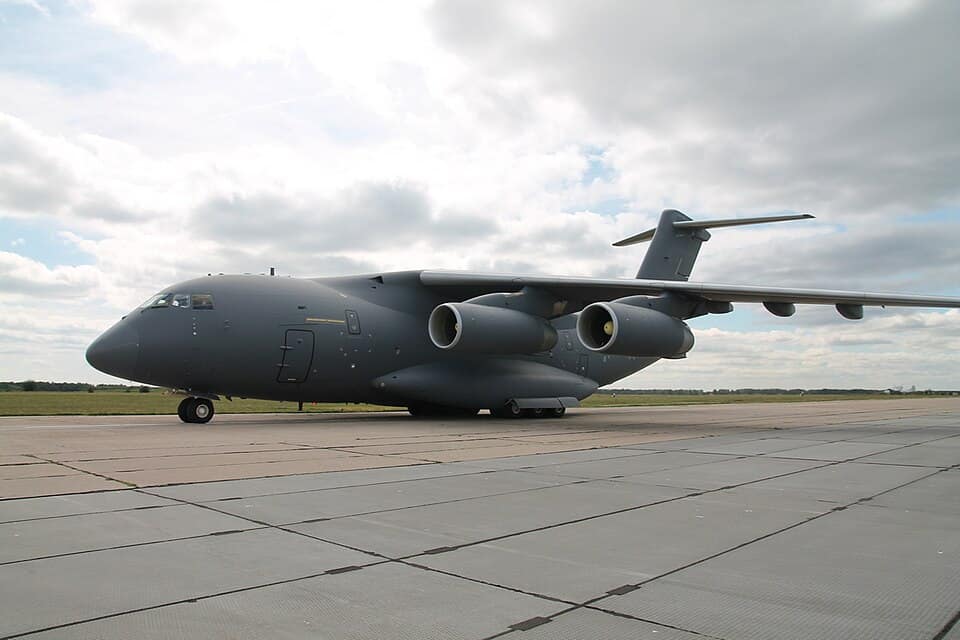
The Xi’an Y-20 heavy transport — the airframe on which China built its KJ-3000 early warning aircraft. The transport variant is already in PLAAF service. Photo: Wikimedia Commons
The KJ-3000 eliminates the rotodome entirely. Its conformal antenna arrays are flush-mounted into the aircraft’s skin, providing electronically scanned coverage in all directions simultaneously. There are no moving parts, no rotation gaps, no dead zones. The system can dwell on multiple targets at once, rapidly switching between search and track modes — a capability that is essential when the targets you are trying to find are designed to be nearly invisible to radar.
The Counter-Stealth Equation
The claimed detection range of 360 kilometres against stealth targets like the F-22 and F-35 deserves scrutiny. Low-observable aircraft achieve their stealth not by being invisible to radar, but by reflecting so little energy back to the transmitter that they blend into background noise. An airborne radar operating at high altitude with powerful transmitters and advanced signal processing can tilt the equation in the defender’s favour — not by defeating stealth physics, but by accumulating enough signal over time to extract a track from the noise.
If the KJ-3000’s conformal arrays operate across multiple frequency bands — particularly lower frequencies in the L-band or UHF spectrum — they could exploit resonance effects that make stealth shaping less effective. This is not speculation; it is established physics. The challenge has always been engineering a radar that is both powerful enough to exploit these effects and refined enough to generate a targeting-quality track. Whether China has achieved this remains classified, but the investment in the KJ-3000 suggests Beijing believes the answer is yes.
All-Indigenous Supply Chain
A PLAAF Y-20 in flight — the KJ-3000 variant replaces the cargo hold with mission systems and integrates conformal radar arrays into the fuselage. Photo: Wikimedia Commons
The KJ-3000 is notable for what it does not depend on: Russia. The original KJ-2000 was built on the Ilyushin Il-76 — a Soviet-designed transport that China had to import. The KJ-3000 sits on the Y-20, an entirely Chinese airframe powered by Shenyang WS-20 turbofans. Every critical component, from the engines to the radar, is domestically produced. This matters operationally because it means China can build as many KJ-3000s as its defence budget allows, without waiting for Moscow to deliver airframes or approve technology transfers.
The WS-20 engines are themselves a milestone. China’s struggle to produce reliable high-performance jet engines has been well documented, and the WS-20’s certification for the Y-20B marks a significant step in closing that gap. Four of these engines give the KJ-3000 the power and endurance to loiter at high altitude for extended missions — a critical requirement for maintaining an air surveillance picture over the Taiwan Strait or the South China Sea.
What It Means for the Pacific
A single KJ-3000 prototype does not change the balance of power. But the aircraft it replaces — the KJ-2000 — was also built in tiny numbers, and the KJ-500 fleet, while growing, lacks the range and radar power for deep surveillance over open ocean. If the KJ-3000 enters production and deploys in meaningful numbers, it gives the PLAAF something it currently lacks: persistent, wide-area early warning coverage extending hundreds of kilometres beyond the Chinese coastline.
For US and allied stealth aircraft operating in the Western Pacific, the implication is clear. The margin of invisibility that the F-22, F-35, and B-21 depend on may be narrowing. Not disappearing — stealth remains a decisive advantage — but narrowing enough that mission planners will need to account for a capable, airborne, all-aspect radar looking for them from 30,000 feet.
Sources: The War Zone, Janes, Military Watch Magazine, FlightGlobal, Army Recognition
Before AWACS, air warfare was a knife fight in a dark room. Pilots relied on their own radar, ground controllers with limited visibility, and radio calls that were often confused, late, or wrong. After AWACS, one side had the lights on and the other did not. The...
On May 1, 1960, CIA pilot Francis Gary Powers took off from Peshawar, Pakistan in a Lockheed U-2 spy plane. His mission: fly across the entire Soviet Union at 70,000 feet, photographing military installations, and land in Bodø, Norway. He never made it. A Soviet S-75...
When the Sukhoi Su-47 Berkut rolled out in 1997, it looked like nothing else in the sky. Its wings swept forward instead of back — an aerodynamic concept that promised extraordinary agility, superior low-speed handling, and enhanced controllability at high angles of...



 English
0 Comments