Somewhere over the Persian Gulf, a widebody airliner’s navigation system suddenly decided it was parked at a nuclear power plant. Not approaching one. Not near one. Parked on top of it. The crew, trained for exactly this kind of absurdity, ignored the display and flew on radar vectors from air traffic control. They landed safely. But the incident — one of hundreds since February 2026 — illustrates a form of electronic warfare that is no longer just a military problem. Iran is weaponising GPS on a scale that affects every civilian aircraft and ship transiting the Middle East.
The numbers are staggering. Within 24 hours of the first US-Israeli strikes on Iranian military targets in February, more than 1,100 commercial vessels in UAE, Qatari, Omani, and Iranian waters reported navigation failures. Onboard GPS systems placed ships at airports, landlocked cities, and facilities that no sane navigator would approach. This is not jamming — the blunt-force denial of GPS signals. This is spoofing: the deliberate broadcast of false GPS data that tricks receivers into calculating phantom positions.
Quick Facts
What: Massive GPS jamming and spoofing across Iranian airspace and the Persian Gulf
When: Intensified January 6, 2026; escalated dramatically after February strikes
Affected area: Iranian FIR (OIIX), Strait of Hormuz, UAE/Qatar/Oman waters
Ships affected: 1,100+ within first 24 hours of February escalation
Aviation impact: Complete GPS loss, position spoofing, integrity alerts for overflying aircraft
Countermeasures: Inertial navigation, ATC radar vectors, traditional backup navigation
Jamming vs Spoofing: A Critical Distinction
GPS jamming is brute force. A powerful transmitter broadcasts noise on the GPS frequency bands, drowning out the legitimate satellite signals. The receiver shows “no GPS” and the pilot or navigator knows immediately that something is wrong. It is disruptive, but it is honest in its disruption — the crew knows they have lost their primary navigation source and switches to backups.
Spoofing is deception. A sophisticated transmitter broadcasts fake GPS signals that mimic the structure of genuine satellite transmissions but encode false position data. The receiver locks onto the fake signals, calculates a convincing but entirely wrong position, and presents it to the crew as truth. If the spoofing is done well, there is no warning. The aircraft’s navigation display shows a smooth, coherent track — it just happens to be in the wrong place.
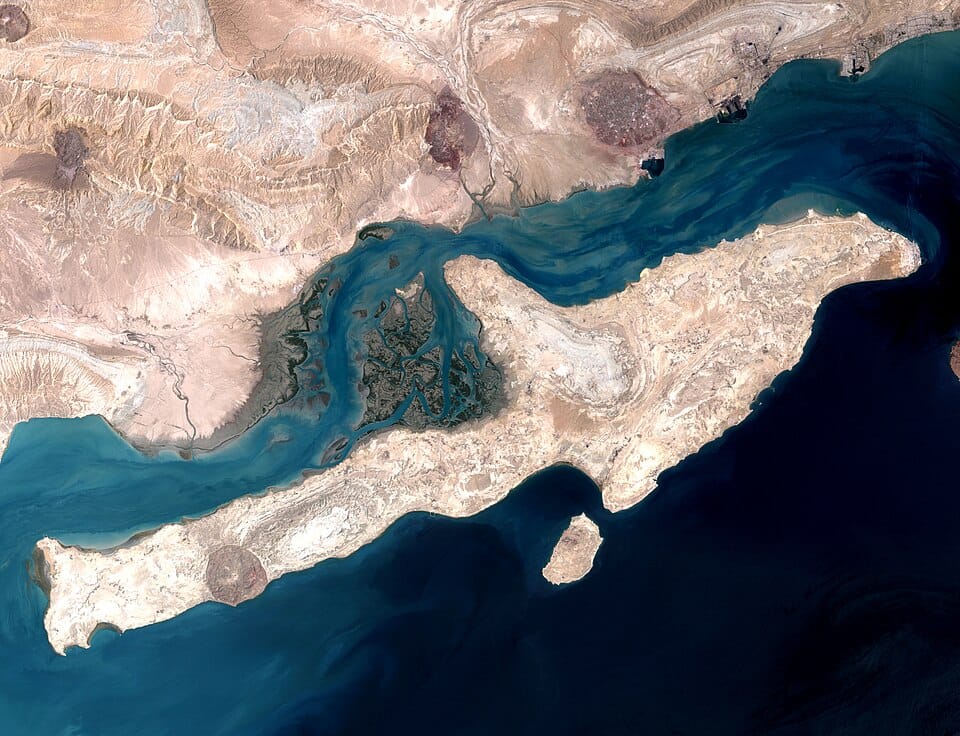
The Strait of Hormuz seen from space — the narrow waterway where Iranian GPS spoofing has placed 1,100 commercial ships at phantom locations including airports and nuclear plants. Photo: NASA / Wikimedia Commons
Iran has deployed both techniques simultaneously across its airspace and the surrounding maritime domain. The jamming creates a zone of GPS denial. The spoofing creates a zone of GPS deception. Together, they form a layered electronic warfare environment that degrades the navigation capability of every GPS-dependent platform in range — military or civilian.
What Pilots Are Experiencing
Airlines operating through or near Iranian airspace have issued detailed guidance to their crews. Pilots are told to expect complete loss of GPS signals, sudden position jumps of hundreds of kilometres, integrity alerts from the flight management system, and conflicting information between GPS-derived position and inertial navigation system position. The standard procedure is to prioritise inertial navigation and ATC radar vectors while treating all GPS data as unreliable.
The orbits of major satellite navigation systems — GPS, GLONASS, Galileo, and BeiDou. Iran’s jamming affects all GNSS signals, forcing pilots to rely on backup navigation methods. Image: Wikimedia Commons
For modern glass-cockpit airliners, this is manageable but not trivial. The flight management systems on Boeing 787s and Airbus A350s were designed to cross-check multiple navigation sources. When GPS disagrees with the inertial reference, the system flags the discrepancy. But older aircraft with less sophisticated avionics — and the thousands of general aviation, cargo, and regional aircraft that transit the Middle East — are more vulnerable to accepting spoofed data without question.
The Strategic Logic
Iran’s electronic warfare campaign serves multiple purposes simultaneously. For military defence, it degrades the precision of GPS-guided weapons — forcing attackers to use more expensive inertially guided munitions or accept reduced accuracy. For power projection, it demonstrates that Iran can disrupt the navigation infrastructure of the entire Persian Gulf region, including the Strait of Hormuz, through which 20 percent of the world’s oil transits daily.
But the civilian cost is real and growing. Airlines are rerouting around Iranian airspace, adding flight time and fuel costs. Shipping companies are reporting increased insurance premiums for Gulf transits. And every crew that flies through the affected zone operates with degraded situational awareness — the very condition that accident investigators cite in nearly every controlled-flight-into-terrain disaster.
No Easy Fix
The fundamental vulnerability is built into GPS itself. The satellite signals arrive at earth’s surface with vanishingly low power — roughly equivalent to a 25-watt light bulb viewed from 20,000 kilometres. Overpowering them with a ground-based transmitter requires minimal hardware. Spoofing requires more sophistication, but the technology is well understood and Iran has had decades to develop it.
The long-term answers — anti-jam GPS receivers, multi-constellation navigation, and ground-based backup systems — are all in development but years from widespread deployment. In the meantime, every pilot who flies within range of Iranian electronic warfare assets does so knowing that the little blue diamond on their navigation display might be lying.
Sources: CNN, Safe Airspace, Breaking Defense, ORF Online, New Space Economy, Army Recognition
From the fjords of northern Norway to the sun-baked runways of southern Spain, NATO is conducting the largest air exercise in Alliance history. Ramstein Flag 2026, which began on 8 June and runs through 19 June, has assembled more than 200 aircraft from 18 nations...
The numbers arrived in Brussels like a cold shower. US fighter jets allocated to NATO: cut from 150 to 100. KC-46 aerial refuelling tankers: all eight withdrawn. Maritime patrol aircraft: slashed from 26 to 15. One carrier strike group, one cruise-missile submarine,...
Forget everything you think you know about how military drones get made. Lockheed Martin's legendary Skunk Works division — the outfit that gave us the U-2, the SR-71 Blackbird, and the F-117 Nighthawk — just showed off an unmanned aircraft that was designed,...




 English
0 Comments