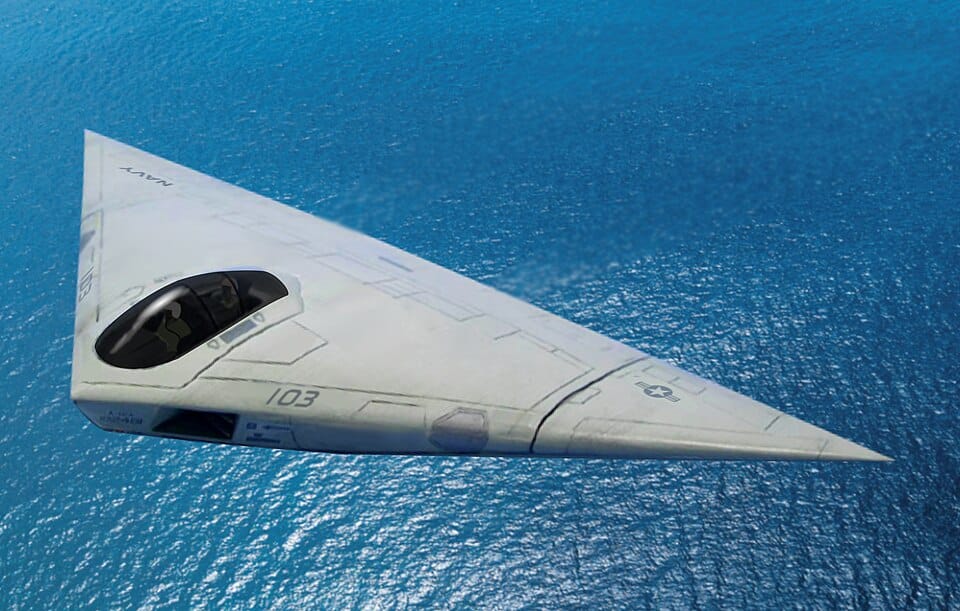
In January 1991, Secretary of Defense Dick Cheney walked into a press conference and killed the most expensive aircraft programme in US Navy history with a single sentence. The A-12 Avenger II — a carrier-based stealth bomber shaped like a tortilla chip, already $5 billion deep and not a single prototype built — was done.
No first flight. No test programme. No combat deployment. Just a full-scale wooden mockup, a mountain of legal filings, and the largest weapons contract termination in Pentagon history. The aerospace industry had a less charitable name for it: the Flying Dorito.
It remains one of the most spectacular failures in American defence procurement — a cautionary tale about what happens when ambition, secrecy, and physics collide on a carrier deck.
Quick Facts
Aircraft: McDonnell Douglas / General Dynamics A-12 Avenger II
Role: Carrier-based stealth attack aircraft (replacement for A-6 Intruder)
Configuration: Triangular flying wing — the “Flying Dorito”
Programme cost at cancellation: ~$5 billion
Weight overrun: 8,000 lbs above specification
Schedule delay: 18+ months behind original timeline
Planned procurement: 858 Navy/Marine + 400 Air Force = 1,258 aircraft
Aircraft delivered: Zero (only a full-scale mockup completed)
Cancelled: January 7, 1991 by SecDef Dick Cheney
Legal battle: 1991–2014 (23 years)
Why the Navy Wanted a Stealth Bomber
The idea made perfect sense on paper. By the mid-1980s, the Grumman A-6 Intruder — the Navy’s primary carrier-based attack aircraft since Vietnam — was aging fast. Its replacement needed to survive the increasingly lethal Soviet air defence network: modern SAMs, look-down shoot-down fighters, and integrated radar systems that could track low-flying aircraft over water.
The answer, the Navy believed, was stealth. If the Air Force could build the F-117 Nighthawk to penetrate Soviet airspace undetected, surely the Navy could do the same from a carrier deck. In 1983, the Advanced Tactical Aircraft (ATA) programme was born.
The A-12 Avenger II compared to other carrier aircraft. The triangular flying wing would have been one of the largest aircraft ever to operate from a carrier deck. US Navy / Wikimedia Commons
The competition came down to two teams: Northrop/Grumman with a more conventional design, and McDonnell Douglas/General Dynamics with something radical — a pure triangular flying wing with no tail surfaces, no vertical stabilisers, and an extremely low radar cross-section. The McDonnell Douglas team won in January 1988, promising to deliver a stealthy, all-weather attack aircraft that could carry 2,000 pounds of ordnance internally and strike targets deep behind enemy lines.
The Navy was thrilled. The Marines wanted it. The Air Force wanted a variant too. Total planned buy: 1,258 aircraft. It was going to be the backbone of carrier air power into the 21st century.
Where It All Went Wrong
Almost immediately, the programme ran into trouble. The A-12’s flying wing design created engineering challenges that the contractors had dramatically underestimated — and, as investigators later discovered, had actively concealed from the Navy.
The biggest problem was weight. Carrier aircraft live and die by weight. Every pound matters because the aircraft has to be catapulted off a ship and stopped by an arresting wire. The A-12’s composite structure, designed to absorb radar energy, proved far heavier than projected. The radar-absorbent materials that worked brilliantly in the dry hangars of Area 51 degraded in the salt spray and humidity of carrier operations. Structural compromises were needed, and each compromise added weight.
Three-view drawing of the A-12 Avenger II showing the distinctive triangular flying-wing planform that earned it the “Flying Dorito” nickname. Wikimedia Commons
By 1990, the A-12 was 8,000 pounds overweight — a catastrophic number for a carrier aircraft. That extra weight meant shorter range, reduced weapons load, and a real question about whether it could even operate safely from a carrier deck. The schedule had slipped 18 months. Costs were spiralling past every estimate.
Worse, McDonnell Douglas and General Dynamics had been hiding the problems. Internal documents later revealed that programme managers knew the weight and schedule issues were far more serious than they were reporting to the Navy. The contractors were burning through their budgets, hoping to solve the problems before anyone noticed.
Cheney Pulls the Plug
By late 1990, the Navy could no longer ignore the crisis. Secretary of the Navy H. Lawrence Garrett III recommended termination. On January 7, 1991, Dick Cheney — then Secretary of Defense, weeks away from launching Operation Desert Storm — cancelled the A-12 Avenger II.
His statement was characteristically blunt. He could not determine how much the programme would cost. He could not determine when it would be ready. The contractors could not tell him either. So he killed it.
An A-12 Avenger II display model — the closest the programme ever got to a real aircraft. Only a full-scale mockup was completed before cancellation. Wikimedia Commons
The cancellation was devastating for McDonnell Douglas, which was already in financial trouble. The company had invested billions of its own capital alongside government funds. The legal fallout — who owed what to whom — became one of the longest-running defence contract disputes in American history.
The 23-Year Lawsuit
What followed the cancellation was almost as remarkable as the programme itself. The US government demanded that McDonnell Douglas and General Dynamics repay $1.35 billion in progress payments for work that produced no usable aircraft. The contractors argued that the Navy had changed requirements, withheld critical stealth data, and shared blame for the failure.
The case bounced between the Armed Services Board of Contract Appeals, the Federal Circuit Court, and the Supreme Court — twice. It outlasted both contractors’ independence: McDonnell Douglas was absorbed by Boeing in 1997, and General Dynamics had long since moved on to other programmes. The legal fight became a case study in defence procurement law, taught at military academies and law schools.
It was not fully resolved until 2014 — twenty-three years after cancellation — when Boeing and General Dynamics agreed to pay back $400 million. The total programme had consumed roughly $5 billion and produced nothing that flew.
The Legacy of the Flying Dorito
The A-12’s failure had consequences far beyond the courtroom. The Navy went without a stealth attack aircraft for decades. The A-6 Intruder soldiered on until 1997, and its successor ended up being the F/A-18E/F Super Hornet — a superb aircraft, but not a stealth bomber.
It took until the 2010s for the Navy to seriously revisit carrier-based stealth with the MQ-25 Stingray tanker drone and, more recently, the F/A-XX programme. The ghost of the A-12 haunted every one of those discussions. Programme managers who remembered the Flying Dorito insisted on rigorous weight tracking, honest reporting, and realistic schedules.
The A-12 Avenger II is a reminder that stealth is not magic. Physics does not care about PowerPoint briefings. And when a programme goes 8,000 pounds overweight on a carrier aircraft, no amount of classification can hide the problem forever.
The only tangible remnant of the entire effort is a full-scale mockup that sits in storage — a wooden triangle that cost the American taxpayer $5 billion and never left the ground.
Sources: National Interest, Simple Flying, 19FortyFive, National Security Journal
Somewhere in the archives of the National Security Agency, there is a list of names. Airmen who took off from bases in Alaska, Japan, Turkey, and England, flew toward the edges of Soviet airspace in aircraft packed with electronic listening equipment, and never came...
On the morning of February 20, 1959, test pilot Jan "Spud" Potocki climbed out of CF-105 Arrow RL-201 at Avro Canada's Malton facility near Toronto. He had just pushed the delta-winged interceptor to Mach 1.75 — its final flight. He did not know that. Nobody at the...
Boeing's best-selling jet is finally accelerating. CEO Kelly Ortberg confirmed during the company's Q1 2026 earnings call that 737 MAX production will reach 47 aircraft per month this summer — up from 42 — with a target of 53 per month by year's end. After years of...



 English
0 Comments