On the morning of February 20, 1959, test pilot Jan “Spud” Potocki climbed out of CF-105 Arrow RL-201 at Avro Canada’s Malton facility near Toronto. He had just pushed the delta-winged interceptor to Mach 1.75 — its final flight. He did not know that. Nobody at the plant did.
At 11:15 the next morning, Prime Minister John Diefenbaker rose in the House of Commons and cancelled the entire programme. By lunchtime, 14,000 Avro employees had been told to go home. Two months later, the government ordered every airframe, every blueprint, every piece of tooling cut to pieces. Canada’s most advanced aircraft — faster and higher-flying than anything in NATO’s inventory — ceased to exist.
They call it Black Friday. More than six decades later, the wound has not fully healed.
Total programme cost: ~$470 million CAD (1959 dollars)
A Machine Built to Kill Soviet Bombers
In the early 1950s, NORAD’s nightmare was simple and terrifying: waves of Soviet Tu-95 Bear bombers crossing the Arctic to drop nuclear weapons on North American cities. Canada sat directly in the flight path. The Royal Canadian Air Force needed an interceptor that could scramble from bases in northern Ontario and Quebec, climb to 50,000 feet in minutes, and destroy bombers at long range in any weather.
No existing aircraft could do it. The CF-100 Canuck was subsonic and aging. American designs were too slow, too short-legged, or not available. So Avro Canada’s engineering team, led by chief designer Jim Chamberlin, started from a blank sheet.
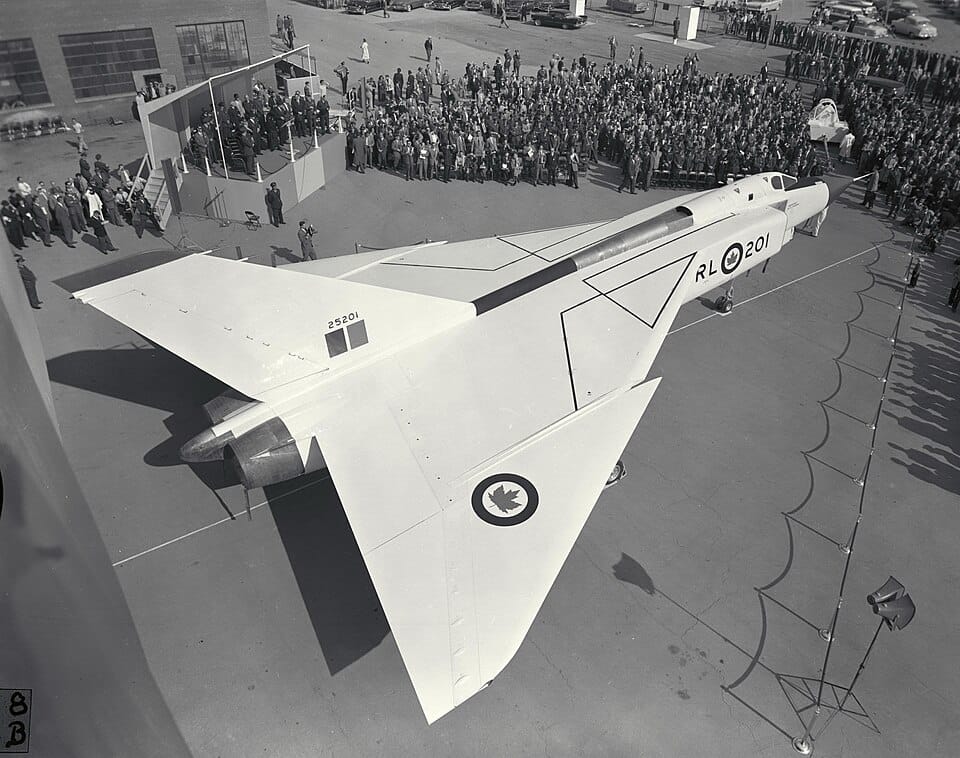
The first Arrow, RL-201, is unveiled at Avro Canada’s Malton plant on October 4, 1957 — the same day Sputnik launched. Wikimedia Commons
What they produced was astonishing. The CF-105 was a large, twin-engine delta with an internal weapons bay, fly-by-wire controls — revolutionary for the 1950s — and a sophisticated fire-control system that could track and engage targets autonomously. The airframe was designed around the Orenda Iroquois PS.13, a Canadian-built turbojet that promised 26,000 pounds of thrust in afterburner. No Western engine in that class existed.
The Arrow’s specifications read like science fiction for 1957: Mach 2+ cruise at 50,000 feet, a combat radius of over 300 nautical miles, and the ability to carry the Sparrow II missile or the nuclear-tipped AIR-2 Genie rocket in a retractable belly bay.
The Rollout That Competed With Sputnik
On October 4, 1957, Avro rolled out RL-201 to the public in a ceremony attended by 13,000 guests. The timing was spectacularly unlucky. That same evening, the Soviet Union launched Sputnik — and every headline in the Western world belonged to a metal sphere, not a white delta-winged interceptor in suburban Toronto.
The first flight came on March 25, 1958, with Potocki at the controls. The Arrow handled beautifully. Over the next eleven months, five Mk. 1 airframes accumulated 66 flights, reaching Mach 1.98 on interim Pratt & Whitney J75 engines that produced far less thrust than the Iroquois. Engineers were confident the Mk. 2, with the Canadian engine installed, would exceed Mach 2 comfortably.
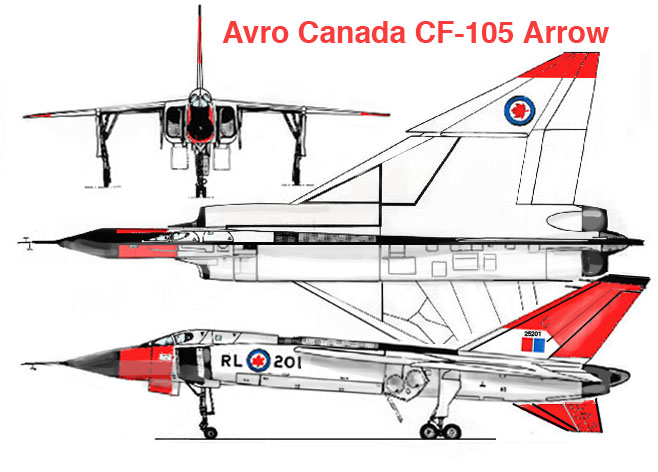
Three-view drawing of the CF-105 Arrow showing the large delta wing and twin-engine layout. Wikimedia Commons
The flight-test data was exceptional. The Arrow demonstrated precise handling at supersonic speeds, stable performance at high altitude, and acceleration that left chase planes behind. Potocki and fellow test pilot Peter Cope reported that the aircraft was a joy to fly — responsive, powerful, and predictable.
The Politics That Killed the Arrow
But the Arrow’s real enemy was never Soviet bombers. It was cost, politics, and a shifting strategic landscape.
By 1958, the programme had consumed roughly $470 million — a staggering sum for a country of 17 million people. The RCAF wanted 169 aircraft. Each Arrow would cost an estimated $7.8 million, roughly twice the original projection. And every month, American defence officials were arguing louder that the future belonged to intercontinental ballistic missiles, not manned bombers. If the Soviets switched to ICBMs, what use was an interceptor?
Prime Minister Diefenbaker’s cabinet was divided. The RCAF wanted the Arrow desperately. The Treasury wanted it gone. The Americans offered the cheaper, nuclear-armed Bomarc surface-to-air missile as an alternative — controversial, but a fraction of the Arrow’s cost.
On February 20, 1959, Diefenbaker announced the cancellation in the House of Commons. The language was blunt. The programme was terminated. Immediately.
The Destruction
What happened next is what transforms the Arrow story from a procurement cancellation into a national trauma.
The government did not mothball the aircraft. It did not donate them to museums. It did not sell the technology. Instead, it ordered everything destroyed. All five flying airframes were cut apart with acetylene torches. The nearly complete Mk. 2 was scrapped. Tooling — the jigs, dies, and fixtures needed to build more Arrows — was demolished. Technical drawings were shredded. The Iroquois engines, which were performing superbly on test stands, were dismantled.
A full-scale replica of the Avro Arrow on display in Toronto — the only way Canadians can see their lost interceptor today. Wikimedia Commons
The thoroughness of the destruction has fuelled conspiracy theories for decades. Why destroy everything? The official explanation was to prevent classified technology from leaking to the Soviets. Critics have always suspected the real motive was more prosaic: to make the decision irreversible, to prevent a future government from resurrecting the programme.
Only a nose section, a wingtip, and a few cockpit components survived — hidden by Avro employees who defied the destruction order. These fragments are now displayed at the Canada Aviation and Space Museum in Ottawa.
The Diaspora
The 14,000 layoffs at Avro were devastating enough. But the ripple effects destroyed Canada’s aerospace brain trust. Engineers who had built one of the most advanced aircraft in the world suddenly had nowhere to work. Canada had no other programme that could absorb them.
So they left. Jim Chamberlin went to NASA, where he became head of engineering for the Gemini programme — the stepping stone to Apollo. Owen Maynard joined NASA’s Manned Spacecraft Center and became chief of the Apollo Lunar Module engineering office. Bryan Frew and John Hodge joined Mission Control. At least 32 senior Avro engineers ended up at NASA during the space race.
Others went to Britain, where they contributed to the Concorde, the Hawker Siddeley Harrier, and the BAC TSR-2. Some went to Boeing, Lockheed, and Douglas. Canada’s loss became the world’s gain — but it was Canada’s loss all the same.
What Might Have Been
The Arrow’s cancellation left a hole in Canadian defence that was never properly filled. The RCAF received the Bomarc missile — which required American nuclear warheads that created their own political crisis — and eventually bought second-hand CF-101 Voodoos and later CF-104 Starfighters. None could do what the Arrow was designed to do.
The deeper legacy is industrial. Before 1959, Canada was building the world’s most advanced interceptor with a domestically designed engine. After 1959, Canada never again attempted to design and build a front-line combat aircraft. The country’s aerospace industry survived — Bombardier, de Havilland Canada, CAE — but it pivoted to civil aviation and components. The era of sovereign Canadian fighter design ended on Black Friday, and it never returned.
Whether the Arrow would have been worth its enormous cost is a legitimate question. Whether destroying it so completely was necessary is another. But there is no question about what was lost: a generation of engineering talent, a world-class aircraft, and a country’s confidence that it could build anything it imagined.
Sources: Canada Aviation and Space Museum (Ingenium), Valour Canada, Heritage Mississauga archives
At 9:04 in the morning Eastern time, mission control in Houston sent four people in orbit an instruction no astronaut wants to hear: get into your spacecraft, put on your suits, and be ready to leave. Not for a drill. Because the International Space Station is losing...
Update, June 5, 2026: Project Fear has released the full video — now embedded below. On the evening of June 2, a YouTube channel best known for sleeping in haunted asylums posted a single thermal-camera frame and lit the aviation internet on fire. The image, captured...
The morning of 1 March 1945 broke cold and foggy over the Heuberg training ground in Baden-Württemberg. While the men waited for the cloud to lift, a 22-year-old pilot named Lothar Sieber stood in a clearing getting last-minute advice from two engineers, the...




 English
0 Comments