
Quick Facts
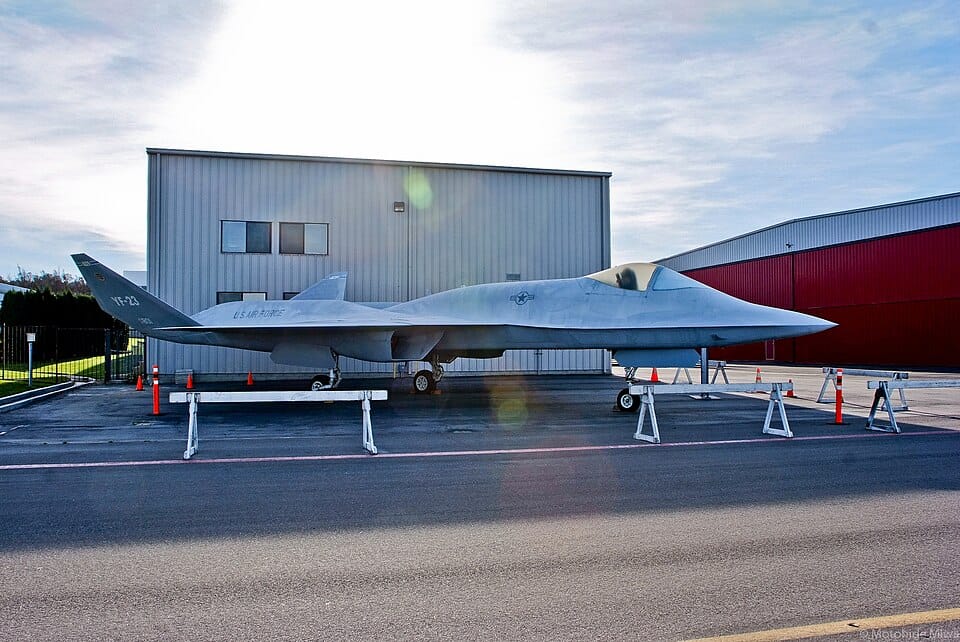
Aircraft: Northrop/McDonnell Douglas YF-23 Black Widow II
Programme: Advanced Tactical Fighter (ATF) competition
Competitor: Lockheed/Boeing/General Dynamics YF-22
Decision Date: April 23, 1991
Supercruise Speed: Mach 1.6+ (YF-23) vs. Mach 1.58 (YF-22)
Top Speed: Classified (Mach 2+ with afterburner)
Stealth: Lower radar cross-section than YF-22 (by multiple accounts)
Prototypes Built: 2 (PAV-1 “Spider” and PAV-2 “Gray Ghost”)
Current Location: Western Museum of Flight (PAV-1), National Museum of the USAF (PAV-2)
The Fighter That Was Too Good
The ATF programme was born in 1981 from a Cold War requirement: the Air Force needed a fighter that could own the skies against the next generation of Soviet aircraft — the MiG-29, Su-27, and whatever came after them. The requirement demanded supercruise (sustained supersonic flight without afterburner), stealth, and superior agility. Seven companies submitted proposals. By 1986, the field had been narrowed to two teams: Lockheed partnered with Boeing and General Dynamics, and Northrop partnered with McDonnell Douglas. Both teams were given $691 million each to build two prototype aircraft and demonstrate their designs in a competitive fly-off. What Northrop produced was unlike anything the world had seen. The YF-23 was a diamond-planform aircraft with no vertical tail surfaces. Where the YF-22 used conventional twin vertical stabilisers — angled outward at 28 degrees — the YF-23 replaced them with a distinctive V-tail arrangement and ruddervators. The engine exhaust was channelled through a trapezoidal trough lined with heat-absorbing tiles, designed to disperse the infrared signature across a wide area rather than focusing it in a hot, detectable plume. The entire airframe was shaped to minimise radar returns from every angle.Speed and Stealth
Two prototypes were built, each with a different engine. PAV-1 — nicknamed Spider — flew with Pratt & Whitney YF119 engines. PAV-2 — the Gray Ghost — used General Electric YF120 engines. It was PAV-2, the Gray Ghost, that achieved the programme’s most impressive supercruise result: Mach 1.6 sustained supersonic flight without afterburner, on November 29, 1990. The YF-22 supercruised at Mach 1.58 — fast, but the YF-23 was faster. In full afterburner, the YF-23 reached at least Mach 1.8 during testing, with its maximum speed classified but widely believed to exceed Mach 2. The aircraft also demonstrated a maximum angle of attack of 25 degrees, though it did not attempt the extreme high-alpha manoeuvres that the YF-22 showcased during the competition. On stealth, the evidence is less precise — radar cross-section data remains classified for both aircraft. But multiple accounts, including statements from engineers who worked on both programmes, indicate that the YF-23 had a lower radar cross-section than the YF-22. The diamond planform, V-tail, and exhaust trough all contributed to a shape that was inherently harder to detect across a wider range of radar frequencies.Why It Lost
If the YF-23 was faster and stealthier, why did the Air Force pick the YF-22? Three factors decided the competition. First, the Lockheed team was rated higher on technical risk. The YF-22 flew considerably more hours and sorties during the demonstration phase. Its thrust-vectoring nozzles — absent from the YF-23 — gave it dramatically better manoeuvrability at high angles of attack, which the Air Force valued for close-in combat. Northrop’s decision not to demonstrate extreme agility was a calculated gamble that did not pay off. Second, the Lockheed team was considered to have more effective programme management. The ATF was not just an aircraft purchase — it was a multi-decade industrial programme. The Air Force needed to believe that the winning contractor could manage production, sustainment, and upgrades over 30 years. Lockheed’s track record, combined with Boeing and General Dynamics as partners, was seen as lower risk. Third, there was a political dimension. Northrop was already building the B-2 Spirit stealth bomber. Awarding ATF to Northrop would have concentrated too much of America’s stealth aircraft production in a single company. The Air Force wanted to preserve competition in the fighter sector, and selecting Lockheed accomplished that. None of these reasons meant the YF-23 was a worse aircraft. They meant the YF-22 was a safer bet for a programme that would define American air power for half a century.The Legacy
The two YF-23 prototypes never flew again after the competition. PAV-1 sits at the Western Museum of Flight in Torrance, California. PAV-2 is at the National Museum of the United States Air Force at Wright-Patterson Air Force Base in Ohio. They are among the most visited exhibits at both museums — more popular, by some accounts, than the F-22 Raptor that beat them. The design philosophy of the YF-23 — stealth above agility, speed above manoeuvrability, a clean airframe with no compromises to conventional layout — has proven remarkably prescient. As air combat has moved increasingly toward beyond-visual-range engagements, where being invisible matters more than being nimble, the YF-23’s priorities look better with every passing year. And now Northrop is back. Its F/A-XX concept, released this week, shows a tailless, dorsally-intaked fighter that echoes the YF-23 in its design DNA. The internet noticed immediately. Whether the F/A-XX wins the Navy contract or not, the influence of the Black Widow II — the fighter that was ahead of its time — is visible in every line. The YF-23 lost the competition. It may yet win the argument.Sources: Wikipedia, The Aviation Geek Club, 19FortyFive, National Security Journal, Defense Feeds

 English
0 Comments